
Polysyndeton is not a weird foreign toothpaste brand, nor the name of your roommate’s favorite metal band, nor something Bill Nye experiments with. It’s actually the sentence you just read.
It’s a literary device that has been around since Homer and Plato, and chances are you’ve heard it countless times without realizing it.
Think about the last time someone listed things with “or” between every single item, or when your niece tried telling you a story and used “and” over and over in the same sentence. That’s polysyndeton.
It sounds like something only a grade-schooler would use, right? But that’s somewhat the point.
Writers use this technique to slow readers down, add weight to their words, or try to create a specific rhythm that will stick in your brain.
Key Takeaways
- Polysyndeton uses repeated conjunctions (usually “and” or “or”) to connect words, phrases, or clauses.
- It creates emphasis, slows pacing, and builds emotional intensity in writing.
- The technique appears across all genres, from biblical prose to modern novels.
- Overusing polysyndeton can make your writing feel repetitive or exhausting.
- Strategic placement matters more than frequency.
What Is Polysyndeton?
Most of us learned to avoid excessive conjunctions in school. We were instructed to use commas in lists to keep things clean and efficient. But polysyndeton throws that rule out the window on purpose.
The word comes from the Greek “poly” meaning many, and “syndeton” meaning bound together. So literally, it means “many bindings.”
You’re binding your words together with conjunctions instead of separating them with commas.


Never Worry About AI Detecting Your Texts Again. Undetectable AI Can Help You:
- Make your AI assisted writing appear human-like.
- Bypass all major AI detection tools with just one click.
- Use AI safely and confidently in school and work.
Polysyndeton isn’t just about being grammatically rebellious or making your essays longer.
It fundamentally changes how your reader experiences your sentences. The repeated conjunctions force them to slow down, give equal weight to each item, and allow them to feel the accumulation of details.
Polysyndeton Definition
Polysyndeton is a rhetorical device where conjunctions are deliberately repeated in close succession between words, phrases, or clauses, contrary to standard punctuation conventions.
In normal writing, you’d write: “She was tired, hungry, frustrated.”
With polysyndeton: “She was tired and hungry and frustrated.”
The second version places extra emphasis on each feeling.
Each adjective carries its own weight. The “ands” pile up the emotions, making them feel heavier, more overwhelming.
Fun fact: Polysyndeton is the opposite of asyndeton. Asyndeton removes conjunctions entirely.
Common Examples of Polysyndeton
You’ve likely heard polysyndeton everywhere. The Bible is full of it. “In the beginning God created the heaven and the earth. And the earth was without form, and void; and darkness was upon the face of the deep.”
Or think about how kids tell stories. “And then we went to the park and we played on the swings and we saw a dog and it was so cute and we pet it and then we got ice cream.” It has a natural, breathless quality to it.
Even in casual conversation, we use it for emphasis. “I told him to stop and to think and to consider what he was doing.” Each “and” adds urgency.
The beauty of polysyndeton is how it affects pacing. When you want readers to slow down and really absorb each element, you add those conjunctions.
When you want speed and efficiency, you strip them away.
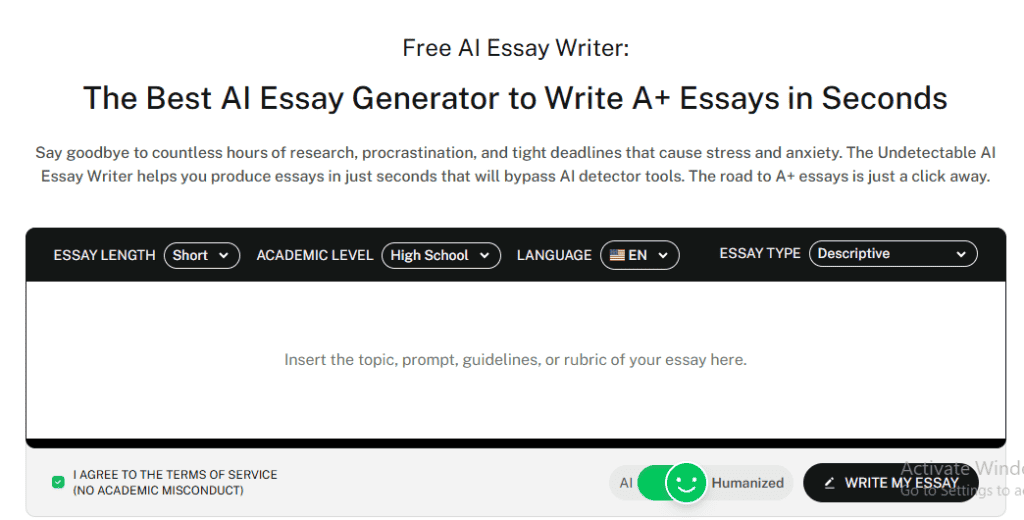
Tools like Undetectable AI’s AI Essay Writer can help you experiment with how polysyndeton affects the rhythm and emphasis in your writing, letting you see the difference right away.
Why Writers Use Polysyndeton
Writers reach for polysyndeton when they want to create specific effects. It’s not random, but calculated.
First, there’s the emphasis factor. When you separate items with “and,” each one demands attention. Compare “I’m hungry, tired, angry” with “I’m hungry and tired and angry.”
The second version makes you feel the weight of all three states simultaneously.
Second, polysyndeton slows readers down. Sometimes you want that. Maybe you’re describing a moment of realization, a traumatic event, or a scene where time seems to stretch.
The repeated conjunctions mirror that stretched feeling.
Third, it creates rhythm. Good writing has musicality, and polysyndeton gives you a distinctive beat. It’s almost hypnotic when done right.
Fourth, it can convey childlike innocence or overwhelming emotion. Think about how people speak when they’re excited, scared, or trying to remember everything at once. The conjunctions tumble out naturally.
Finally, polysyndeton builds intensity. Each “and” or “or” adds another layer, another detail, another reason to care.
By the end of a polysyndetic list, your reader feels buried under the weight of accumulated meaning.
How Polysyndeton Works in Communication

Polysyndeton isn’t just for fancy literature. It shows up in everyday speech, advertising, politics, and social media.
Politicians love it for speeches. It makes their points sound more substantial, more complete. “We will fight and we will win and we will rebuild and we will thrive.” Each promise gets its own moment.
Advertisers use it to pile on benefits. “Our product is affordable and effective and easy to use and environmentally friendly.” The conjunctions make the list feel longer, more impressive.
In personal communication, polysyndeton often emerges naturally when we’re emotional. “I can’t believe you did that and you didn’t tell me and you knew how I’d feel and you went ahead anyway.”
The speaker is processing multiple grievances, and the conjunctions let each one land.
Social media captions sometimes employ polysyndeton for effect. “Grateful for my friends and my family and my health and this beautiful day and coffee and everything.”
It creates a sense of overflowing abundance.
The psychological effect is real. Our brains process the repeated conjunctions as markers of importance. We can’t skim past them as easily as we skim commas. We’re forced to engage with each element.
Classic Examples of Polysyndeton
Let’s look at some famous instances where writers nailed polysyndeton.
Ernest Hemingway used it in “The Sun Also Rises”: “He was a good man and a great bullfighter and I liked him.”
Simple. Direct. Each quality gets its own space.
The Book of Genesis opens with polysyndeton: “And God said, Let there be light: and there was light. And God saw the light, that it was good: and God divided the light from the darkness.”
This biblical style influenced countless writers. The repeated “ands” create a sense of ritual, of formal pronouncement.
Shakespeare employed it in “Othello”: “It is the cause, it is the cause, my soul. Let me not name it to you, you chaste stars. It is the cause.”
That repetition builds dread. Othello is working himself up to murder, and the polysyndeton mirrors his circular, obsessive thinking.
Cormac McCarthy in “The Road” writes: “He walked out in the gray light and stood and he saw for a brief moment the absolute truth of the world.”
The conjunctions slow us down, make us experience the moment’s gravity alongside the character.

Want to see how different versions of polysyndeton land with readers?
The Paragraph Rewriter tool from Undetectable AI can help you create multiple variations of the same passage, testing out different conjunction patterns while maintaining clarity and impact.
Sometimes seeing options side by side reveals which version is most impactful.
Common Mistakes When Using Polysyndeton
Like any rhetorical device, polysyndeton can go wrong. Here’s how writers often misuse it.
- Overuse is the biggest problem. If every sentence employs polysyndeton, the effect dilutes completely. It becomes white noise, and your reader tunes out instead of leaning in.
- Using it without purpose is another issue. Don’t throw in repeated conjunctions just because you can. Ask yourself what effect you’re creating. If the answer is “none,” cut it.
- Ignoring your genre’s conventions can backfire. Academic writing rarely benefits from polysyndeton. Business emails definitely don’t. Know your audience and context.
- Mixing it with already complex sentences creates confusion. Polysyndeton works best with a relatively simple structure. If your sentence has multiple clauses, subclauses, and parenthetical phrases, adding polysyndeton on top makes it unreadable.
- Forgetting about pacing across paragraphs is common. You might nail polysyndeton in one sentence, but if the surrounding text doesn’t support that rhythm, it feels jarring.
- Using the wrong conjunction weakens the effect. “And” and “or” work best. “But” repeated multiple times usually sounds awkward. “Nor” can work in certain contexts but requires careful handling.
How to Use Polysyndeton Effectively
Want to make polysyndeton work in your writing? Here’s how to do it.
- Start by identifying moments that need emphasis. Where in your piece do you want readers to slow down? Where do multiple elements need equal weight? Those are your polysyndeton opportunities.
- Keep the items in your list parallel. If you’re connecting adjectives, stick with adjectives. If you’re connecting clauses, keep them structurally similar. It’ll help you maintain clarity even as you break punctuation conventions.
- Limit yourself to 3-5 repeated conjunctions. After that, the effect becomes exhausting rather than emphatic.
- Read it aloud. Your ear catches rhythm problems your eye misses. If the polysyndeton sounds forced or awkward when spoken, it’ll read that way too.
- Consider the emotional tone you’re creating. Polysyndeton can feel breathless, overwhelming, childlike, or solemn depending on context. Make sure that it matches your intention.
- Place it strategically within your larger piece. One or two well-placed instances have more impact than five mediocre ones scattered throughout.
- Pair it with simpler surrounding sentences. Let the polysyndeton stand out by keeping adjacent prose more straightforward.
- Trust your instincts about when enough is enough. If you’re questioning whether to add another “and,” you’ve probably already hit the sweet spot.
Polysyndeton in Different Genres
Different types of writing call for different approaches to polysyndeton.
- In literary fiction, polysyndeton often appears in stream-of-consciousness passages or moments of heightened emotion. It mirrors how people actually think under stress or excitement. Literary writers also use it to create distinctive narrative voices.
- Poetry embraces polysyndeton freely. The device’s rhythmic qualities align perfectly with poetic goals. Whitman’s poetry overflows with polysyndetic lists that create a sense of abundance and democracy.
- Creative nonfiction and memoir use it to recreate authentic speech patterns and thought processes. When you’re capturing how someone actually told you their story, polysyndeton often emerges naturally.
- In genre fiction, polysyndeton appears most often in action sequences or emotional climaxes. Thriller writers might use it to pile on dangers. Romance writers employ it during declarations of love or moments of realization.
- Speechwriting depends heavily on polysyndeton for building rhetorical power. Think of Martin Luther King Jr.’s speeches, or any political address that aims to move people.
- Business writing generally avoids it. The exception might be marketing copy that wants to convey abundance or emphasize multiple benefits.
- Academic writing rarely uses polysyndeton intentionally. The style prioritizes clarity and efficiency over rhetorical flourish. If it appears, it’s usually by accident.
The key is matching the technique to your genre’s expectations.
Literary readers expect and appreciate rhetorical devices. Business report readers just want the information.

When you’re working across genres or trying to make your writing sound more natural, tools like Undetectable AI’s AI Humanizer can help ensure your polysyndeton examples feel authentic rather than forced, maintaining reader engagement without drawing attention to the technique itself.
Try out our AI Detector and Humanizer right below!
And Words And Rhythm And Mild Chaos
Polysyndeton is one of those tools you didn’t know you needed until you learned its name. Now you’ll notice it everywhere.
The thing about rhetorical devices is that they work best when readers don’t consciously notice them.
Polysyndeton should enhance your meaning, not distract from it. When used well, it disappears into the emotional impact you’re creating.
Remember that all the rules about writing are really guidelines. Shakespeare broke every rule that existed in his time, and we still read him four centuries later. If polysyndeton enhances your sentence, use it. If it doesn’t, don’t.
The goal isn’t to show off your knowledge of rhetorical devices. The goal is to move your reader, to make them feel something, to keep them reading.
Polysyndeton is just one way to do that.
Ensure your writing flows naturally and passes AI detection with Undetectable AI.