
If we were doing addition in Math, it would look like this: 1 + 1 = 2.
But what happens if we try addition in English? Spoon + Fork = Spork. Breakfast + Lunch = Brunch.
These are real words that you and I use all the time. In fact, they are even more common in Gen Z vocabulary. But do you know what they are technically called?
They are called a Portmanteau.
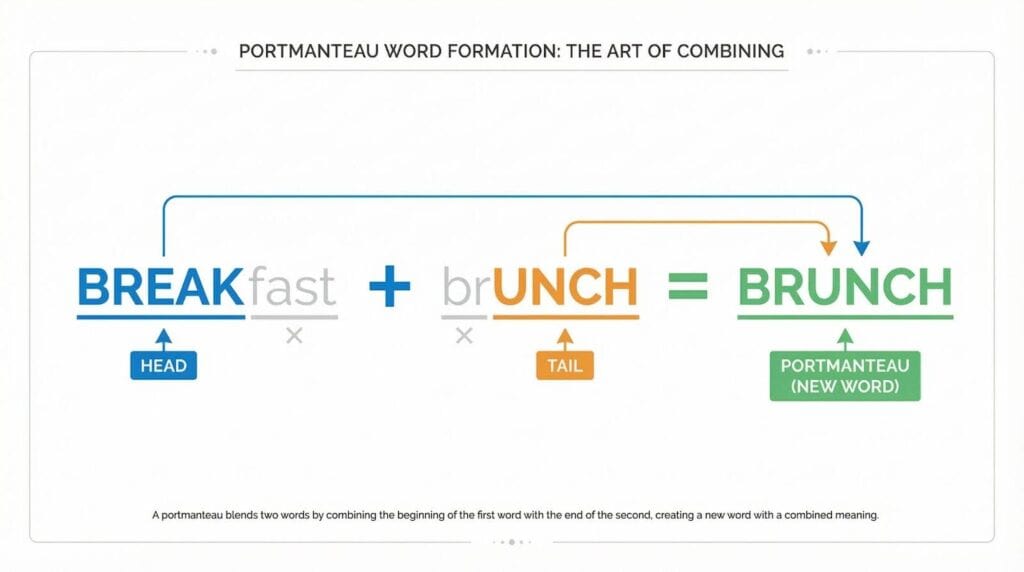
What is a portmanteau? It is simply blending the sounds and meanings of two words to create a brand-new one.
But hold on a second. In this blog, we are going to cover everything about portmanteau in detail.
We will look at the fascinating history behind the term, analyze portmanteau examples, see why writers use them, and analyze the common mistakes they make.
Let’s dive in.
Key Takeaways
- A portmanteau blends both the sounds and meanings of two words (e.g., Breakfast + Lunch = Brunch).
- The term was originally a physical suitcase. Lewis Carroll famously applied it to linguistics in Through the Looking-Glass.
- Unlike compound words (which stack words whole), portmanteaus require “clipping” or removing parts of the original words.
- Writers use them for efficiency (speed), branding (Verizon), and social framing (Glamping).
- Inventing new words can sound robotic. Tools like Undetectable AI help blend these creative terms naturally into your writing.
What Is a Portmanteau?
To understand the portmanteau definition, we must first look at its roots.
The word “Portmanteau” is derived from two French words:
- Porter meaning “to carry”
- Manteau meaning “coat or cloak”
Portmanteau Definition
What is a portmanteau?


Never Worry About AI Detecting Your Texts Again. Undetectable AI Can Help You:
- Make your AI assisted writing appear human-like.
- Bypass all major AI detection tools with just one click.
- Use AI safely and confidently in school and work.
Based on this origin, a portmanteau is a specific type of compound word. It is formed by blending the sounds and combining the meanings of two or more parent words into a single new term.
When analyzing portmanteau meaning, it is crucial to distinguish it from standard word formations:
- Unlike Compound Words (e.g., Toadstool), which simply stack complete words together.
- Unlike Contractions (e.g., Don’t), which merely shorten words for speed.
A portmanteau requires the “clipping” of at least one parent word.
This disintegration creates a new, independent word that retains the “semantic DNA” of its ancestors.

Historically, in the 16th and 17th centuries, a portmanteau was not a word but a physical object.
It was a large, stiff leather suitcase that opened into two distinct compartments combined into a single carrying device.
This physical object provided the perfect metaphor for the literary device.
This connection was first drawn by Lewis Carroll in his 1871 novel Through the Looking-Glass, describing how two meanings are “packed up” into one word like a suitcase.
Common Examples of Portmanteau
Portmanteau examples are everywhere.
Here are a few you likely use every day:
- Brunch
Mix of: Breakfast + Lunch
Background: Before this word existed, eating late in the day just looked lazy. Coined in 1895, “Brunch” gave people a valid excuse to sleep in on Sundays. It turned a late breakfast into a fun, social event instead of just a missed meal.
- Smog
Mix of: Smoke + Fog
Background: “Smog” described a dangerous mix of pollution and fog that could hurt your lungs. Giving it a specific name helped scientists and governments realize it was a serious health crisis, eventually leading to laws for cleaner air.
- Motel
Mix of: Motor + Hotel
Background: This word changed travel. Old “hotels” were big buildings in the city where you walked through a lobby. A “motel” was designed specifically for people driving cars on the highway. You could park your car right in front of your room door.
- Podcast
Mix of: iPod + Broadcast
Background: This is a funny one because technology moved faster than language. It combined “iPod” (the Apple music player) with “Broadcast.” Even though most people don’t use iPods anymore, the name helped people understand the new idea of “downloadable radio” by connecting it to a device they knew.
- Cosplay
Mix of: Costume + Roleplay
Background: This word traveled the world. It started from English roots, became huge in Japan (as kosupure), and came back to English. It means more than just wearing a Halloween mask, it implies that you are actually acting like the character.
Creating clever portmanteau words requires creativity. Most basic AI tools just predict the next likely word, which often makes them sound boring or repetitive.
This is where the Undetectable AI’s AI Essay Writer stands out.
- For example, if you are writing a story and need a word for “a robot that works as a bureaucrat,” the tool can analyze the sounds and suggest logical blends like “Robocrat” or “Bureauid.”
Why Writers Use Portmanteaus
Here is why writers use portmanteau words so often:
- Speed and Efficiency
If one word can do the job of a whole sentence, our brains prefer the short version because it reduces “cognitive load,” and the reader doesn’t have to think as hard.
- Example: “Staycation” (Stay + Vacation). Instead of saying, “I am taking time off work but remaining at my own house to relax,” you just say one word. It packs a complex idea into three syllables.
- Creating Humor and Playfulness
Portmanteaus break the rules of language, which naturally grabs attention.
- Example: “Chillax” (Chill + Relax) or “Guesstimate” (Guess + Estimate). These words immediately tell the reader, “We aren’t being 100% serious right now.”

3. Softening Reality
Sometimes, a portmanteau word is used to make a harsh reality feel better, or to sell something to a new audience.
- Example: “Glamping” (Glamour + Camping). Regular camping sounds dirty and uncomfortable to some people. By adding “glamour,” marketers reinvented sleeping in a tent as a luxury experience, allowing them to sell it to people who hate bugs.
4. Building “Insider” Groups
Using specific blended words helps define communities. If you know the word, you are part of the club.
- Example: “Netizen” (Internet + Citizen) implies someone is deeply involved in online culture, not just a casual user. “Brony” (Bro + Pony) specifically identifies male fans of My Little Pony.

5. Smart Business Branding
In the business world, you cannot trademark common words (you can’t trademark the word “Apple” to sell fruit). But if you invent a new word, you own it.
- Example:
- “Pinterest” (Pin + Interest). It describes exactly what the app does while creating a unique name that they legally own.
- “Verizon” (Veritas [Truth] + Horizon). It sounds professional and futuristic, giving the company a strong corporate image.
Portmanteau vs. Compound Words
To master the portmanteau meaning, you must see how it differs from standard compounds.
| Feature | Compound Words | Portmanteaus |
| Structure | Full Integrity. Both original words are kept whole and complete. | Truncation (Damage). Words are clipped, broken, or blended. Parts are lost. |
| Example | Butterfly (Butter + Fly are both fully visible). | Spork (The “oon” of spoon and “f” of fork are gone). |
| Meaning | Just a Label. A butterfly is not a mix of butter and insects. It is just a name for a new item. | A Fusion. A spork is physically a mix of both tools. It is an “alloy” of function. |
| Purpose | To name things using existing words. | To create a new definition for a specific, blended concept. |
Common Mistakes When Using Portmanteaus
While portmanteau examples can be clever, they are easily misused.
Here are the major traps writers fall into:
- The “Frankenword” Effect
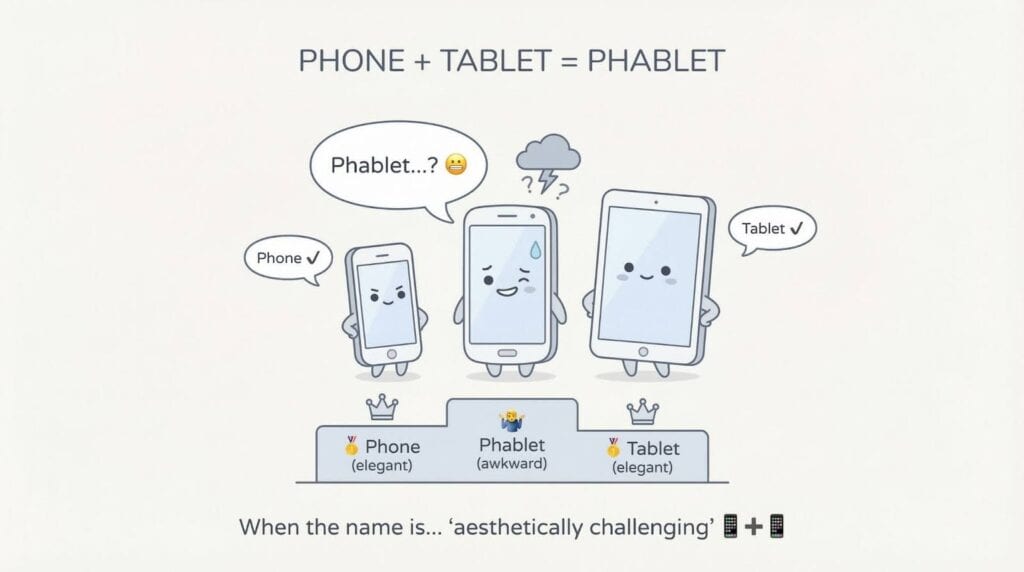
Some blends simply sound bad. They might be hard to pronounce or create awkward sounds that feel industrial rather than natural.
- Example: “Phablet” (Phone + Tablet). This word was widely criticized because it is aesthetically unappealing.
2. Semantic Opacity
If you cut off too much of the original words (the “splinter”), the reader has to stop and guess what the source words are.
- Example: “Hundranger.” Is it Hundred? Hunger? Ranger? Danger? Because the roots are unclear, the word fails to communicate.
3. Lazy Habits
This happens when writers lazily slap a suffix like “-holic” or “-gate” onto any word. Linguists call these “libfixes.”
- Example:
- “Chocoholic” or “Shopaholic.” These aren’t clever neologisms; they are just lazy shortcuts.
- “Mansplaining” derivatives. While “Mansplaining” was culturally significant, creating endless copies like “Manterrupting” or “Manspreading” can make writing feel repetitive and annoying rather than witty.
How to Use Portmanteaus Effectively
To use portmanteau words professionally, you must act as both an inventor and an editor.
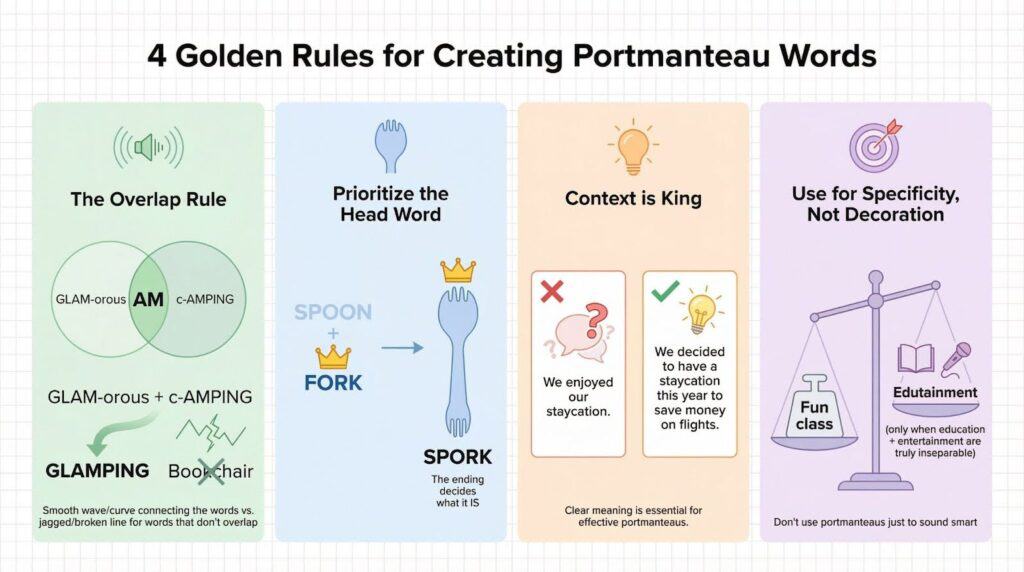
- Follow the “Overlap” Rule
Look for phonetic similarities. “Glamorous” and “Camping” both share the “am” sound. This makes the transition in “Glamping” smooth and natural.
Write down the sounds of both words. If they don’t overlap, the word will feel clunky.
- Prioritize the “Head” Word
In English, the second word usually decides what the object is. Think of a Spork (Spoon + Fork). Because it ends with the sound of “Fork” (or creates a rhyme with it), it feels like a utensil.
- Context is King
Never let a new word stand alone. You must introduce it in a sentence that explains the meaning automatically.
Don’t just say, “We enjoyed our staycation.”
Say, “We decided to have a staycation this year to save money on flights.”
The context of “saving money on travel” immediately tells the reader that “stay” + “vacation” means staying home.
- Use for Specificity, Not Decoration
Don’t use a portmanteau word just to sound smart. If you mean a “fun class,” just say “fun class.” Use “Edutainment” only when you mean that education and entertainment are inseparable.
Inventing words is a high-risk activity. If your writing sounds stiff or robotic, a made-up word will look like a mistake or an AI error (“hallucination”).
This is where the Undetectable AI’s AI Humanizer becomes essential.
If the text around your new word is boring, the reader won’t trust you.
- Basic AI Example: “The technological landscape is seeing a rise in phablets which are phones and tablets combined.” (This is clunky and reads like a dictionary).
The Undetectable AI Humanizer refines the rhythm and emotion of your sentences so the new word fits perfectly.
- Humanized Example: “As our hunger for larger screens grows, the line between phone and tablet blurs, giving rise to the ‘phablet’—a device that refuses to compromise on size or portability.”
Experience our AI Detector and Humanizer in the widget below!
Conclusion
Language is not a static museum, it is a living, breathing laboratory.
From Lewis Carroll’s “Jabberwocky” to the “Brunch” menu at your local cafe, portmanteau words prove that we are always looking for faster, wittier ways to describe our world.
So, don’t be afraid to experiment. Just remember: there is a fine line between a clever coin (like Podcast) and a linguistic disaster (like Phablet).
Want to create inventive content without sounding like a robot?
Ensure your creative blends land perfectly with your audience.
Use Undetectable AI to refine your writing, humanize your tone, and ensure your new words feel like they have belonged there all along.