What do ancient Roman snails have to do with your writing habits?
Surprisingly, everything.
You might think “Purple Prose” sounds like a compliment. After all, purple is the color of royalty, right?
But in the literary world, it is actually an insult. To understand the purple prose definition, we have to travel back to Ancient Rome.
The term comes from the poet Horace, who wrote about the purpureus pannus—the “purple patch.”
In those days, purple dye was painstakingly extracted from the mucus of the Murex snail. It was rare, gross to make, and worth more than its weight in gold.
Horace used this as a savage metaphor for bad writers.
He described authors who would take a boring story (like a dirty burlap sack) and sew on a shiny, expensive “purple patch” of flowery words just to show off. It didn’t make the story better.
Today, the purple prose meaning hasn’t changed much.
To define purple prose simply: it is text that tries too hard.
So, are you writing beautiful lyrics, or are you just sewing patches on a burlap sack?
In this blog, we are going to peel back the layers of this term. We will cover the purple prose meaning, look at some cringey purple prose examples, and teach you how to spot them and avoid them.
Let’s jump in.
Key Takeaways
- Purple prose is writing that’s too fancy and distracts from the story.
- It often uses too many adjectives, complicated words, and stacked metaphors.
- Writers fall into purple prose because of insecurity, copying old classics, or forcing emotions.
- Modern AI tools generate purple prose because they are trained on predictive text patterns, often favoring flowery, and cliché adjectives.
- Purple prose slows the story, breaks immersion, and makes feelings feel fake.
- Simple, honest writing (combined with AI detection tools) keeps your text clear and engaging.
What Is Purple Prose?
To understand the purple prose meaning, we have to look at the intention behind the words.
Purple Prose is writing that is too fancy, flowery, or dramatic. It tries so hard to sound poetic that it distracts the reader from the actual story.
- Core Meaning of Purple Prose
In good writing, the story (substance) is the most important thing.


Never Worry About AI Detecting Your Texts Again. Undetectable AI Can Help You:
- Make your AI assisted writing appear human-like.
- Bypass all major AI detection tools with just one click.
- Use AI safely and confidently in school and work.
When you define purple prose, you’re describing writing where style becomes more important than the plot.
If you look at the structure of the sentences, purple prose usually relies on three specific bad habits:
- Adjective Stacking: Instead of using a strong verb, the writer uses a weak verb and props it up with too many adjectives.
- Standard: “The wind blew.”
- Purple: “The tempestuous, mournful gale howled sorrowfully.”
- The Thesaurus Trap: The writer avoids simple, punchy words in favor of long, complicated Latin-based words to sound “smart.”
- Standard: “Sweat” or “Think.”
- Purple: “Perspire” or “Ratiocinate.”
- The Metaphor Pile-Up: Using too many comparisons in one sentence that don’t match each other.
- Purple Example: “His anger was a volcano, a storm waiting to unleash a tidal wave.” (Is it a mountain, a storm, or a wave? The reader can’t visualize it).
At its heart, purple prose is ego-driven writing. It screams, “Look at me!” rather than “Look at this character.” It treats words like decorations rather than tools to tell a story.
- Examples of Purple Prose
Here are the most famous purple prose examples to understand them clearly:
- The Classic: “It Was a Dark and Stormy Night”
This is the most famous “bad” sentence in history, written by Edward Bulwer-Lytton in 1830.
It is so iconic that there is now a contest to see who can write a worse opening line.
The writer tries to do too much in one breath (describing the rain, the wind, the location (London), and the mood) all at once.
The writing feels labored and heavy instead of scary.
The Example: “It was a dark and stormy night; the rain fell in torrents—except at occasional intervals, when it was checked by a violent gust of wind which swept up the streets (for it is in London that our scene lies), rattling along the housetops, and fiercely agitating the scanty flame of the lamps that struggled against the darkness.”
- The “Thesaurus Syndrome” (Modern Amateurs)
This is very common in online stories (fanfiction) or self-published books.
The Example: “The mahogany-haired adolescent girl glanced fleetingly at her rugged paramour, a crystalline sparkle in her cerulean orbs as she gazed, enraptured, upon his countenance.”
It sounds unnatural.
- Instead of “brown hair,” they say “mahogany-haired.”
- Instead of “boyfriend,” they say “paramour.”
- Instead of “blue eyes,” they say “cerulean orbs.”
The writer is avoiding normal language, making the characters feel like aliens rather than people.
- The “Bodice Ripper” (Bad Romance)
Purple prose appears often in romance novels where the writer tries to make a scene feel intense but pushes it too far.
The Example: “He felt himself grasped by his long lapels… as a creature with a hundred mouths started sucking the marrow from his bones… He felt her clammy shins, her hot kisses…”
This is supposed to be a passionate scene, but phrases like “sucking the marrow” and “clammy shins” make the reader think of a monster movie, not a love story.
Why Writers Use Purple Prose
If critics, editors, and teachers all disguise purple prose meaning, why do so many writers still use it?
Let’s explore the top 5 reasons why many writers fall into the trap.
- The Genius Trap
A new writer reads a classic book (like Lolita or Ulysses) and sees that it is hard to read.
They make a mistake in their logic: “This book is great, and it is complex. Therefore, if I write complex sentences, I will be great too.”
They try to copy the symptoms of genius without having the actual skill. They use big words and tangled sentences, thinking that if their writing is hard to understand, it must be “deep.”
- Fear of Being Basic
Many writers are secretly terrified of sounding stupid. This usually comes from school.
In academic essays, teachers reward students for using big vocabulary words and long sentences.
When these students start writing stories, they feel that simple words like “said” are weak. They use purple prose as a shield.
- The Sledgehammer Effect (Forcing Emotion)
Writers often use purple prose when they care too much about a scene. They want the reader to feel the exact pain or love the character is feeling.
They worry that saying “he was sad” isn’t enough. So, they grab a “linguistic sledgehammer” and write: “He was drowning in a bottomless abyss of melancholic despair.”
They don’t trust the reader’s imagination to do the work, so they try to force the emotion with heavy adjectives.
- Copying Their Heroes
Writers imitate what they love.
If a young writer loves H.P. Lovecraft (a horror writer from the 1920s), they will see him using words like “eldritch” and “cyclopean.”
They try to use those same words in a modern story, not realizing it doesn’t fit.
Lovecraft’s style worked because he was writing cosmic horror a hundred years ago.
Copying that style today just looks like a bad costume.
- A Different View of the World
Interestingly, for some writers (especially those who are autistic or have high sensory processing sensitivity) purple prose is how they see the world.
For them, the world is intense, overwhelming, and hyper-detailed.
Writing a simple, minimalistic sentence feels like a lie because it doesn’t capture the explosion of senses they feel.
How Purple Prose Affects Writing
Understanding the purple prose definition helps you see how it actively sabotages the reader’s experience.
It’s like trying to watch a movie while someone stands in front of the screen shouting descriptions at you.
Here is how it affects the writing:
- It Breaks the Trance (Cognitive Overload)
When you are deeply engaged in a book, your brain enters a “flow state.” You are basically watching a movie in your head.
Purple prose destroys that illusion. Every time you hit a word that is too fancy or a sentence that is too tangled, your brain has to slam on the brakes to decode it.
Instead of feeling the story, you are suddenly stuck analyzing the grammar.
- It Kills the Pacing
Imagine reading a fight scene where a single punch takes three paragraphs to describe because the writer is obsessing over the “knuckles of retribution.”
By the time you finish the sentence, the excitement is dead. The reader wants the action to move fast, but the writing is moving at the speed of a Victorian sermon.
- It Makes Emotion Feel Fake
The harder a writer tries to force an emotion with flowery words, the less the reader feels it. Simple, honest writing leaves room for the reader to step in and feel the pain themselves.
Purple prose crowds them out.
Recognizing Purple Prose
Now that we have covered the purple prose definition, how do you spot it in your own work?
Here are the top five indicators:
- Excessive Adjectives and Adverbs: Using too many descriptive words in a single sentence, e.g.,
- “fiercely agitating the scanty flame of the lamps that struggled against the darkness”.
- Overly Long Sentences: Sentences that meander with multiple clauses, parentheses, or digressions that could be broken into smaller ideas.
- Redundant Phrasing: Repeating the same concept in different words, e.g.,
- “the rain fell in torrents—except at occasional intervals”.
- Forced or Obvious Metaphors: Metaphors or similes that are stretched or over-complicated.
- Attention-Seeking Descriptions: Details that serve more to show off writing skill than to advance the story or meaning.
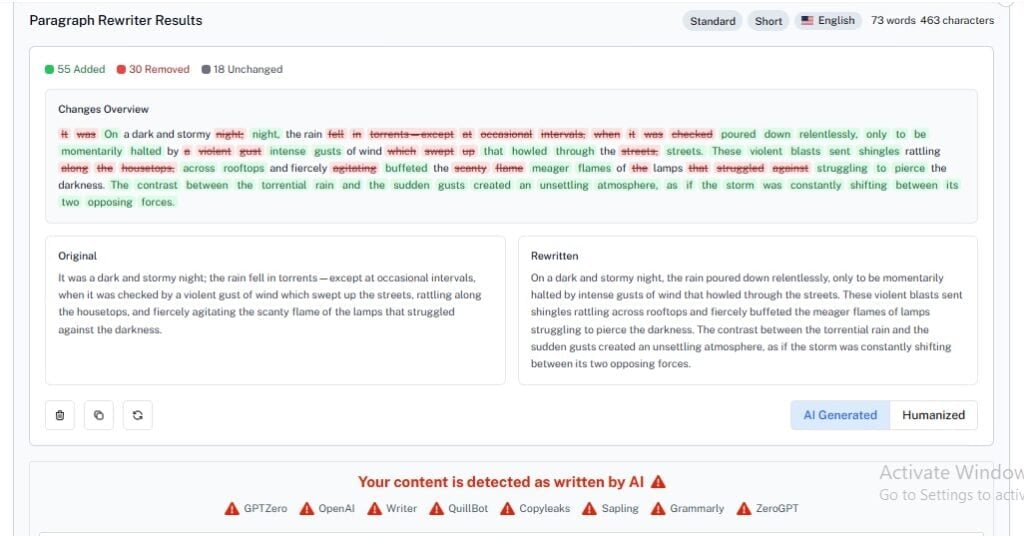
You can use a Paragraph Rewriter to keep the voice and imagery while making the sentence clearer.
Original (purple prose example): It was a dark and stormy night; the rain fell in torrents—except at occasional intervals, when it was checked by a violent gust of wind which swept up the streets, rattling along the housetops, and fiercely agitating the scanty flame of the lamps that struggled against the darkness.
Simplified Version:
How to Avoid Purple Prose
In the past, avoiding purple prose was just about discipline. Today, it’s a bit more complicated because Artificial Intelligence (AI) has entered the chat. Surprisingly, robots love purple prose.
Here is how to use both old-school tricks and new tech to keep your writing clean.
- Traditional Strategies (The Old School Way)
Before we talk about robots, here are the three classic rules every writer should know:
- Kill Your Darlings: This is a famous rule. It means you must be willing to delete the sentences you are most proud of if they don’t help the story. Usually, the sentence you wrote just to “show off” is the purple one. Cut it.
- The Hemingway Approach: Use tools like the Hemingway Editor. It highlights sentences that are “very hard to read” or use too many adverbs. It forces you to write simply, like Ernest Hemingway.
- The Read-Aloud Test: Read your writing out loud. Purple prose often sounds clunky or breathless. If you stumble over the words, or if you feel silly saying them to an empty room, it’s probably purple.
- Why Robots Write Purple Prose
You might think AI would write like a cold, logical machine. But actually, Large Language Models (like ChatGPT or Gemini) often write like a bad poet from the 1800s.
Why does this happen?
AI is trained on the entire internet including fanfiction, amateur blogs, and old Victorian books. It is a predictive engine. It guesses that the word after “eyes” should be “sparkling” or “orbs.”
If your writing tools are suggesting clunky, flowery replacements, they might be hurting your story more than helping it.

Don’t let algorithms disrupt your immersion. Use the AI Detector to spot robotic patterns and the AI Humanizer to rewrite them.
These tools are designed to ensure suggested revisions sound natural and maintain the specific narrative flow of your story. They keep the reader hooked without the distraction of purple prose.
Use our AI Detector and Humanizer right in the widget below!
Conclusion
So here’s the lowdown on what is purple prose.
Purple prose is the literary equivalent of wearing a tuxedo to a backyard BBQ. You might think you look dressed to impress, but really, you just look confused.
Your readers didn’t buy a ticket to your vocabulary show, they came to get lost in a story.
Think of writing like cooking.
Would you dump the entire spice rack into a pot of soup just to prove you own fancy ingredients?
Of course not.
That would taste terrible.
The best meals let the real flavors shine. In writing, clarity beats cleverness every single time.
So, the next time you feel the urge to create purple prose examples like calling blue eyes “cerulean orbs” or use the word “ejaculated” instead of “said” (please, just don’t), take a deep breath.
Ask yourself: Does this sentence help my story, or am I just showing off?
The practical purple prose definition isn’t about a lack of talent, it’s about a lack of honesty.
Put away the peacock feathers. Trust your story enough to let it stand naked. Sometimes, the most powerful thing you can write is exactly what you mean.
Keep your writing clear and authentic with Undetectable AI.