
‘Rags to riches’ is an idiom in the English Language (phrases that have an implied meaning rather than being used for their literal meaning).
It is used to describe the shift from poverty to wealth, and besides money, we can also use it to describe when someone had very little of something but eventually, they bagged a lot of it, for instance, respect, power, autonomy, privilege, social status, etc.
Someone winning a lot of money gambling at a casino may be described as going from rags to riches. The word ‘rag’ describes an old piece of clothing, which in this phrase, is a metaphor for the scarcity of something.
There are many examples of famous people in history and in modern times who went from rags to riches. In this article, you’ll get to know about them.
We’ll also discuss the meaning and correct usage of the idiom ‘rags to riches’ and all the grammar rules that apply to it, with example sentences alongside.
Let’s jump in.
Key Takeaways
- ‘Rags to riches’ means the change from having no money at all to having a lot of money. It can also be used in the context of privilege, respect, power, social standing, etc.
- The idiom has been in use since the 1880’s, and it is said that the American author Horatio Alger wrote the first documented rags-to-riches stories, though the first exact use of the phrase is unknown.
- It is a noun phrase, when used in sentences, it is preceded by a verb (moved, went, transitioned, climbed, etc) and the preposition ‘from.’
- It is a famous trope in fiction storytelling, you’ll often find protagonists in books and movies rising from nothing and ultimately ending up as a hero.
Understanding Rags to Riches
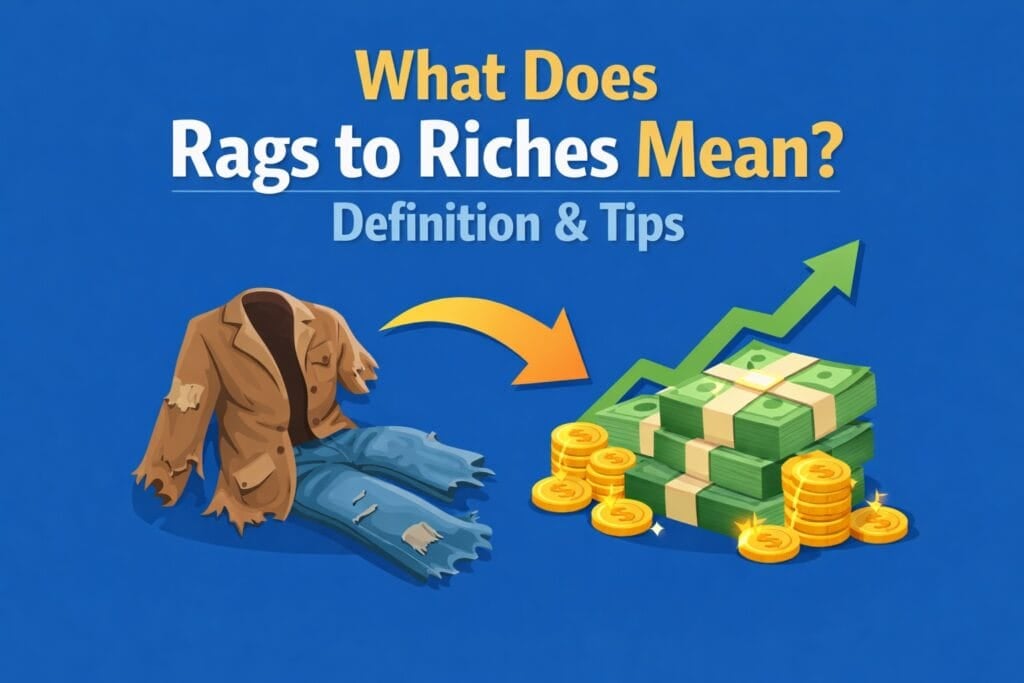
Rags to riches is an idiom that means to move from extreme poverty to a state of being well off. It can be used to describe the dramatic change from scarcity to abundance of power and recognition, too.
So, you use it either to talk about money or social standing.
A “Rag” in its literal sense is a piece of old clothing torn from a larger sheet that you use for cleaning purposes. In the idiom, it refers to the concept of bare survival.


Never Worry About AI Detecting Your Texts Again. Undetectable AI Can Help You:
- Make your AI assisted writing appear human-like.
- Bypass all major AI detection tools with just one click.
- Use AI safely and confidently in school and work.
Part of the reason why rags to riches became a famous phrase is that it follows the rule of three. According to psychology, the human mind tends to remember things grouped in three components better than other combinations.
If you’re observant, you’ll find that a lot of the idioms we use today are made of three words simply because it was easier to remember them.
Rags to riches also uses alliteration. This concept in English refers to the same sound occurring at the beginning of adjacent words. Both the main words in ‘rags to riches’ begin with the “r” sound that makes it roll off the tongue.
Origin of Rags to Riches
No one is really confident about the first time rags to riches was used in the literature.
However, we’ve repeatedly seen the context of this idiom across history, in legends, religious stories, folktales, biographies, etc, all centered on people who had humble beginnings but they rose up to influence.
The phrase itself has been in use since at least the 1880s.
Some sources say that the earliest usage of ‘rags to riches’ is attributed to the American author Horatio Alger.
Alger wrote stories of poor boys who went through harsh circumstances in life with persistence and eventually became prosperous young men.
Rags to Riches in Real Life
I’m sure as you read through the meaning and context of the phrase rags to riches, you must at least have recalled someone you know of who had no social or financial standing some time ago, but now they’re doing great.
These stories are a great reminder that change, no matter how uncomfortable it may be, is possible!
- Famous people
There are lots and lots of people you’ve heard about in history books who stood from nowhere, but they ended up with great power and privilege, which is why they are in books.
Many modern-day famous people also had humble beginnings.
Abraham Lincoln, long before he became the 16th President of the United States, was born into a family so poor that his early years were spent in a simple log cabin. But he somehow worked his way up to lead an entire nation.
Genghis Khan was born on a harsh Mongolian land where he was deserted by his clan after his father’s death. As he grew up, he united the tribes to build the largest contiguous land empire in history.
Emperor Diocletian began his life in the low ranks of society as the son of a freed slave. He, too, rose up to become one of Rome’s most powerful emperors.
Perhaps the most interesting example of rags to riches in modern times is J.K. Rowling’s. She suffered rejection after rejection for her Harry Potter manuscript as a single mom barely scraping by taking care of her child.
It wasn’t until years later that the publishing world finally said yes to create a Harry Potter universe that flipped the course of her life.
- Everyday Examples
Although rags to riches is a great plot device in fiction storytelling where the transition is almost always attributed to a person’s hard work and talent. Life, unfortunately, doesn’t work the same way.
Most of us don’t make global headlines when we improve our circumstances. In most cases, a winning lottery ticket or windfall inheritance can shift someone’s entire life overnight.
Hard work alone makes us move up the financial ladder only by a few steps.
The probability that a child born into poverty will make it to the living class with top 5% income is less than 1%. By comparison, being born in an already rich home gets you a 22% chance of reaching the same place.
That is not to say ‘rags to riches’ isn’t possible. It’s just that we have our own thresholds for riches. In everyday terms, we use it to describe leaving bad living conditions for better ones.
A street dog can go from rags to riches after being adopted by a caring family.
Or, someone who leaves a low-paying, toxic workplace, gains new skills or a degree, and then lands a far more comfortable job can also be described as the same.
How to Use Rags to Riches in a Sentence
Rags to riches is used as a noun phrase. It is very commonly used in conversations and fictional storytelling.
Since it describes a transformation, we use it as a noun to refer to the whole phase of change rather than the actual action of moving up the financial status.
So, to use it in a sentence, you need a verb in its past tense and the preposition ‘from’ just before the phrase, i.e., “She went from rags to riches.”
Verbs you can use to describe the process are:
- Go
- Rise
- Move
- Transition
- Climb
- Turn
- Progress
Note that all these verbs imply movement.
You can also use it right after the preposition “of” when narrating someone’s story of change, e.g., “Her story of rags to riches is impressive!” In this case, it takes the place of a descriptive noun phrase for the type of story being told.
Sometimes, ‘rags to riches’ is used as an adjective before a noun, for example, “a rags-to-riches tale” or “a rags-to-riches journey.” As an adjective, it is spelled with hyphens as a single word describing the noun.
Tips and Common Mistakes
Now, here are some quick tips you should take care of when using ‘rags to riches’ in a sentence:
- Make sure you spell it with a hyphen (rags-to-riches) when it is used as an adjective
- Do not use ‘rags to riches’ when the contrast between the two situations is not too dramatic. The idiom fits well in conditions that are drastically different.
- Always support the phrase with a verb, e.g., went, rose, turned, moved, etc. And also follow your verb with the preposition ‘from.’
- Do not assume that ‘rags to riches’ only applies to money. As we discussed earlier, you can also use it to signify a huge change in someone’s privilege, power, comfort, and social standing.
And if you ever feel like you’re not confident about the grammatical accuracy of your sentences where you’ve used ‘rags to riches,’ a quick chat with an Undetectable AI’s AI Chat will be great.
It will point out if there are any errors in your text and will correct the sentences for you with real-time feedback such that you learn too.

Practical Uses of Rags to Riches
By now, you must have had an idea about what situations we use the idiom ‘rags to riches’ in. Here, we have some example sentences that describe its usage in language:
- J.K. Rowling went from rags to riches the moment Harry Potter broke the internet after being rejected by 12 different publishing houses.
- John’s rags-to-riches story started in a cramped basement apartment where he taught himself to code on a secondhand laptop.
- Olivia dismisses the rags-to-riches narrative journalists keep pushing for her journey to becoming a CEO because she insists that luck played a bigger role than hustle ever did.
- Nobody believed the scruffy kid from the trailer park would ever amount to anything, but today, she owns half the commercial real estate downtown, and people can’t wrap their heads around her rags-to-riches story.
- He went from rags to riches after a venture capitalist stumbled upon his garage workshop and offered him funding on the spot.
- He shot from rags to riches when a viral video of his street performances caught the attention of a talent scout who happened to be stuck in traffic.
Explore our AI Detector and Humanizer in the widget below!
Final Thoughts
You can find plenty of examples for rags-to-riches stories of other famous people from historical and modern times.
Is fighting your way from rags to riches a common phenomenon? Not really. Is it possible? Definitely, though, luck has a certain part to play even after you’ve worked way too hard for it.
But by now, at least you know how to use this idiom in your conversations the right way, so I’d call it a win.
Use Undetectable AI Chat to practice your sentences a few times, and you’ll be as good at using it as native speakers.
Check out Undetectable AI tools today!