For as long as we have existed, we’ve used persuasion to shape how we think, act, and make decisions in our day-to-day lives. As a social species, everyone influences others in some way.
Yet, some people are remarkably better at it than others. You might have experienced this when someone presents a case that hits all the right spots.
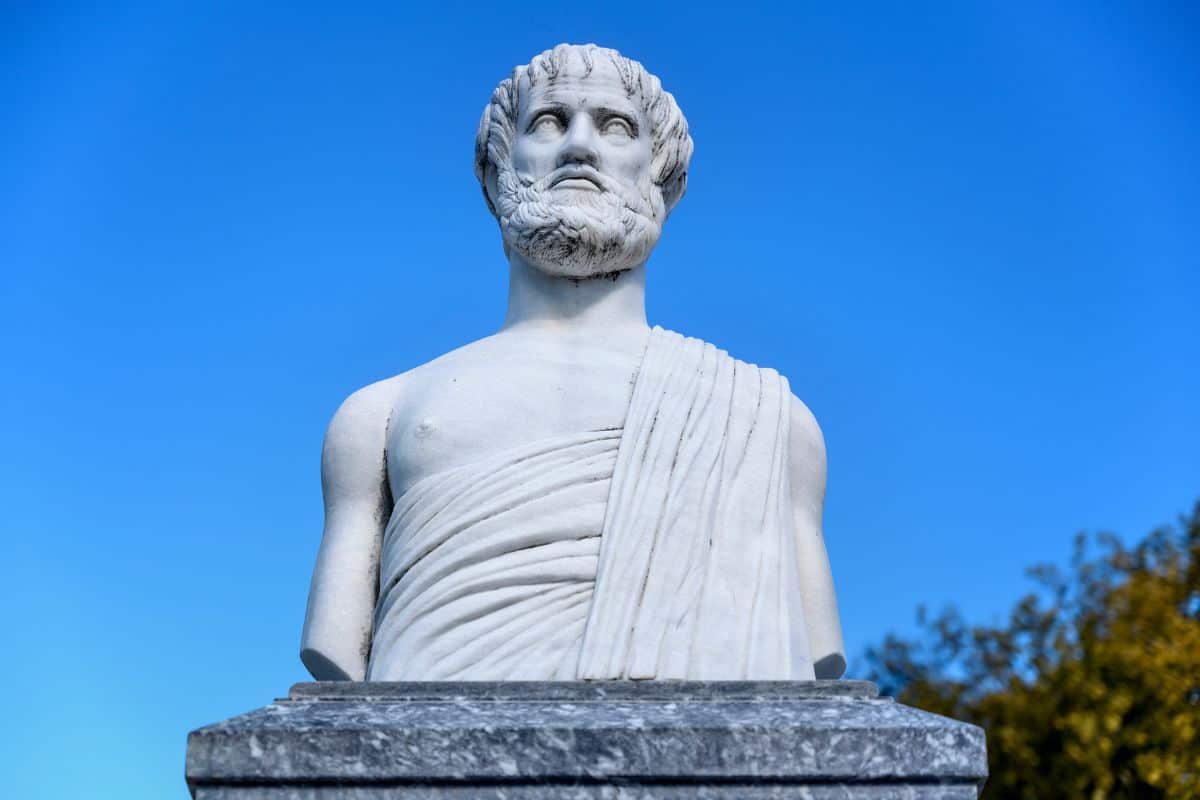
They often achieve this persuasion through Aristotle’s rhetorical triangle.
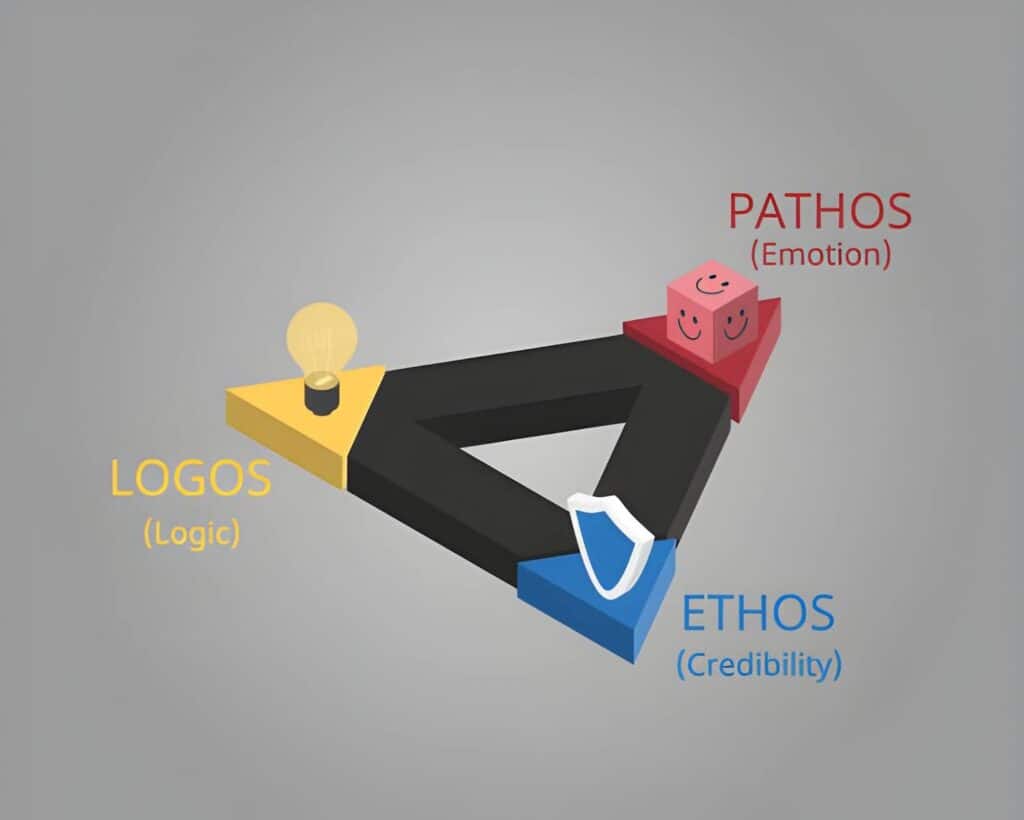
This triangle divides the process of persuasion into three parts, which are Ethos, Pathos, and Logos.
In this guide, we will provide you with the needed understanding for you to apply the rhetorical situation triangle in your personal writing and speech.
Let’s dive in.
Key Takeaways
- A rhetorical triangle is a persuasion model that writers and speakers adopt to suit their rhetorical goals of persuading their audience on certain views.
- The triangle works by appealing to people based on the user’s ethos (credibility), audience’s pathos (emotions), and user’s logos (logical arguments).
- The three appeals are popularly arranged in a triangular form. This is why it’s called the rhetorical triangle
What Is a Rhetorical Triangle?
The rhetorical triangle is a communicative framework that can be used to create persuasive rhetoric.
This triangle consists of three essential elements for persuasive communication that include ethos (credibility of your own), pathos (your emotional appeal to the audience) and logos (logical reasoning).
Together, they form what is known as the rhetorical triangle. This concept was developed more than 2,000 years ago by the Ancient Greek philosopher Aristotle.


Never Worry About AI Detecting Your Texts Again. Undetectable AI Can Help You:
- Make your AI assisted writing appear human-like.
- Bypass all major AI detection tools with just one click.
- Use AI safely and confidently in school and work.
He found out that our communication is more convincing to others when we use these three major appeals.
Core Meaning of Rhetorical Triangle
We’ve established in the rhetorical triangle definition that it has three components. However, there’s more to each component of the triangle, and we explained each below:
Ethos: Establishing Credibility
Ethos is simply a matter of building trust between yourself and your audience. They must first trust you and have confidence in you before they will be persuaded to listen to your argument.
Aristotle believed ethos was one of the most powerful forms of persuasion. He argued that we’re naturally more likely to believe good people than bad ones, and that a speaker’s character matters as much as their argument.
According to Aristotle, ethos is about demonstrating to people that you have a good moral character and goodwill toward your audience.
This is an important setup in your communicative effort, because people can sense when you’re trying to manipulate them. In that case, your argument loses power before you’ve stated it.
Credibility can come from different sources. Sometimes it’s based on your expertise and official certifications, such as a doctor or lawyer speaking on a subject.
On other occasions, common values between you and your audience will make you credible to them. That is why countless brands and influencers strive to establish credibility authentically with their target audience.
Pathos: Appealing to Emotion
Pathos targets the heart of your audience. This appeal uses emotion to move your audience.
People are sensitive creatures, and as such, when we engage with other human beings, we tend to rely on emotions. In a bid to further substantiate this, Aristotle wrote that the role of emotions in our judgment is quite significant.
In the case of Aristotle, pathos was based on relating what you are saying to what is of real interest to your audience. Even popular brands use pathos.
For example, Apple ads rarely talk about technical specifications; instead, they show families capturing memories, artists creating masterpieces, and people connecting across distances.
The message connotes luxury and capturing great moments with quality cameras.
Coca-Cola does the same thing around Christmas by making its adverts about oneness and warmth.
They sell you a feeling tied to the beverage. Basically, when you influence people’s feelings, you create a bridge to what they think.
Logos: Appealing to Logic
The last form of appeal in the rhetorical triangle is logos or just logic.
Once you are credible and you have appealed to the emotional aspect of your audience, it is time to use logic to bring all these together.
Aristotle believed that logos is critical in the triangle since human beings are rational and react to rational reasoning.
Logos works best when you have evidence and sound logical arguments that can bolster your position. When you use logos, you expect your audience to follow a clear line of reasoning from point A to B and your conclusion.
Due to this, Aristotle gave two forms in which reasoning can work. First is deductive reasoning. In deductive reasoning, you use a general principle and apply it to a specific case for your conclusion.
The second one is inductive reasoning, where you build your argument from specific examples to a general conclusion about events.
A great case of logos is Tesla. After Tesla has appealed to your emotions about global warming and environmental consciousness, they close the loop with reasoning that supports their message.
Elon Musk’s argument won’t just be that his electric cars are better for the environment. He’ll also present data on the car’s acceleration times, range capabilities, and total cost of ownership compared to gas vehicles.
Since his argument is built on measurable performance metrics and economic logic, you’ll feel like you’re helping the environment and getting the best automobile experience.
How the Rhetorical Triangle Works Together
The real power of the rhetorical triangle is in using every aspect of the triangle competently and not in isolation. The appeals are quite simple to weave together, so they reinforce each other.
Here’s how the rhetorical situation triangle works. First, you establish a trustworthy background on why people should listen to you.
Then, you have to genuinely connect with people’s emotions about the issues troubling them. Lastly, you close the loop with evidence they can trust.
In isolation, a purely logical argument can feel detached from humanity, while an emotional appeal without credibility seems manipulative.
For instance, if a doctor rattles off statistics about lung cancer and heart disease, this might work for some people, but scare the patient off.
An empathetic doctor will adjust the approach and establish ethos by showing they genuinely care about the patient’s well being. They will then bring in pathos by asking the patient to think about their quality of life and future with their family.
This will convince the patient before the doctor supports their message with statistics on exactly how smoking damages the body. All three appeals working together make the message stick.
Common Mistakes When Using the Triangle
The rhetorical triangle is a great tactic you can use for your next speech, but you must avoid the following mistakes that could derail your message:
- Do not use one type of appeal too much while ignoring the others. This can play out with you using so many statistics until readers feel buried under numbers. You can also create another pitfall by going in with many emotional stories but offering no logical framework or evidence.
- Use pathos carefully so you don’t come off as manipulative to your audience. When you exploit people’s fear or use guilt trips without offering real solutions, your audience will sense it. Your use of pathos will work best when they’re honest and tied to legitimate concerns.
- Do not assume your trustworthiness is obvious to everyone you come across. Although you might be an expert in your field, if your audience doesn’t know that, they won’t listen to you. You have to present your credentials early. This gives you the foundation to speak to them and lead them to the conclusion you want.
- Avoid using weak logic and hope an emotional story covers it. Witty listeners will see gaps in your reasoning despite how touching your speech is. However, with tested facts, you won’t seem dishonest to them.
- You have to understand your audience before you begin tailoring the rhetorical triangle to their circumstances. An example is when a politician is addressing blue-collar workers. He will not present numbers to them but appeal to their emotions. However, academic audiences would prefer statistics and logic in your speech on policy and the economy. Once you know who you’re talking to, try to adjust your triangle accordingly.
Applying the Rhetorical Triangle in Writing and Speech
The following are steps on how to use the rhetorical triangle in your work:
- Understand who you’re speaking or writing to. This will influence which area of the triangle you should focus on more.
- Next, build your credibility from the start. In persuasive writing, this might mean opening with your qualification and citing reputable sources. In speech, it could be sharing a relevant personal experience.
- Match your emotional appeal to what the situation calls for.
- Ground everything in solid reasoning. When your logic is sound, the other appeals have something sturdy to build on.
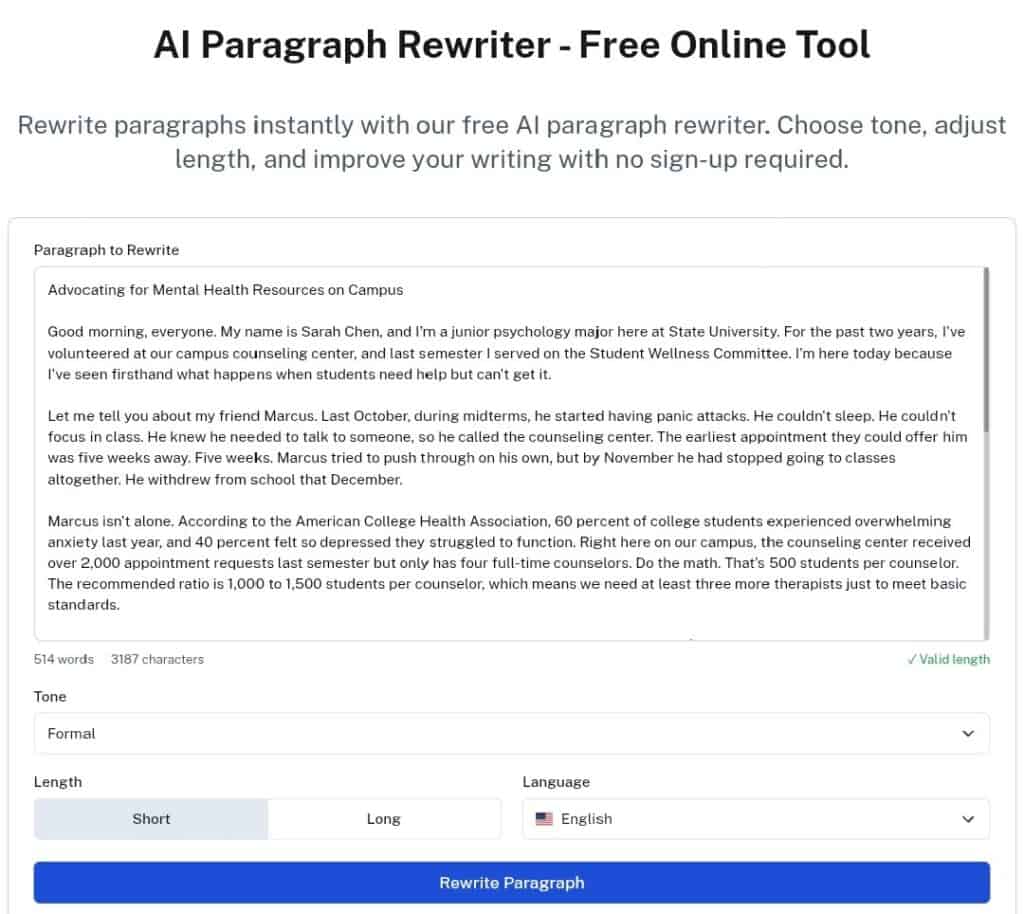
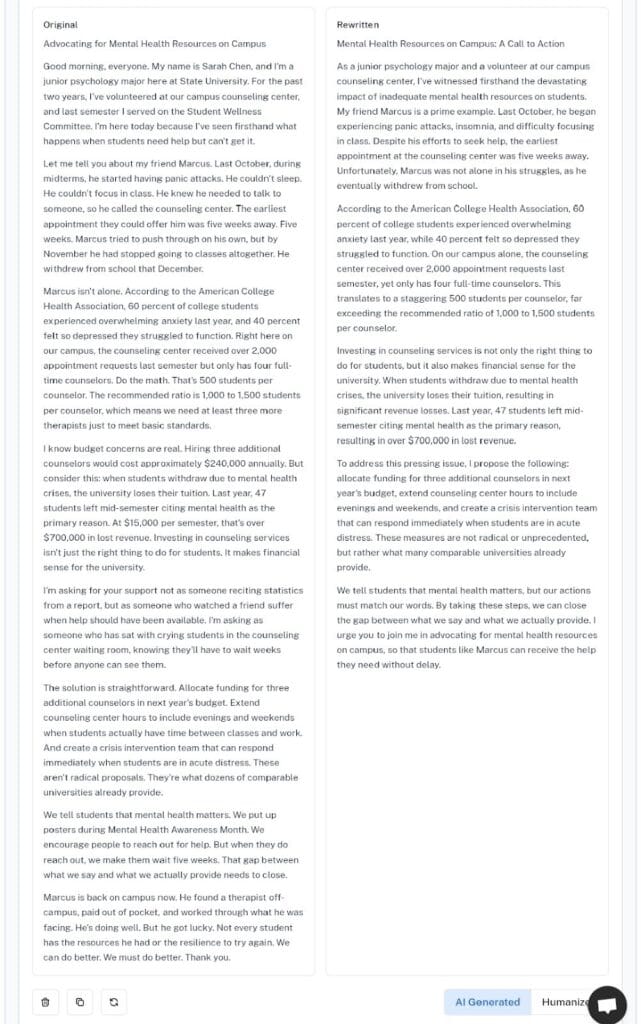
- Finally, you have to review your work with our paragraph rewriter. This tool will properly apply the rhetorical triangle to your work.
Below are clear examples of how our paragraph rewriter can help you effectively use the rhetorical triangle in different contexts.
With this tool, you can maintain balance and avoid overusing one appeal over the other in your work.
Classic Examples of the Rhetorical Triangle
Master communicators use the rhetorical triangle to appeal to their audiences either to sell something or convince them of an action.
These examples show how:
- Abraham Lincoln’s Gettysburg Address
This was the speech given by President Lincoln in 1863. In this speech, he made use of the rhetorical triangle and commemorated a cemetery for the dead Civil War soldiers.
First, he used ethos by showing himself as a sitting president during the nation’s darkest hour. Also, he didn’t place himself above the people or dead soldiers, seeing himself as their equal.
To drive home his point, he said the world would “little note, nor long remember what we say here.” He ensured that he paid tribute to the dead rather than take attention away from them.
He further used pathos by referring to the dead soldiers as “these honored dead.” He mentioned the values they had died protecting in America and admonished the living to be “dedicated to the great task remaining before us.” He was tying the dead and living together with sadness and patriotic will.
For logos, Lincoln built a clear logical argument that the nation was founded on equality. The war tested the will of the American people, especially at a time when they doubted the country would survive.
Lincoln’s speech assured them that the living must continue the fight to ensure “that government of the people, by the people, for the people, shall not perish from the earth.”
- Steve Jobs’s 2005 Stanford Commencement Speech
Jobs structured his entire speech around three personal stories. His ethos came from being a successful person named Steve Jobs. More credibility also came from his willingness to be vulnerable as a billionaire.
He talked about personal situations like getting fired from Apple and ultimately facing the possibility of death from cancer. By not focusing solely on his successes, he was able to build his credibility through authenticity. Hence, the graduates could trust someone who admitted he didn’t have all the answers.
The pathos was woven throughout. When Jobs described learning he had pancreatic cancer and how he faced his mortality, that resonates with them.
Additionally, they felt the same struggle of not knowing where life takes them when he discussed dropping out of college and sleeping on the floor of his friends’.
His most notable quote, which was, “Stay hungry, stay foolish,” worked emotionally because it gave graduates permission to take risks.
His logos appeared in how he connected the dots between seemingly random life events. He showed how dropping out led to a calligraphy class, which led to beautiful typography on the Mac, which changed personal computing.
The logical lesson was that your experiences will prove valuable eventually. It was reasoning disguised as storytelling, and it worked because the evidence came from his own life.
You too can improve your speech or written work to sound natural and convincing with our AI Humanizer. This way, your work stands the test of time and becomes a classic.

Test our AI Detector and Humanizer with the widget below!
Conclusion
At the end of the day, the rhetorical triangle is a powerful persuasive tool that can be used in personal engagements, advertising, political speeches and even unexpected situations to convince other people of your point of view.
Aristotle was able to solidify this as a triangle under ethos, pathos and logos.
You can also follow the tradition of great writers and orators by using our Undetectable AI tools to polish and improve your work before reaching wider audiences.