
The idiom ‘rule of thumb’ is used in circumstances when you do something because it has worked for other people before. It may or may not be 100% accurate.
The origin of the phrase comes from the time in history when the thumb was used as an approximation for measurement by many tradesmen.
They would approximate a thumb’s width to about an inch. It was very useful to carpenters, masons, tailors, and brewers, for example.
Many rules of thumb have been widely used in business and everyday life contexts, such as lifestyle, personal budgeting, healthy eating, and productivity.
In this article, you will learn the meaning and origin of ‘rule of thumb’ along with practical examples of the phrase.
Let’s jump in.
Key Takeaways
- The ‘rule of thumb’ means a practical, approximate method to do something based on experience.
- It is a noun phrase used with an article ‘a’ or ‘the’ before it, and is followed by a singular verb.
- ‘Rule of thumb’ and ‘the thumb rule’ mean the same, however, the latter is not a standard version of the idiom.
- It is one of the oldest idioms that has been in use in English from the 1600s. Its first recorded use in history was in 1685 in the sermons of Scottish preacher James Durham.
What Is the Rule of Thumb?
Rule of Thumb is an idiom that means to perform an action based on your experiences instead of precise, calculated decisions.
We can say that it is a practical guideline to do something quickly when a 100% accuracy is not needed. Rule of thumb actions do work well enough to get you through most of the real life situations.
The reason we make ‘rule of thumb’ decisions is that they are tried-and-tested methods that have worked for other people in everyday practice. It’s just common sense to follow the same methods.


Never Worry About AI Detecting Your Texts Again. Undetectable AI Can Help You:
- Make your AI assisted writing appear human-like.
- Bypass all major AI detection tools with just one click.
- Use AI safely and confidently in school and work.
Rule of Thumb Origin
The origin of the phrase ‘rule of thumb’ takes us back to the time in history when certain professions used different parts of the human body as measuring aids.
Many trades, such as carpenters, masons, tailors, and brewers, used the width of a thumb as a reference for their measurements. The wish of a thumb was equivalent to an inch in cloth trading.
The earliest appearance of the idiom in print was in 1685. It is said that the Scottish preacher James Durham wrote in one of his sermons,
“Many profest Christians are like foolish builders, who build by guess, and by rule of thumb (as we use to speak), and not by Square and Rule.“
It became more common in writing by the late seventeenth and early eighteenth centuries.
We see the first usage of the phrase as it is used in a modern context in a collection of Scottish proverbs written by James Kelly in 1721, which reads,
“No Rule so good as Rule of Thumb, if it hit“
A modern folk story also claims that the ‘rule of thumb’ came from an old English law allowing a man to beat his wife with a stick no thicker than his thumb.
However, that is a myth that has been debunked because there are no sources that say whether any such law existed.
It was, however, associated with domestic abuse in the 1900s for some time. The United States Commission on Civil Rights in 1982 created a report, “Under the Rule of Thumb” on domestic abuse.

Rule of Thumb in Everyday Life
We use ‘rule of thumb’ to describe circumstances when a rough guide or general guidance is sufficient to move forward. It is an informal alternative to a strict set of rules you must follow.
These rules simply help us go about our lives without over-analyzing our daily life choices.
Here are some examples of ‘rules of thumb’ in everyday life:
- Workplace
Business decisions are full of uncertainty, so it is a common practice, and a pretty good one, to just follow the rules that have previously worked for many experts in your industry.
Forbes even published an article on why rules of thumb from experts in your field work well in business decisions.
You don’t want to overwhelm your mental capacity by making sure every single everyday action is based on data. At a workplace, we’re expected to make hundreds of mciro-decisions everyday, and doing so will only lead us towards decision fatigue.
A very well-known rule of thumb that many businesses take into account is the Pareto principle, better known as the 80/20 rule.
It suggests that around 80% of your revenue comes from 20% of your customers. Of course, it is only an estimation, the 80% revenue in your specific business may be coming from 23% customers, or someone else’ s may be 18%.
The 5% percent rule in financial reviews, which says that up to 5% fluctuations in income are background noise rather than meaningful chances in your revenue, is another example of a general rule of thumb in businesses.
- Daily Situations
In everyday life too, many ideas that apply to lifestyle, personal budgeting, healthy eating, productivity, etc, are so popular that they are considered rules of thumb.
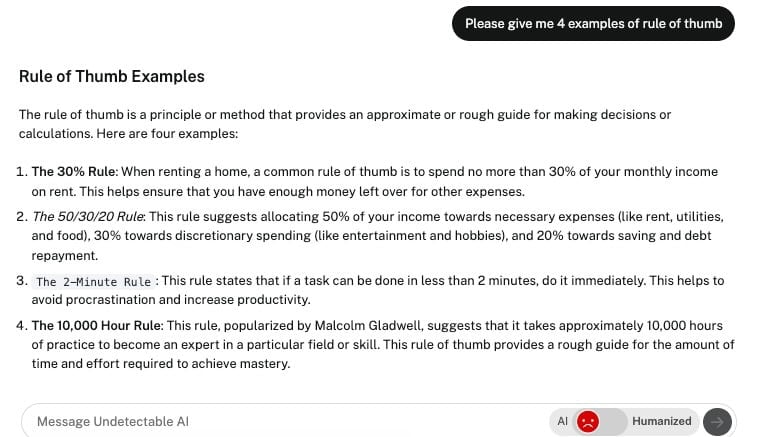
The 50/30/20 rule in personal finance, where you allocate 50% of your income to needs, 30% to your wants, and 20% to savings, is commonly implemented.
There are many, many other things that we are taught to just do out of habit that have become rules of thumb.
For example:
- Looking both ways before crossing the street
- Keeping a regular sleep schedule
- Breaking down big tasks into smaller chunks to improve your productivity
- Having a fruit and a vegetable at every meal to keep it healthy
And all of us choose to follow the rules of thumb that fit best with our goals. You can find many more examples through the Undetectable AI’s AI Chat.
How to Use Rule of Thumb in a Sentence
“Rule of thumb” is a noun phrase in which ‘rule’ and ‘thumb’ are nouns and ‘of’ is a modifier. It is most often paired with an article, and in most cases, you’ll use it with “a.”
Sometimes, the article “the” may also be used if a specific guideline is being talked about.
For example:
- “A rule of thumb is to double the recipe for larger groups.”
- “The rule of thumb for communication we follow at our workplace is to respond to all queries within 24 hours.”
As a noun phrase, it is used as the subject of a sentence with a singular verb, e.g. “A rule of thumb makes our decisions easy.” Note that the singular form of the verb with an -s (makes) is used.
The standard spelling for the phrase is not hyphenated, so the rule-of-thumb will not be grammatically very accurate.
The most frequent usage of the phrase happens in conversational English and in news and media writing. It is far less common in formal business documents or scientific writing.
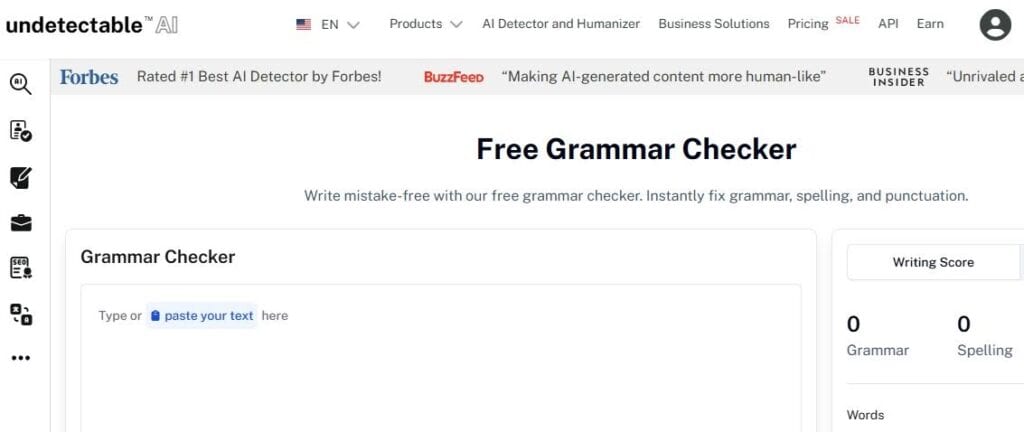
When you’re learning how to use ‘rule of thumb’ in your sentences, always make sure to run your text through Undetectable AI’s Grammar Checker to ensure that you’ve followed all these rules.
If you missed any, the tool will correct them for you, and you’ll also be able to learn from your mistakes in real time.
Tips and Common Mistakes
It is very common for English learners to have a hard time understanding the correct usage of idioms, and the ‘rule of thumb’ is no different.
Some people end up misusing it in situations where they also simultaneously mention an exact measurement.
For example, “The rule of thumb is to cook the steak for exactly five minutes,” is grammatically incorrect because you can’t use ‘rule of thumb’ and ‘exactly’ in the same breath.
A better way to phrase this sentence would be, “The rule of thumb is to cook the steak for about five minutes.”
You will sometimes incorrectly hear “the thumb rule” being used in the same sense. It is a non-standard version of the idiom, and it’s best that you stick to the grammatically and linguistically accepted form, ‘rule of thumb.’
You can always refer to the free Undetectable AI’s Paragraph Rewriter any time you write anything using the phrase. It will automatically provide you with another version with such details fixed in your text.
Practical Applications of Rule of Thumb
Now, let’s practice the practical application of the phrase ‘rule of thumb’ through example sentences:
- A rule of thumb for houseplants is to stick your finger roughly two inches into the soil before watering.
- The rule of thumb my grandmother swore by was never to lend money you couldn’t afford to lose completely.
- A rule of thumb in journalism is to verify your information through at least three independent sources before publishing anything remotely controversial.
- The rule of thumb at our bakery requires tossing anything that’s been sitting in the display case longer than eight hours.
- She seasons all her dishes gradually throughout the cooking process, and that’s a rule of thumb her culinary school instructor drilled into every student.
- As a rule of thumb, you should replace your toothbrush every three months.
- As a rule of thumb, my accountant advises setting aside thirty percent of freelance income for taxes.
- The landscape architect spaces trees at least fifteen feet from foundations and swears by that as a rule of thumb for preventing root damage in the future.
- As a rule of thumb, never send an angry email without sleeping on it first.
- The rule of thumb passed down through three generations of our family insists on never discussing politics at the dinner table.
Use the widget below to test our AI Detector and Humanizer!
Final Thoughts
The practical applications of ‘rule of thumb’ are not very difficult. You just need some practice to use it in your casual conversations.
Try to avoid it in formal situations because, well, as a general rule of thumb, we don’t include any idioms and metaphors in academic/professional writing to make communication as clear as possible (see what I did there!).
And use Undetectable AI’s Sentence Rewriter as you learn the usage of idioms. The grammar rules for idioms don’t really have a specific pattern, and you may have a hard time learning them all.
Therefore, a tool will be really handy until you become confident enough to recognize all the grammar patterns.
Check out Undetectable AI today!