
Satire is a common part of our daily conversations.
At some point, you’ve probably laughed at a Saturday Night Live sketch exaggerating a political figure, realizing how it feels better than the real press conference, or seen a viral tweet throwing shade at a celebrity, being so ridiculous it’s laughable.
Satire is definitely not just an Internet thing. It is a literary device being used for centuries to point out the flaws in society so that people realize they need a change.
Over time, satire became so common in classic literature that we started treating it as a genre in its own right.
In this article, I talk about what does satire mean, what are its types, how and where it is used, and how to get better at it.
You’re in for a ride!
Key Takeaways
- Satire is a literary device or a literary genre used to discredit a person, a trait, an organization, or a social vile with witty, subtle use of words.
- It is based on heavy opinions, which is what makes it a natural fit for political conversations, journalism, media, social commentary, etc. But it should not be used in academic and formal settings.
- Satire has three types, Harotian, Juvenalian, and Menippean, all named after ancient writers who had distinct writing styles. Literary satire is a genre of its own.
What Is Satire?
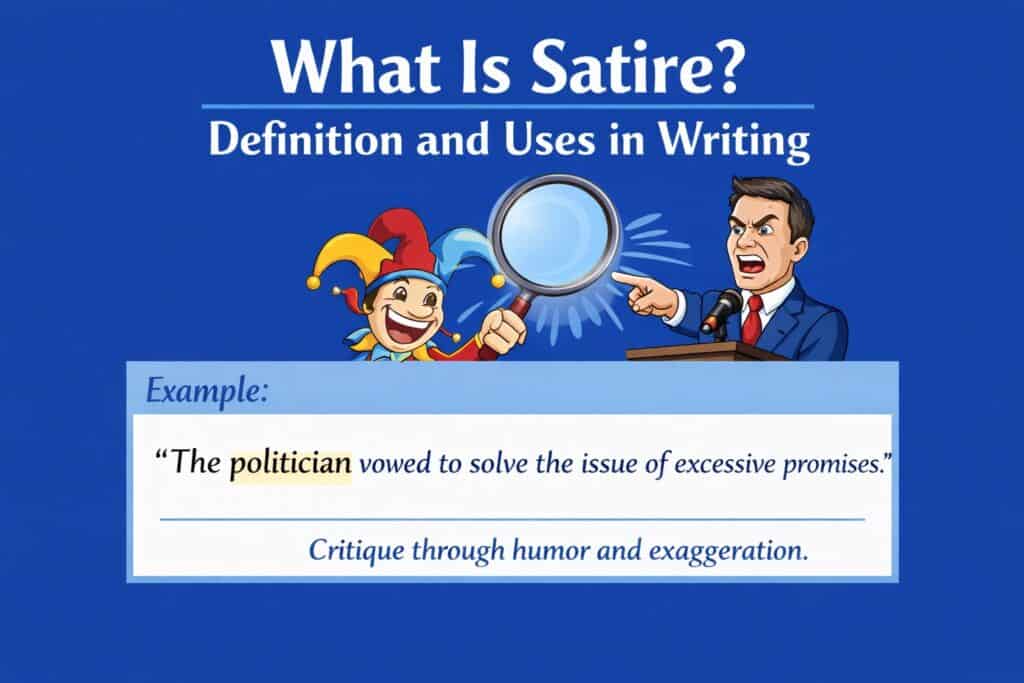
Merriam Webster describes satire as ‘wit, irony, or sarcasm used to expose and discredit vice or folly (as of a person, government, or society.’)
Wit, irony, sarcasm, all of these words describe intentional, clever use of words to discredit someone.
In simple terms, satire is humor that has a target. The target could be an individual, governments, social trends, or even entire cultures. It is best used in situations where you know that direct criticism will not be taken well.


Never Worry About AI Detecting Your Texts Again. Undetectable AI Can Help You:
- Make your AI assisted writing appear human-like.
- Bypass all major AI detection tools with just one click.
- Use AI safely and confidently in school and work.
On the surface, it sounds funny, light enough that people can laugh at it and move on. It is possible that you don’t even notice it right away, but later it clicks to you, ‘Oh. That’s what they meant!’
The Different Types of Satire
There are three different types of satire.
Horatian Satire

The Horatian satire is named after Horace, a famous Roman poet. It is the mildest form of satire.
It raises a point at the target (i.e., what the writer thinks is wrong) in a calm, humorous way, almost as if the writer says, “We all do it sometimes,” instead of accusing anyone directly.
You do not want to embarrass anyone for the mistake, just subtly make them realize it and have a laugh. It is used knowing that people have their flaws, but they can correct themselves if prompted to self-reflect.
You could say that Horatian satire does not attack anyone in a harsh tone. And naturally, the person at the receiving end does not end up defending themselves or getting angry at it.
It can be used for experiences common to everybody, like vanity, procrastination, laziness, social pretensions, etc.
Juvenalian Satire

The Juvenalian satire refers back to the Roman writer Juvenal. It is a lot harsher in tone compared to the Horatian satire.
Junenalian satire is emotionally charged because the person it is coming from is frustrated at certain issues and wants the reader to feel it too.
These issues could be experienced by a large population, but they are caused by someone in power.
For example, injustice, power abuse, and corruption are serious problems that affect a huge number of people, and you can not just address them with polite humor.
Therefore, it is more direct at the target and exposes them for their wrongdoings.
The most common targets of Junenalian satire are influential systems, like governments, courts, social systems, etc.
Menippean Satire

This type of satire is named after the Greek thinker Menippus.
What makes Menippean satire different from the other two is the fact that it is never targeted at individuals.
Rather, it criticizes ideas or ways of thinking that people believe in without ever questioning them, like blind optimism and fake intelligence.
The point of Menippean satire is to make the reader stop and question their beliefs. Beliefs that seem logical on the surface, but when you really think about them, you realize how hollow they are.
How Satire Depends on Context
Words alone are never sufficient to convey the real intention behind satire because this literary device is entirely context-dependent.
By context, I mean the shared assumptions between the writer and the reader that aren’t written down anywhere but are still somehow understood.
If we talk about sarcasm, for example, you would almost take it as a praise if you aren’t aware of the context it is said in. In the right context, sarcasm is supposed to mean the opposite of what the words literally translate to.
You just know that a co-worker saying, ‘Oh great, another meeting,’ does not mean they love being in the meetings because it’s common sense that too many meetings are hated.
One of the uses of satire is as irony, i.e., saying someone not in the literal sense, but to convey that the current situation is the exact opposite of what should logically happen.
Again, that contrast can only be understood if you’re aware of the context.
Similarly, satire can be humorous if said in a fun way while exposing the systems we are used to accepting without question.
The context behind satirical humor is that a trial was pushed far beyond normal limits, such that it has become ridiculous. You laugh at the thought of how bad it is.
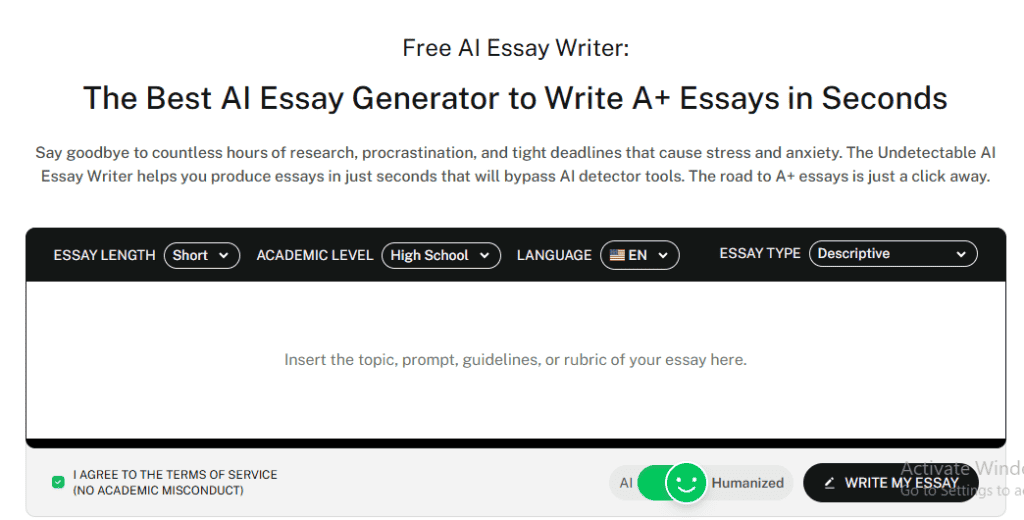
As a learner, you could lean on Undetectable AI’s AI Essay Writer to understand satire in different contexts.
Feed it a few literary pieces to understand how exactly the tone is ironic, and create some practice exercises for yourself to really nail down the satirical context.
You’ll eventually get better at recognizing it with practice.
Spoken vs. Written Satire
Spoken satire is part of our daily conversations, so much so that most of the time, we don’t even realize it. It naturally is part of the way we talk to others.
Again, using the example of a co-worker, if you hear someone say, ‘Yeah, because that worked so well last time, no thanks, we’re better off without this idea,” you don’t stop and think, ah yes, verbal irony at play! You just get it.
Plus, a huge contribution to verbal satire is through the way it is communicated. You’d just get it from the tone of the speaker, the facial expressions they make, their raised eyebrows, etc.
Written satire is deliberate. Very deliberate. Before using it, the writer would have to build a context because you can’t expect a reader to get it if it’s used in the first sentence in a novel.
But, it’s been so widely used in literary works that we now consider satire a separate genre in literature.
Some examples of written satire, as in classic literature, include:
- Gulliver’s Travels
- Candide
- Animal Farm
- A Modest Proposal
- Catch-22
- American Psycho
And the list can go on and on.
Casual use of written satire is usually for opinions. You’d very frequently see it being used in politics and journalism without the writer being overly aggressive.
Due to it being opinion-driven, it usually isn’t used in academic or formal writing since they require you to be neutral.
Where Satire Is Commonly Used
It should be clear to you by now that satire is primarily opinion-driven, i.e., it is someone reacting to a situation and questioning it rather than sharing an established fact.
Now, industries that are heavily based on opinions rather than facts and stats are the prime opportunities to use satire.
For instance, it’s almost impossible that you listen to a political conversation without the opponents throwing shade at each other’s unfulfilled promises.
The audience is also very well aware of the injustice that they have been through, so they get the context instantly.
The most frequent uses of satire are in:
- Politics
- Journalism
- The media industry
- Entertainment
- Social commentary
- Television, e.g., film, stand-up comedy, cartoons
Fun fact, the American media company, The Onion, literally only publishes satirical articles on real events through fake, uncomfortably believable ones.
Satire usually isn’t used in academic or formal writing since they require you to be neutral. Your arguments have to be explicitly based on facts and stats because there’s no room for context-dependent understanding in such settings.
You must be as clear as possible.
Using Satire Intentionally
We all may sound sarcastic at times if we are really frustrated at something, and the situation doesn’t allow for overt expression. But intentional use of satire is very different.
Before anything else, you need to have a very strong opinion about the issue you’re writing or speaking about. Spoiler alert, it is not for the neutrals!
Now, good satire uses words that mean exactly the opposite of what you mean. As in, praising something you clearly disapprove of, or saying that you’re impressed by something that’s obviously foolish.
It is upon the reader to understand the reversal of meaning. The audience needs to understand the issue well enough to realize that your words are not to be taken literally.
Think of one vile, one characteristic or event that you have an opinion on, and over-exaggerate it so much that the reader can’t ignore it and move on.
Make it sound so obviously ridiculous that people have no choice but to notice how unreasonable it already was to begin with.
Intentional use of satire can also include allegory. An allegory is a story that can be read in two ways at once, i.e., it has a literal meaning, which is complete on its own, and a hidden meaning that symbolizes a political or social situation.
It is best for situations when you know that direct criticism will be too confrontational. You don’t expect everyone to get it too, only those who think about it critically will understand it.
Any use of satire requires a background context to be established first. In writing, don’t use it in the first thing you think of, rather, build the atmosphere so that your readers really understand your intention.
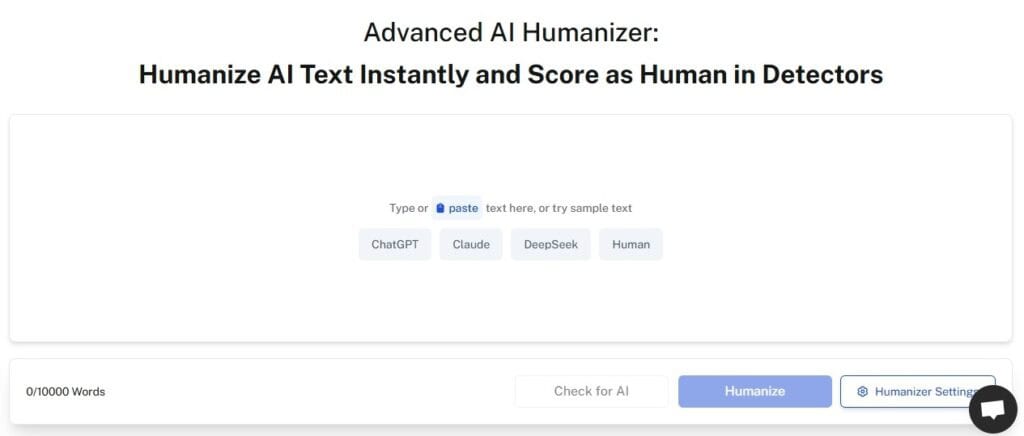
And don’t forget to use Undetectable AI’s AI Humanizer to tone down your satire and prevent an overly harsh tone that may get you in trouble.
Discover our AI Detector and Humanizer in the widget below!
Conclusion
Writing good satire is no easy feat because there’s no support of tone and raised eyebrows on paper compared to verbal satire.
You have to build the background context first, clearly enough that the reader understands the real weight of your words.
It takes practice, a lot of it. Therefore, learners should take advantage of Undetectable AI’s Ask AI, feed it some examples of well-written satire from the literature, and actually understand how it is written.
Study the techniques and apply the tips we discussed today, experiment with tone, and you’ll eventually get there.
Check out Undetectable AI today!