
As a student or researcher dealing with loads of papers and articles, you must have been hard-pressed to outline them into clear summaries that capture key ideas accurately.
Understandably, there are tools out there offering summarization features, and SciSummary is one of such tools.
In the relentless flood of scientific literature and groundbreaking papers piling up faster than you can read, SciSummary AI has emerged as a game-changer, promising researchers summaries they can trust.
However, before you open your wallets, read our SciSummary review and be informed if it’s worth your time and money.
Key Takeaways
- SciSummary is a science-oriented AI summarization tool that summarizes complex academic research papers into simplified and accessible summaries.
- Users can create a library of their summaries based on the projects they’re working on.
- SciSummary has a 7-day free trial and a $6.99/month or $34.99/year premium tier.
- SciSummary allows users to send papers via email to get them summarized and receive them when they’re processed.
What Is SciSummary?
SciSummary is an AI-powered platform that automatically summarizes your scientific research papers and academic articles into easy-to-understand summaries that capture key findings, methodologies, and conclusions.
Most of all, SciSummary AI uses specialized AI models that zero in on scientific niches.
This enables SCiSummary to grasp science jargon that stumps general AI summarizers, thereby preserving the summarized paper’s essence without slog.


Never Worry About AI Detecting Your Texts Again. Undetectable AI Can Help You:
- Make your AI assisted writing appear human-like.
- Bypass all major AI detection tools with just one click.
- Use AI safely and confidently in school and work.
Naturally, this has made it a godsend for grad students cramming lit reviews or professionals sifting through journals.
As a result, academics will find it easier to stay current with rapidly growing fields and conduct efficient literature reviews.
Feature Highlights of SciSummary
Although SciSummary, on the surface, looks like an AI tool primed just for summarization, it goes further, offering a suite of intelligent features designed to enhance your research workflow.
These features include:
- Summarize with Structure
SciSummary creates specialized summaries by breaking down complicated and dense academic papers into a logical structure.
The AI identifies and preserves key sections from the abstract and methods, and generates a conclusion. In the end, you get organized summaries that mirror the original paper’s framework.
This structured approach ensures you understand what the research found and arrive at the conclusion.
Furthermore, SciSummary AI gives users more research leeway with their bulk paper summarization and synthesization. You then get multiple papers summarized and compared in a single summary.
- Curate Your Library
On the flip side, if you’re working on multiple projects, you can build and organize your personal research repository within SciSummary the way you want and can understand.
This library feature makes SciSummary more than a summarization tool, as you now get to create your knowledge management system and keep all your research insights accessible in one centralized location.
- Chat with Figures
This is perhaps one of SciSummary’s most innovative features. It enables you to interact directly with charts and data visualizations from research papers.
Once you ask questions about specific figures, you actually get interpretations you can use.
In the long run, you can explore the implications of visual results through natural conversation with the SciSummary AI, making complex data analysis more intuitive and accessible.
- Podcast Generator
You don’t have to restrict yourself to texts anymore. You get to turn your paper summaries into engaging podcasts that you can listen to during commutes or while conducting lab work.
This is perfect for multitasking researchers and an innovative way to stay current with literature when reading isn’t practical.
- Presentation Generator
SciSummary can generate presentation slides from scientific papers for you. If you’re a professor, this will come in handy when you need visual elements and structured talking points for lectures.
Therefore, you save hours of manual slide creation for seminars and professionals delivering research updates to their teams.
How Does SciSummary Work?
SciSummary operates through a streamlined AI-driven pipeline that breaks down scientific papers in moments.
However, at its core, SciSummary AI incorporates specialized large language models (LLMs) and natural language processing (NLP) algorithms that have been trained on millions of peer-reviewed papers from different scientific disciplines.
Unlike generic AI summarization tools, SciSummary’s models can easily understand complex technical terminology and mathematical equations.
To give you the summaries, the system uses transformer-based architectures that can process lengthy documents while maintaining context throughout.
The resulting summaries then accurately capture the nuances in the research.
How It Works in Practice
The SciSummary platform works quite intuitively. Users get several input methods to upload papers.
They include:
- Uploading new files
- Adding links to articles
- Adding the raw text
- Searching the paper’s database
- Adding the PubMed ID, and
- Importing from Zotero.
They also give an email method for users who want a more flexible arrangement. With the email method, you can send the articles you want summarized directly to SciSummary LLC.
You can include any of the following file formats in the email:
- PDF attachment
- Article URL
- Article text in email.
Once you’ve submitted the paper, the SciSummary AI then analyzes the document’s structure and identifies key sections.
Within minutes, you get an AI-generated summary that highlights research questions, methods used, main findings, and the significance of the work.
SciSummary users can receive their summaries via email if they wish or through their dashboard. They can also request revisions and save the summary to their curated library for future reference.
User Reviews Of SciSummary
SciScummary provides users with summaries; however, it lacks an AI detector or humanizer to give its content a more natural touch.
Nevertheless, we conducted a test on the platform to compare its output with ours.
We used ZDNet’s strict testing strategy, which found our AI detector to be one of the best AI detectors out there with a 100% accuracy rate.
So, for the test, we gave the SciSummary AI a scientific text to summarize. The summarization wasn’t quick.
This implies that the larger the text, the slower the summarization process.
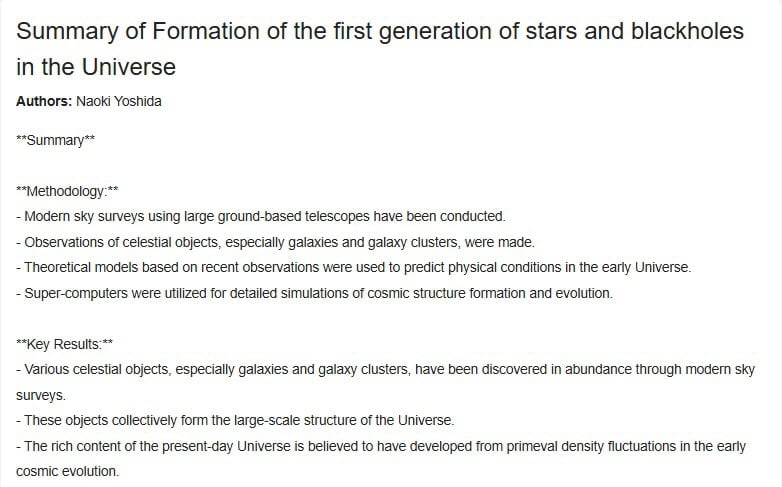
We ran the summary result through our AI detector, and the result came back with a disappointing 89% AI probability.
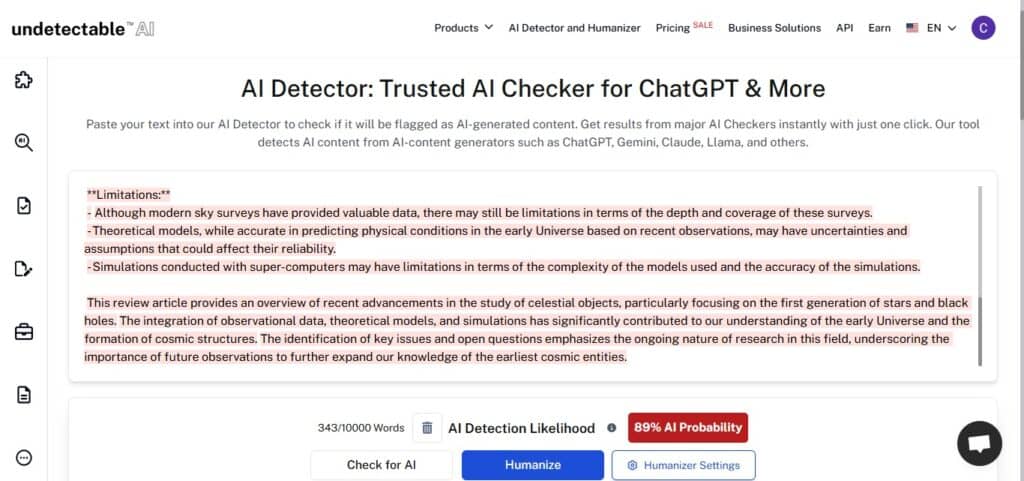
This result shows that SciSummary’s output can not be used in academic spaces lightly, as institutions use advanced AI detectors to check submissions.
If you were to use SciSummary for your literature review and to synthesize papers, then you’re going to run into issues.
The best way to avoid this is to use our AI Detector and Humanizer. It’ll help you verify if your content is AI or human.
Even if the result shows a high AI score, you can easily get it rewritten with our humanizer and avoid getting your academic integrity questioned.
Advantages and Disadvantages of SciSummary
Like any tool, SciSummary AI comes with its own set of strengths and limitations.
Nevertheless, you’ll get to make an informed decision from our compiled overview of what SciSummary LLC does exceptionally well and where it might fall short.
| Advantages | Disadvantages |
| It condenses hours of reading into minutes, allowing researchers to review multiple papers quickly. | It could occasionally oversimplify intricate theories and nuanced methodologies in highly theoretical papers. |
| It handles papers across various scientific fields, from biology to physics to social sciences. | Although it has a free trial, the platform relies on paid plans for unlimited use. The free tier limits summaries and frustrates heavy users. |
| SciSummary maintains the paper organization. This makes it easy to locate specific information like methodology or results. | It focuses mostly on providing summaries. As an academic summarization tool, it doesn’t evaluate study quality, methodology flaws, or potential biases. |
| The platform offers innovative features beyond basic summarization. | Users can’t fully trust the summaries, as SciSummary gives users a disclaimer that their AI-generated content is not always entirely accurate. For this reason, you have to always verify critical information against the exact paper before using it. |
| SciSummary users can use the built-in organization tools to maintain their personal knowledge base and summaries. | Some of SciSummary’s advanced features may require time to master for optimal use. |
| It makes dense scientific literature accessible for students and non-specialist professionals. | SciSummary doesn’t have access to every academic database, especially those behind paywalls and private domains. Hence, users have to upload quality documents; otherwise, it may yield suboptimal results. |
SciSummary vs Competitors
The AI-powered research summarization space is becoming increasingly crowded.
Although SciSummary has carved out a strong position in this market, numerous platforms are vying to become researchers’ go-to tool. Here are SciSummary’s competitors and how they stack up against it.
Scholarcy
Scholarcy is one of the most established players in the academic summarization space, offering users digestible flashcard-style summaries of academic papers.
It excels at extracting key information into structured cards.
This platform has a significant advantage over SciSummary in its advanced data handling.
Scholarcy integrates well with reference managers like Zotero and Mendeley, making it ideal for researchers who already use these tools.
However, compared to SciSummary, Scholarcy’s interface can feel more utilitarian, although its pricing is competitive.
SciSpace
SciSpace, formerly known as Typeset, positions itself as a broad research ecosystem with an all-in-one AI research assistant that prioritizes deep comprehension and an integrated research workflow.
Importantly, SciSpace’s standout feature is its ability to explain complex concepts and mathematical equations in simple language through highlighting and asking questions.
Although it’s broader in scope than SciSummary, the SciSpace deep review feature helps researchers find connections and compare findings across multiple papers.
This versatility can make it feel less specialized for pure summarization tasks.
HeyScience
HeyScience takes a unique approach by focusing on daily research updates and personalized paper recommendations based on your interests.
The tool is highly efficient at providing a quick snapshot of ongoing projects and researcher contributions within a specific field.
Subsequently, its main focus is on accelerating the entire literature review process so you get to search effortlessly through millions of publications and synthesize results in minutes rather than weeks.
It goes further by delivering relevant papers directly to your inbox with AI-generated summaries.
This proactive discovery model sets it apart from SciSummary’s on-demand summarization approach.
For researchers who prefer curating their own reading list rather than receiving automated suggestions, SciSummary’s model may feel more controllable.
ChatPDF
Now, if you need a more interactive feature than just summarization, then ChatPDF is the tool for you.
It brings conversational AI to document analysis, allowing users to chat with any PDF as if having a conversation with the document itself.
ChatPDF’s strength lies in its simplicity and question-answer format, making it highly accessible for quick queries about specific paper sections.
However, ChatPDF isn’t specialized for scientific literature, which means it lacks the scientific training that makes SciSummary particularly adept at handling technical jargon and research structures.
Quillbot
Quillbot is primarily known as a paraphrasing and rewriting tool that happens to include a powerful summarizer.
In spite of this, Quillbot is better designed for general content than scientific papers specifically.
Yet, Quillbot’s advantage is that users get summarization alongside grammar checking and writing enhancement tools.
However, it works well as a multipurpose writing assistant, but researchers seeking deep scientific summarization with features like figure interaction and structured academic summaries will find SciSummary more purpose-built for their needs.
Can SciSummary Detect AI-Edited or Paraphrased Text?
No, SciSummary cannot detect AI-edited and even paraphrase text since the platform doesn’t have a dedicated AI detector.
The lack of an AI detector has severely limited SciSummary’s ability to meet most academic users’ needs.
In that case, you can consider using our AI Chatbot to get your scientific questions answered while getting humanized answers.
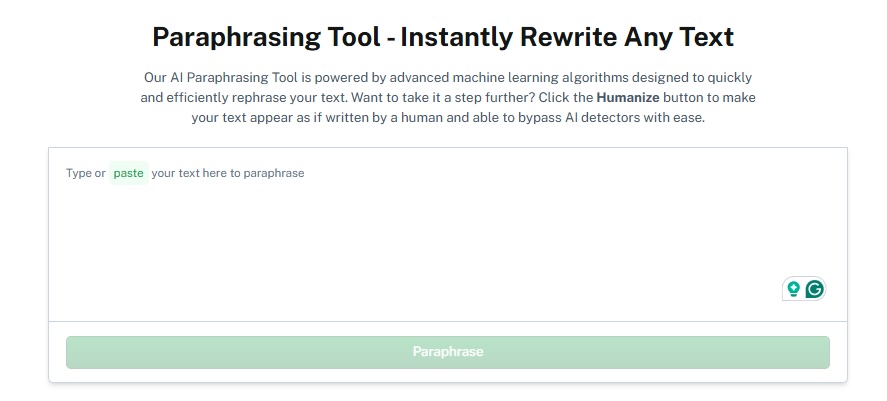
More so, for paraphrasing, you can use our AI Paraphrasing tool to edit AI-generated content from SciSummary and confidently evade AI detection.
Start refining your text with our AI Detector and Humanizer below!
Conclusion
SciSummary works well as an AI summarizer with its affordable pricing and free trial. Beyond summarization, it also offers great side features that gamify the experience.
From our assessment, SciSummary is not a breakthrough AI tool, as its results are replicable via other tools.What makes it stand out is its scientific AI models, yet there are competitors in that space as well.
So, it’s worth paying for due to its affordability.
Nonetheless, you’ll need our AI Detector and Humanizer to make the tool’s output bypass academic AI detectors.
Make every AI-generated text pass as human with Undetectable AI.