If you’re searching for an honest scribbr ai detector review before you trust it with your grades, your job, or your client’s content, here’s the short answer: Scribbr is reliable when text is obviously AI-generated, but it struggles once that text has been edited or refined by a human.
In one of our tests, it scored a heavily AI-edited essay as 0% AI, a result that should have raised a flag.
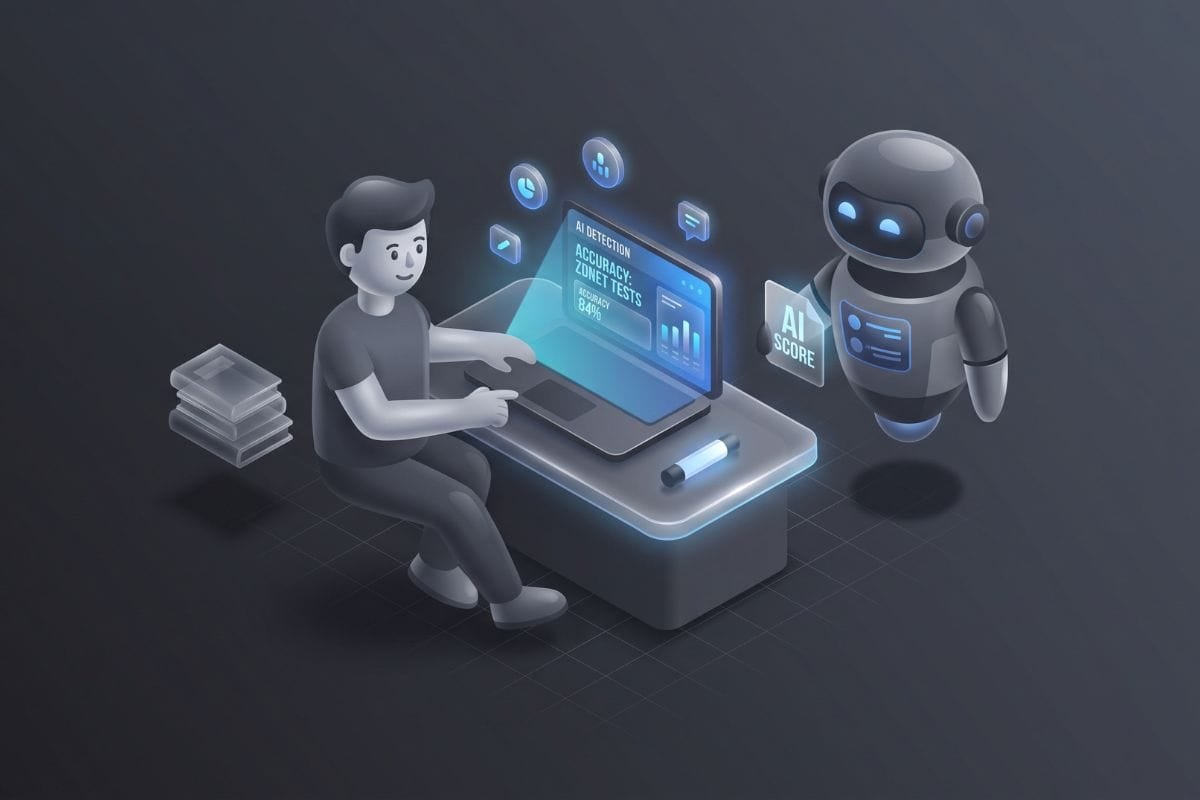
According to ZDNet’s independent benchmark of 10 AI detectors, Scribbr’s premium tool landed at 84% accuracy. That’s a solid number for a free-to-start tool, but it also means roughly 1 in 6 samples gets misread. So treat Scribbr’s score as a first-pass signal, not the final word.
This review breaks down what Scribbr actually does, how it performed in our own head-to-head test against ChatGPT-generated and AI-edited content, where it falls short, and how it stacks up against GPTZero, Originality.AI, Copyleaks, and Undetectable AI.
Let’s dive in.
Key Takeaways
- Scribbr AI Detector gives paragraph-level feedback and works across multiple languages, including English, German, French, and Spanish.
- It’s built for academic use. It’s solid at flagging obviously AI-generated writing but weak at catching AI-edited human writing.
- In our test, Scribbr scored an AI-edited essay as 0% AI when it should have flagged it. Undetectable AI caught the same text at 95%.
- Scribbr’s premium tier hit 84% accuracy in ZDNet’s independent testing, while the free version has real limits on which AI models it can catch.
- If you need a second opinion or want to rewrite flagged content, Undetectable AI offers both detection and humanizing in one tool.
What Is the Scribbr AI Detector?
Scribbr AI Detector is a detection algorithm built to identify whether a piece of text was generated or refined using artificial intelligence. It analyzes text produced by tools like ChatGPT, Gemini, and Copilot.
What sets it apart from a basic yes-or-no checker is its paragraph-level feedback. Instead of giving you one score for the whole document, it points to specific sections that may be AI-generated, AI-refined, or fully human-written.
Educators, students, researchers, and content creators use it to verify originality before submitting or publishing work. It also supports detection in multiple languages, including English, German, French, and Spanish, which is more than most free detectors offer.


Never Worry About AI Detecting Your Texts Again. Undetectable AI Can Help You:
- Make your AI assisted writing appear human-like.
- Bypass all major AI detection tools with just one click.
- Use AI safely and confidently in school and work.
Key Features of Scribbr AI Detector
Scribbr has built out a handful of features that explain why it keeps showing up on detector comparison lists.
- AI Text Detection: Scans your text and returns a percentage score estimating the likelihood it was produced by AI.
- Detailed Content Analysis: Goes beyond a single label. It can flag content as fully AI-generated, AI-refined, human-written but AI-polished, or purely human-written.
- Paragraph-Level Feedback: Highlights the specific sentences or sections driving the score, so you know exactly what to revise.
- Privacy Assurance: Scribbr states it doesn’t store submitted text, which matters if you’re checking unpublished drafts or student work.
- Integration with Other Academic Tools: Works alongside Scribbr’s plagiarism checker, grammar checker, and citation generator, which is useful if you’re already using those for academic writing.
How Does the Scribbr AI Detector Work?
Scribbr’s detector runs on natural language processing (NLP) and machine learning models trained on large sets of both human-written and AI-generated text. That training lets it recognize patterns that show up more often in AI writing than in human writing.
Specifically, it looks at word choice patterns, sentence structure consistency, and overall stylistic uniformity.
AI-generated text tends to be more even and predictable across these markers than human writing, which naturally varies more in rhythm and word choice. Based on that analysis, the tool returns a confidence score estimating how likely it is that the text came from an AI system.
Scribbr Free vs. Premium: What Actually Changes
Scribbr’s free and premium tiers aren’t just about a paywall. There are real differences in what each version can actually catch, and this is the part most reviews skip.
| Free Version | Premium Version | |
|---|---|---|
| Models detected | GPT-2, GPT-3, GPT-3.5 | Adds GPT-4 and newer models |
| Accuracy | Lower; more likely to miss edited or newer AI text | Around 84% in independent testing |
| Sign-up required | No | Yes, paid subscription |
| Best for | Quick, low-stakes checks | Anyone submitting work where a false result has real consequences |
If you’re checking a student paper or a piece written recently, the free tier’s blind spot on GPT-4 content is worth knowing before you rely on a 0% score.
If the stakes are real, whether that’s a grade, a job, or a client deliverable, the premium version is the one that’s actually built to catch current AI models.
Is the Scribbr AI Detector Accurate?
Here’s the honest answer: it depends heavily on what kind of AI content you’re feeding it. To find out for ourselves, we ran a direct test rather than relying on marketing claims.
The Test
We generated content with ChatGPT and ran it through both Scribbr and Undetectable AI’s AI Detector to compare accuracy. We also ran a second sample: human-written text that had been lightly polished by AI, which is a much harder case for any detector to catch.
The Results
Cover Letter (fully ChatGPT-generated):
- Scribbr AI Detector Score: 100% AI. Accurate.
- Undetectable AI Score: 99% AI, with a 1% margin of error.
Essay Excerpt (human-written, then AI-edited):
- Scribbr AI Score: 0% AI. This is flawed. The text had been visibly reworked by AI.
- Undetectable AI Score: 95% AI likelihood, which better reflects what actually happened to the text.
Scribbr does well on content that’s fully AI-generated. It’s the AI-edited, human-originated text where it falls short, and that’s exactly the kind of writing most people are trying to catch or avoid getting flagged for.
Where Scribbr Gets It Wrong
Based on our testing and third-party benchmarks, Scribbr’s failure mode is consistent: it’s much better at spotting AI content from scratch than AI content layered on top of human writing.
- False negatives on edited text. Text that started as human writing and was cleaned up, rephrased, or expanded by AI can slip through as 0% AI, as it did in our essay test.
- Model coverage gaps on the free tier. The free version doesn’t reliably catch GPT-4 or newer models, so recent AI writing may score lower than it should.
- Short text is harder to judge. Like most detectors, Scribbr’s confidence drops on shorter passages where there isn’t enough text to establish a pattern.
If you’re relying on a single “0% AI” result to prove authorship, that result alone isn’t strong enough evidence, especially with lightly edited text.
How to Use Scribbr AI Detector (Step by Step)

Using Scribbr itself is straightforward.
Here’s the process from start to finish:
- Go to the Scribbr AI Detector page. No sign-up is needed for the free version.
- Paste your text into the input box. There’s a character limit, so longer documents may need to be checked in sections.
- Click “Detect AI” and wait a few seconds for the scan to complete.
- Review the overall percentage score, which estimates the likelihood the text is AI-generated.
- Check the paragraph-level breakdown to see which specific sections are driving that score.
- If you want a second read, especially on anything scored as human-written but that you suspect was AI-assisted, run the same text through a second tool before drawing conclusions.
What to Do With Your Score
Scribbr doesn’t just give you one number. It breaks results into four categories: fully AI-generated, AI-refined, human-written but AI-polished, and purely human-written.
Knowing what each one actually means helps you respond correctly.
- Fully AI-generated: The text closely matches patterns typical of AI output start to finish. If this wasn’t your intent, a rewrite is likely needed.
- AI-refined: Original human writing that’s been noticeably smoothed, restructured, or expanded by AI. This is the category Scribbr is most likely to underscore or miss entirely.
- Human-written but AI-polished: Light AI involvement, such as grammar or phrasing tweaks. Usually lower risk, but worth knowing if your institution or client has strict AI-use policies.
- Purely human-written: No significant AI markers detected.
If you get flagged and believe it’s wrong, keep your drafts, outlines, or version history handy as evidence. It’s also worth running the text through a second detector before assuming the first score is final, since no single detector is right 100% of the time.
Scribbr AI Detector vs. Undetectable AI
After running both tools through the same test, a few clear differences stand out.
| Scribbr AI Detector | Undetectable AI | |
|---|---|---|
| Purpose | Built for academic integrity and plagiarism prevention. | Detects AI content and rewrites it so it reads as human-written, built to bypass detectors like Turnitin, GPTZero, and Scribbr. |
| Function | Used mainly by universities and students to check work against models like ChatGPT. | Built for content creators, marketers, and students using tools like Claude, ChatGPT, and Jasper. |
| Accuracy | Reliable on obvious, unedited AI text. ZDNet’s independent testing put Scribbr’s premium detector at 84% accuracy. | ZDNet’s same benchmark found Undetectable AI’s detector 100% accurate across the tested sample, and our own testing shows a consistent 90 to 100% range. |
| Performance | Breaks results into a 0 to 100% AI score with a category breakdown. | Most detectors lose accuracy against text humanized by Undetectable AI, with a 95 to 98% bypass rate. |
| Ease of use | Paste text, click “Detect AI,” get a score in seconds. | Paste text, click “Check for AI,” see which tools would flag it, then optionally humanize it instantly. |
Scribbr vs. GPTZero vs. Originality.AI vs. Copyleaks
Scribbr isn’t the only academic-leaning detector out there. Here’s how it compares to three other commonly used tools.
| Scribbr | GPTZero | Originality.AI | Copyleaks | |
|---|---|---|---|---|
| Best for | Students, educators | Educators, general users | SEO writers, agencies, web publishers | Institutions using LMS platforms |
| Free tier | Yes, limited | Yes, limited | No, paid only | Limited trial |
| Character limit | Moderate | 5,000 characters per scan | Higher, credit-based | Moderate |
| Plagiarism check included | Separate tool | No | Yes, built in | Yes, built in |
| Known weakness | Misses AI-edited human text | Misfires on short or heavily edited content | Credit system can get costly | Primarily built for institutional use |
Alternatives to Scribbr AI Detector
If Scribbr’s results didn’t fully convince you, or you just want to compare, here are the main alternatives worth trying:
- Undetectable AI Detector and Humanizer: Rigorous testing puts this at 100% accuracy for AI detection, and it also lets you humanize flagged text in seconds, making it one of the few tools that solves both sides of the problem.
- GPTZero: A natural alternative if you want something similar to Scribbr but more detailed. It can misfire on short or heavily edited content, and it’s capped at 5,000 characters per scan.
- Originality.AI: Combines AI detection with plagiarism checking, which makes it a favorite for web publishers and agencies. It’s paid-only and credit-based, but many users find it worth the cost.
- Writer.com AI Content Detector: Simple, free, no sign-up needed. It’s not very accurate on sophisticated or edited AI content, but fine for a quick, low-stakes check.
- Copyleaks AI Content Detector: Integrates well with LMS platforms and Turnitin, which makes it popular with schools and corporate teams. Similar probability-score format to Scribbr.
- Turnitin AI Detection: One of the most established names in plagiarism and AI detection, deeply built into academic workflows. The catch is it’s only available to institutions, not individuals.
Frequently Asked Questions About Scribbr AI Detector
Is Scribbr free to use?
Yes. The free version lets you check text for AI content without signing up. The premium version adds broader model coverage and higher accuracy for anyone who needs more reliable results.
How accurate is Scribbr’s AI detection tool?
In ZDNet’s independent benchmark testing, Scribbr’s premium detector reached 84% accuracy. It performs well on clearly AI-generated text but is less reliable on AI-edited human writing, as shown in our own test above.
Can Scribbr detect GPT-4?
The free version is limited to detecting GPT-2, GPT-3, and GPT-3.5 content. GPT-4 and newer models are only reliably detected through the premium version, so a “0% AI” result on the free tier for recent AI writing shouldn’t be taken as final.
What’s the difference between Scribbr’s free and premium AI Detector?
The free version covers older AI models and offers a basic score. Premium adds detection for newer models like GPT-4 and comes with the higher accuracy rate reported in independent testing.
Does Scribbr flag paraphrased or lightly edited text as AI?
Not consistently. Our test showed an AI-edited essay scoring 0% AI, which means lightly edited or paraphrased AI content can slip through undetected.
Can Scribbr detect content from Claude, Gemini, or other non-ChatGPT models?
Scribbr’s detection isn’t limited to one AI model, but its accuracy varies by model and version, similar to most detectors on the market. Content from newer or less common models may be harder for it to catch reliably.
Does Scribbr integrate with Turnitin or LMS platforms?
Scribbr operates as a standalone tool alongside its own suite of academic products, like its plagiarism checker and citation generator. It doesn’t have the same direct LMS integration that tools like Copyleaks offer.
Is a high Scribbr AI score proof of academic dishonesty?
No. A high score is a signal, not proof. False positives happen, and institutions should treat any AI detection score as one piece of evidence rather than a final verdict. Keeping drafts or version history is the best way to support your case if you’re flagged.
What happens if you’re falsely flagged?
Provide evidence of your writing process, such as drafts, outlines, or version history. It’s also worth checking your text with a second detector to see if the result holds up, since no single tool gets it right every time.
Conclusion
Scribbr has earned its place among academic AI detectors, and it does a solid job flagging text that’s obviously AI-written. But its accuracy drops once AI has only lightly touched a piece of human writing, and that’s the exact scenario most people actually need to catch.
If you want a second opinion or need to clean up flagged content instead of just identifying it, try Undetectable AI’s AI Detector and AI Humanizer to double-check your results and rewrite anything that needs it.