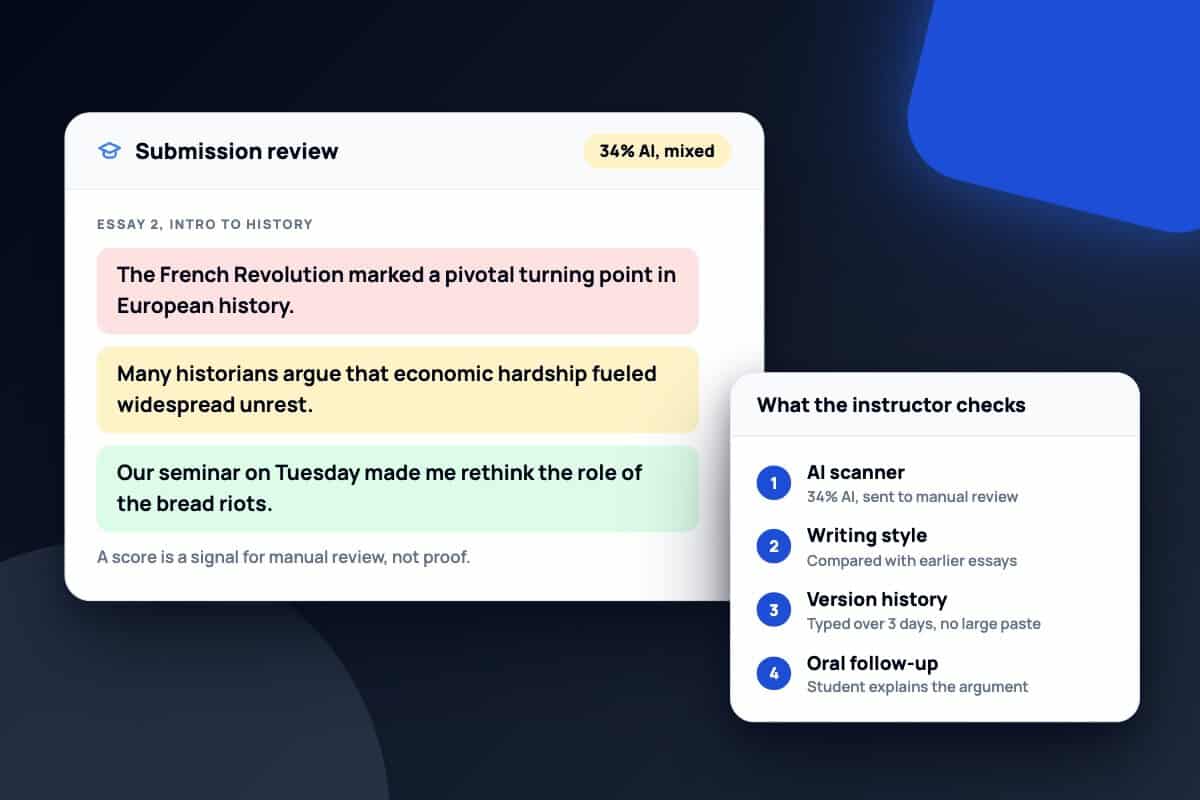
Yes, but not reliably, and if you are wondering can colleges detect chatgpt, that gap in reliability is where the real problems start.
While over 70% of higher education institutions employ automated scanning tools like Turnitin, Copyleaks, or GPTZero, independent benchmarks consistently show false-positive rates between 1% and 5%, alongside massive false-negative rates when AI content is lightly edited or polished.
In practice, this margin of error has left innocent students fighting unfair academic integrity accusations, while leaving professors struggling to separate authentic student voices from machine-generated prose.
This comprehensive guide covers how automated AI detection works in higher education, which tools universities actually use, why major research institutions are turning off AI software, how academic assessment is changing, and what to do if you face a false accusation.
Let’s dive in.
Key Takeaways
- Colleges use detection software, but it is far from perfect. Tools like Turnitin and Copyleaks are integrated into learning systems, but they generate frequent false positives (wrongfully flagging human work) and false negatives (missing edited AI text).
- Human review and stylometrics carry the most weight. Professors rely primarily on personal knowledge of a student’s previous writing, structural anomalies, and source verifications rather than raw software scores.
- Over 50 major universities have disabled or restricted AI detectors. Top institutions like Vanderbilt, Yale, Johns Hopkins, and Northwestern have turned off or restricted automated AI detection due to accuracy flaws, privacy concerns, and equity bias against non-native English speakers.
- Assessment models are shifting away from passive essays. Colleges are moving toward viva-style oral defense exams, tracked Google Docs version histories, in-class bluebook essays, and transparent AI-assisted drafting portfolios.
- Responsible AI usage requires transparency. Students can protect their academic standing by using AI strictly for brainstorming or outlining, maintaining edit logs, following institutional policies, and humanizing their final text.
Is ChatGPT Detectable?
ChatGPT and modern large language models generate fluid, highly coherent text. While this opens up massive learning possibilities, it poses a central challenge for universities seeking to evaluate individual student competence.
Most AI detectors used by colleges rely on two primary statistical metrics to flag AI-generated text:
- Perplexity: A measure of word choice randomness and unpredictability. Human writing tends to have high perplexity (unpredictable vocabulary choices), whereas AI language models select the most statistically probable next word (low perplexity).
- Burstiness: The variation in sentence structure and length across a piece of writing. Humans naturally mix short, punchy sentences with complex, multi-clause thoughts. AI models tend to generate uniform, monotonous sentence structures.
The fundamental flaw is that disciplined human writers, non-native English speakers, and structured academic papers often exhibit low perplexity and low burstiness naturally. As a result, software frequently misidentifies genuine human effort as machine output.


Never Worry About AI Detecting Your Texts Again. Undetectable AI Can Help You:
- Make your AI assisted writing appear human-like.
- Bypass all major AI detection tools with just one click.
- Use AI safely and confidently in school and work.
Which Detectors Do Colleges Actually Use?
Universities do not rely on a single uniform system. Software choices depend on budget, existing Learning Management System (LMS) contracts, and faculty preference.
| Tool | Adoption Level | LMS Integration | Known Limitations | Notable Actions by Institutions |
| Turnitin AI Indicator | High (~70% of US/UK colleges) | Direct (Canvas, Blackboard, Brightspace, Moodle) | High false-positive rate on non-native English prose; struggles with lightly edited AI text. | Disabled or restricted by Vanderbilt, Yale, Johns Hopkins, Northwestern, and Waterloo. |
| Copyleaks | Moderate | Direct (Canvas, Moodle, Brightspace, Schoology) | Sensitive to formal formatting; often flags standard academic templates as AI. | Used widely in business and professional graduate programs. |
| GPTZero | Moderate (Individual faculty level) | Limited API/LMS integration; mostly web app based | Prone to false flags on short text excerpts (under 300 words). | Frequently used as an informal secondary check by individual professors. |
| Originality.ai | Low (Higher Ed) / High (Web Publishing) | Web-based API / Chrome Extension | Extremely aggressive detection algorithms designed for SEO content; heavy false-positive rate on formal essays. | Rarely adopted institutional-wide due to strict scoring parameters. |
| Canvas / LMS Native logs | Universal | Built-in | Does not scan text directly; tracks user activity, browser focus, and rapid copy-pasting into submission boxes. | Enabled across nearly all digital assignment portals. |
How Many Colleges Use AI Detection?
Automated AI detection adoption grew rapidly following the initial launch of ChatGPT, with up to 75% of North American universities enabling Turnitin’s AI feature upon release. However, widespread accuracy issues triggered a significant institutional pushback.
Over 50 major universities worldwide have formally disabled, restricted, or prohibited automated AI detection software.
- Vanderbilt University: Disabled Turnitin’s AI tool after determining that even a 1% false-positive rate would falsely accuse hundreds of innocent students every semester across tens of thousands of paper submissions.
- University of Waterloo: Deactivated AI detection tools following internal benchmark tests where fully human-written papers were repeatedly flagged as 100% AI-generated.
- Johns Hopkins University: Moved to an advisory-only stance, strictly banning professors from using software flag scores as primary evidence in academic misconduct charges.
- Northwestern University & Yale University: Turned off institutional Turnitin AI modules, directing faculty to evaluate authentic student work through process-based assignments instead.
Detection Methods in Higher Education
Universities approach academic integrity through multiple layers of analysis rather than relying on a single piece of software.
1. Stylometry
Stylometry examines a student’s unique writing voice across a historical portfolio of work, analyzing syntax preference, punctuation habits, sentence complexity, and passive-versus-active voice patterns. A sudden, unexplained jump in rhetorical sophistication or vocabulary shift between an in-class quiz and an at-home essay serves as an immediate trigger for manual review.
2. Statistical Pattern Analysis
AI models are trained to pick the most probable word sequences. Statistical pattern tools scan document data for uniform clause lengths, predictable transitions (such as “Furthermore,” “In conclusion,” or “It is important to note”), and a lack of stylistic variance.
3. Contextual and Semantic Analysis
Generative AI often produces essays that sound authoritative on the surface but lack real analytical depth. Evaluators inspect submissions for detailed connections to specific classroom lectures, local context, nuanced arguments, or assigned physical textbook readings that an off-the-shelf AI model cannot access.
4. Machine Learning Classification
Institutions and plagiarism detection vendors train custom machine learning classifiers on massive databases containing paired human essays and AI-generated text. These models attempt to spot subtle underlying feature vectors unique to specific LLM model architectures.
5. Human Review and Academic Judgment
Research from the computer science repository arXiv indicates that experienced instructors consistently outperform automated AI software in identifying machine-written student work. Professors who know their students’ verbal expressions and reasoning capabilities can quickly identify when a paper does not reflect the writer’s authentic voice.
Limitations of AI Detection in Academia
Relying on automated software to judge student academic honesty presents significant operational and ethical flaws:
- High False-Positive Rates: Automated tools routinely flag high-achieving human writers, non-native English speakers, and students with highly structured or formulaic writing habits.
- Equity and ESL Bias: A Stanford University study demonstrated that popular AI detectors misclassified non-native English writers’ essays as AI-generated over half the time, largely due to simpler vocabulary usage and uniform sentence structures.
- Ethical concerns: Serious issues emerge when invasive detection practices infringe on student privacy, create friction between students and faculty, or foster an environment of perpetual distrust.
- Evasion and Humanization: Students can alter AI text using advanced humanization tools, restructuring syntax and tweaking word choices to bypass raw statistical detection algorithms.
Detection Policies by Region
Academic institutions regulate generative AI based on differing national legislative standards and regional university norms:
- United States: Highly decentralized. Individual university systems, colleges, and even specific departments set their own rules. Policies range from total bans to full integration, though major research universities are increasingly disabling automated detectors due to legal exposure and false accusations.
- United Kingdom: Guided by the Quality Assurance Agency (QAA) and Russell Group recommendations. UK universities emphasize institutional transparency and authentic assessment design over blind reliance on software flags.
- Australia: Monitored by the Tertiary Education Quality and Standards Agency (TEQSA). Australian universities have largely abandoned standalone automated detection software following massive backlogs of contested false-positive cases. Focus has shifted almost entirely to secure, invigilated assessments and oral defenses.
- Canada: Heavily focused on student privacy and equity concerns. Institutions like the University of Waterloo have set strict precedents by disabling Turnitin’s AI features institutional-wide.
- European Union: Influenced by strict privacy mandates under GDPR. Many EU institutions strictly prohibit uploading identifiable student intellectual property into unapproved cloud-based AI detection tools without explicit consent.
Beyond Detection: How Assessment Is Changing
Because automated AI detection software is unreliable, higher education is actively redesigning how student learning is evaluated.
- Viva Voce (Oral Defenses): Professors are replacing traditional take-home term papers with short 5-to-10-minute oral defenses. Students must verbally explain their thesis, outline their research steps, and respond to spontaneous follow-up questions regarding their claims.
- Version History Tracking: Instructors increasingly require students to complete assignments inside Google Docs or Word for Web with full version histories turned on. This provides a transparent record of typing speed, revision passes, and time spent on the document, serving as clear proof of human authorship.
- Process Portfolios: Grading is shifting from a single final submission to a multi-stage process. Students earn marks for initial brainstorming notes, annotated bibliographies, working outlines, and peer-reviewed draft iterations.
- AI-Permitted Assignments: Rather than banning AI, many educators actively require students to use tools like ChatGPT for initial research or brainstorming, asking them to submit their exact prompt transcripts along with a critical commentary evaluating where the AI was helpful or inaccurate.
How to Read Your University’s AI Policy

University syllabi generally fall into one of three structural categories regarding artificial intelligence:
- Category 1: Strictly Prohibited (Zero Tolerance): Any use of generative AI tools for writing, outlining, or editing is classified as academic dishonesty.
- Category 2: Permitted with Disclosure: Students may use AI for preliminary brainstorming, checking grammar, or organizing outlines, provided the tool is explicitly cited and all final text is written by the student.
- Category 3: Fully Integrated: Courses actively incorporate generative AI into class modules, requiring prompt logging, output analysis, and collaborative human-AI synthesis.
Questions to Ask Your Professor Before Using AI
If your course syllabus is vague, protect yourself by asking these specific questions in writing before submitting your work:
- “Are grammar-checking platforms like Grammarly or basic spellcheck permitted on this paper?”
- “Am I allowed to use ChatGPT to generate an essay outline or brainstorm initial research topics?”
- “If I use AI for research background, what specific citation format (APA, MLA, Chicago) should I use to log my prompts?”
- “Would you like me to submit my Google Docs editing history link or working drafts alongside my final document?”
What Happens If You’re Accused
If automated software or an instructor flags your submission for suspected AI use, follow this structured response process:
- Initial Notification: You will receive a formal notice or email from your instructor or academic integrity board stating that your work has been flagged.
- Evidence Compilation: Do not panic or delete any files. Immediately collect:
- Google Docs or Word version and edit history logs showing total time spent typing.
- Time-stamped research notes, outlines, phone notes, or voice memos.
- Browser history records showing source material lookups.
- Physical or digital drafts completed prior to the final submission.
- Informal Faculty Meeting: Meet directly with your professor. Walk them through your research steps, explain the core argument in your own words, and show your documented version logs.
- Formal Hearing: If the professor does not drop the flag, the case moves to an academic board. Present your document edit history and point out known software error rates and institutional policies regarding AI detector limitations.
- Appeals Process: If penalized, file a formal appeal through your university ombudsperson, citing lack of conclusive evidence and technical unreliability of automated detection tools.
Can Professors Tell Without a Detector?
Yes. Experienced faculty members often identify uncredited AI usage through direct stylistic indicators without relying on automated detection tools:
- Voice Mismatch: A drastic jump in vocabulary or a sudden shift in tone compared to previous in-class writing tasks or live discussion contributions.
- Fabricated / Hallucinated Citations: AI models frequently invent non-existent journal articles, fake author names, or incorrect publication years that immediately fail basic verification.
- Lack of Course Specifics: General claims that do not reference assigned readings, specific lecture examples, or unique classroom discussions.
- Wrong-Register Vocabulary: Frequent use of generic AI transition words (such as “delve,” “tapestry,” “testament,” “pivotal,” or “furthermore”) and overly grand, empty conclusions.
AI Detection in Admissions vs. Coursework
The risks and mechanisms for AI detection vary significantly between university admissions essays and routine undergraduate coursework:
| Feature | Admissions Essays (Personal Statements) | Coursework Submissions (Term Papers) |
| Primary Goal | Evaluate personal character, voice, and unique background | Evaluate specific course mastery and analytical skills |
| Detection Method | Heavy reliance on human review; light reliance on automated tools | Integrated LMS software scanners (Turnitin, Copyleaks) |
| Historical Baseline | No historical writing samples on file for comparison | Professor has access to previous assignments and exams |
| Impact of Flag | Instant rejection of application without formal appeal process | Academic integrity hearing, grade penalty, or suspension |
| Primary Red Flag | Generic, overly polished prose lacking personal vulnerability | Hallucinated citations, missing syllabus materials |
Ways to Safely Use AI Tools (Featuring Undetectable AI)
AI does not have to be the enemy of academic honesty. When used correctly, it can enhance understanding without replacing original thought. Here is how students can work with AI safely and transparently:
- Use AI for brainstorming and structuring ideas, not writing full essays.
- Cite your sources and log your prompts if AI helped generate background insights.
- Edit heavily to ensure every paragraph reflects your original reasoning.
- Rely on specialized tools from Undetectable AI to ensure your writing remains original, clear, and true to your authentic voice.
Recommended Suite of Tools
- AI Humanizer: Converts rigid, robotic AI outputs into fluid, natural writing that matches your unique human voice.
- AI SEO Content Writer: Ideal for students managing personal blogs or portfolios who need search-optimized content created ethically.
- AI Image Detector: Designed for visual projects and multimedia assignments, helping verify visual content origins and maintain compliance.
By adopting ethical ways to use AI, students can engage modern learning technology without compromising academic standards, building long-term trust with educators.
Glossary of Terms
- AI Humanizer: Software designed to alter syntax, sentence lengths, and vocabulary choices in text to reflect natural human writing patterns.
- Burstiness: The variation in sentence structure, length, and rhythm across a written piece.
- Perplexity: A statistical measure of how predictable a sequence of words is to a language model.
- False Positive: When an AI detector incorrectly flags authentic, human-written text as AI-generated.
- False Negative: When an AI detector fails to identify text that was produced by AI.
- Stylometry: The quantitative study of literary style and individual writing habits through language processing.
- Version History: Time-stamped logs recorded by word processors that record every edit, addition, and deletion made to a document.
- Viva Voce: An oral examination where a student verbally explains and defends their written research paper.
Frequently Asked Questions
Can colleges detect ChatGPT-generated content?
Yes, but not always accurately. Detection tools like Turnitin and Copyleaks can flag likely AI usage, but they frequently miss edited text and produce false positives on human writing. Human review remains essential.
Does Turnitin detect ChatGPT?
Turnitin includes an AI detection engine built to flag ChatGPT text. However, it produces false positives on genuine human writing and can often miss content that has been edited or humanized.
Do Canvas and Blackboard detect AI directly?
Canvas and Blackboard do not scan text for AI on their own. Instead, they integrate third-party plugins like Turnitin or Copyleaks to perform text scans. However, native LMS portals do log user activity, browser tab switches, and rapid pasting into submission windows.
Can professors see ChatGPT use in Google Docs?
Professors cannot automatically see what you do in other browser tabs. However, if you share your Google Doc version history, a professor can see if a large block of text was pasted into the document all at once rather than typed out over time.
Is brainstorming with AI allowed?
This depends entirely on your instructor’s syllabus policy. Many professors permit using AI for ideation, keyword research, or topic exploration, provided you write the essay text yourself. Always verify first.
Does using Grammarly count as cheating?
Basic spellcheck and grammar fixes rarely trigger AI flags or violate policies. However, using advanced generative features in Grammarly (such as paragraph rewriting or tone shifting) can inject predictable sentence structures that trigger detection algorithms.
What AI percentage is acceptable on Turnitin?
There is no universal safe percentage. Turnitin scores reflect statistical likelihood, not absolute proof of cheating. However, many instructors treat scores over 15% to 20% as a prompt for manual review.
Can I be expelled for using ChatGPT?
Yes. If using AI violates your university’s academic integrity policy and is classified as plagiarism or contract cheating, penalties can range from a zero on the assignment to course failure, academic probation, or expulsion.
Do detectors work on translated text?
Detection accuracy drops significantly on translated text. Translating foreign-language text into English via AI often produces rigid, highly predictable sentence structures that trigger false positives.
What if a student is falsely accused of using AI?
False positives happen regularly. If accused, do not panic. Gather your document version histories, timestamped outlines, voice notes, and research records, then schedule a meeting with your instructor to walk through your personal writing process.
Do grad schools check for AI?
Yes. Graduate programs scrutinize master’s theses, doctoral dissertations, and admissions essays very closely, utilizing both software scans and detailed faculty review committees.
Are AI policies the same across departments?
No. Policies vary widely. A computer science department might require using generative AI for coding tasks, while an English literature department in the same university may enforce a zero-tolerance policy. Always review each course syllabus independently.
Conclusion
The evolution of higher education lies not in attempting to ban artificial intelligence, but in adapting how learning and original thought are evaluated.
While colleges use various scanning tools, automated detection software remains inherently flawed and prone to errors. True academic integrity relies on student understanding, open dialogue, and transparent process records.
Whether you are a student navigating complex university guidelines or an educator updating your course assessments, utilizing transparent tools like Undetectable AI helps ensure your work remains original, human, and aligned with academic standards.