
You know those moments when you write down awhile and instantly think, “Wait, did that sound right? Didn’t I see someone elsewhere write it as a while?”
What is the a while vs awhile meaning is a question that plagues many, and it’s not really surprising why, since both phrases sound identical when you say them out loud.
While this can be quite frustrating when you want to write it down, there’s actually a simple trick that can help you select the right option no matter the situation, and over time, it’ll become second nature for you.
You’ll be introduced to several simple examples of their differences as well as tips that will show you how they function within a sentence in this guide.
Sukelletaanpa sisään.
Keskeiset asiat
- Awhile is an adverb that means an action happened “for a period of time.” As such, it’s used after a verb with no prepositions needed.
- A while is a noun phrase that means “a period of time” and is always used after a preposition so it makes sense for readers. That’s why a while occurs in sentences like “a while ago” and “for a while” without exception.
- The noun phrase “a while” has been in use as far back as the 12th century, and from it, the adverb, awhile developed as writers and speakers naturally began fusing the two words together.
What Is the Difference Between Awhile and A While?
Upon a closer inspection, a while ja awhile seem similar enough, and that is why most people don’t think twice before using them.
However, this seemingly small difference can matter a lot. If you aren’t careful, it can crop up in your writing. Here’s the awhile vs a while meaning.
“A while” refers to a noun phrase, while “awhile” is an adverb. Awhile works with a verb and tells you that an action happened “for a period of time.”
Älä enää koskaan murehdi tekoälyn havaitsevan tekstejäsi. Undetectable AI Voi auttaa sinua:
- Tee tekoälyavusteinen kirjoittaminen näkyväksi ihmisen kaltainen.
- Bypass kaikki tärkeimmät tekoälyn tunnistustyökalut yhdellä napsautuksella.
- Käytä AI turvallisesti ja luottavaisesti koulussa ja työssä.
Conversely, a while means “a period of time” and needs to appear with a preposition to fit smoothly into the sentence. Even though their meanings overlap, their structure does not.
A great example of this shows up in this phrase awhile ago vs a while ago. They both look so similar, it’s very easy to use one in place of the other when writing.
Between the two, the correct expression is a while ago. The reason “awhile ago” is wrong is that it’s an adverb, and ago is a preposition that’s not meant to be there.
Going off this common mistake, you’re likely to face similar sentence structures and make similar mistakes when writing quickly and not stopping to think about which one is the correct form.
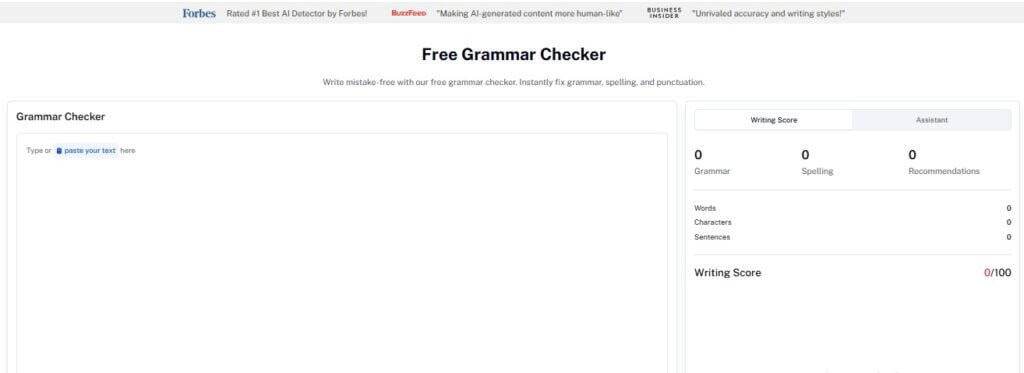
You can best catch these mistakes with our Kieliopin tarkistusohjelma that’ll spot the small errors and clean up your work.
What Does “Awhile” Mean?
Awhile on adverb that simply means “for a period of time” for an action to take place. Moreover, in a sentence, this adverb directly modifies the verbi that comes before it.
Therefore, you have to use awhile immediately after a verb in a sentence.
A sentence like “stay awhile” is an example of a correct usage, as the word works naturally after the verb pysy. It is also worth noting that awhile can always replace a preposition, so you can’t write “for awhile.“
That would be incorrect, and it’s essentially writing the same word twice. This redundancy is one of the more common mistakes you can make when using this adverb.
You can best use awhile when you’re writing in informal situations with friends and family. Meanwhile, a while works better for formal situations.
What Does “A While” Mean?
A while on substantiivinen lause meaning “a period of time,” and what makes it unique is that it’s considered two words rather than one word, as seen with its adverb counterpart.
As such, a while needs support from a prepositio like “for” to work properly in a sentence or utterance. This is what makes a while to be considered as an object of a preposition.
Conversely, awhile is never seen or accepted to function similarly.
For you to better understand how a while functions in a grammatically correct sentence, consider these sentences that have the phrase coming after a preposition:
- I have not seen her in a while, tai
- We waited for a while before leaving.
Now, if you tried replacing a while kanssa awhile in either of these sentences, it would make them incorrect and affect their meaning.
- I have not seen her in awhile – Virheellinen
- We waited for awhile before leaving – Virheellinen
Awhile vs. A While: How to Use Them in a Sentence
So now you’ve seen what each version of awhile and a while means, let’s put them to work in a sentence.
Nothing quite illuminates the grammatical difference more than awhile vs a while examples, so let’s see where all the points we’ve discussed come together.
Using Awhile and A While
The simplest way to keep these two straight is to look at what comes before and after them in a sentence. The words surrounding them will almost always tell you which version belongs there.
Awhile (The Adverb)
Awhile works on its own without any preposition holding it up. It sits directly after a verb and adds information about how long the action lasts.
- She sat awhile before making her decision.
- We rested awhile by the side of the road.
- Linger awhile and enjoy the view.
A While (The Noun)
A while follows prepositions and works as the object of those prepositions within a sentence. A quick hack for you to use is to check if you can place “osoitteessa” tai “osoitteessa” directly before it.
If it works, then that’s the correct choice.
- I have not spoken to him in a while.
- We waited for a while before the doors opened.
- It has been a while since anyone asked that question.
Real-Life Examples

These are some real-life examples where people used either awhile or a while so you too can have a context of how to properly apply them.
| Awhile | A while |
| I found her having sat awhile on my front porch by the time I came to open the door for her. | It will take a while to move the boxes from home to my new workplace. |
| I stopped awhile at the bakery to get some fresh loaves of bread right from the oven. | A while ago, my father took us to his beachside cabin to fish. |
| I had to rest awhile before moving on to the harder part of the project. | She stepped away from work a while back when she lost her mom. |
| She swore he lingered awhile outside her window last night till she screamed at him. | You know it takes me a while to drive from home to the mall during rush hour. |
| The new couple were offered the dancefloor for just them to dance awhile. | You’ll have to give me a while to gather my things and leave you for good. |
| In the middle of her speech, she had to pause awhile to take a sip of water. | A century is just a while for powerful beings like gods to sleep. |
| My dog rested awhile after we got back from our morning walk. | Maria used a while on her pet project that we expected to fail. |
| The children only played awhile before they were chased away from the park. | Nature would actually take a while to restore the damage humans have done. |
| The night is still young, so stay awhile with me. | She told me a while ago that she would turn down his proposal. |
How Did Awhile and A While Come About?
Lause a while appeared first, stemming from the Vanha englanti term hwil. That Old English word still sounds like how we pronounce the word kun taas tänään.
As English evolved over the centuries, it transformed into a while osoitteessa Modern English, and has been commonly used since the 12th century to refer to a period of time. This sense has persisted to the present day.
After many twists and turns, speakers started merging the words together and used the merged form as an adverbial.
Therefore, linguists at the time accepted it as an adverb and added it as a new word in the English dictionary.
We notice this same process called univerbation with words like ehkä ja goodbye that used to be two separate units that eventually became one, as the words changed through time.
What makes this particular pair interesting is that both versions survived without one replacing the other entirely.
English held onto both forms and assigned each one a distinct grammatical role, which is exactly what creates the confusion that writers still deal with today, since most of us have never been taught the difference.
How Undetectable AI Helps You Write Better
Artificial intelligence has influenced the way people write, and now academic institutions, publishers, and professional platforms are using AI detection tools to identify content that was generated by a machine rather than written by a human.
Havaitsematon tekoäly came to address exactly that with a growing suite of tools that support better human writing across the board.
From grammar checks to readability improvements, there are resources available for writers at every level who want their work to come out cleaner and more polished than it went in.
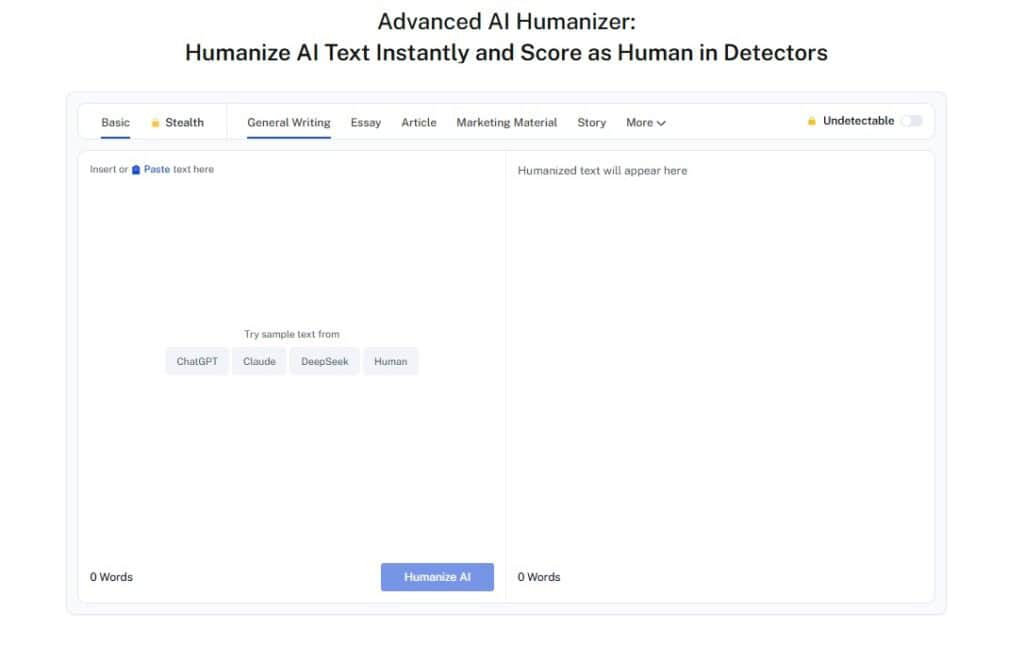
Consequently, for students and writers who use AI as part of their writing process, Undetectable AI offers a humanizer that takes your Tekoälyn luoma sisältö and rewrites it in a way that reads as if it came from a person who sat down and thought carefully about what they wanted to say.
Naturally, you too can use our AI Humanizer to catch errors automatically and make sure every line sounds like it was written by a careful human writer.
Give it a try and see the difference it makes in your next piece of writing as you pass through AI detection tools without raising any flags.
Simple Tips to Remember
Either form of these words does not need you to memorize complex grammar rules every. You just need a tip or two that’ll help you use the right form when you sit to write.
These tips include:
- Adverbs love to follow verbs. This natural pairing is one of the easiest ways to recognize when to use awhile. Therefore, if the word is coming directly after a verb, then use the adverb form of the word, awhile.
- Slowing down is actually the easiest fix when awhile ja a while are giving you trouble. Both expressions have fuller versions you can use in place of the shorter ones. For instance, awhile means “for a period of time.” Similarly, a while means “a period of time.” You can read these out loud in your sentence to know which one belongs there.
- Perhaps you keep having doubts about which form to use, just go for the safest option, which is a while. It fits into more sentence structures and many people default to this form without a second’s thought.
- Nouns and noun phrases usually come after prepositions to function as their object. That’s the role a while plays. Hence, whenever you have a preposition, always be prepared to use this form for accuracy.
Tutustu AI Detectoriin ja Humanizeriin alla olevassa widgetissä!
Lopulliset ajatukset
Awhile and a while are not so different from each other. What actually makes a difference is how you use them grammatically due to their specific functions.
As we’ve established, awhile functions as an adverb and a while as a noun phrase, so you need to use the right form in the proper sentence for it to be correct.
Nevertheless, you could make mistakes while writing quickly and use the wrong version. You don’t have to trouble yourself much about this because the tools on Undetectable AI can detect this and correct it before you ever publish your writing.
Catch grammar slips instantly and keep your writing clear and natural with Havaitsematon tekoäly.