
Les textes rédigés par une IA ont un trait caractéristique, et la plupart des lecteurs sont capables de détecter en quelques secondes si un texte a été rédigé par une IA, même s’ils ne peuvent pas expliquer exactement pourquoi. Vous vous demandez peut-être pourquoi j’affirme cela avec tant d’assurance, n’est-ce pas ?
Je dirige Undetectable AI, ce qui consiste à générer et à humaniser Contenu de l'IA Ce n'est pas une nouveauté pour moi, ni une expérience secondaire ; c'est ce que nous faisons à grande échelle, chaque jour chez Undetectable AI.
Mon expérience m'a appris que le problème avec l'écriture générée par l'IA ne réside généralement pas dans l'écriture elle-même, mais plutôt dans le caractère prévisible des schémas utilisés.
Au fil du temps, mon équipe et moi-même, chez Undetectable AI, avons testé plusieurs stratégies censées améliorer la qualité de l’écriture générée par l’IA. Il s’agit notamment de stratégies qui prétendent vous aider à obtenir des scores 100%, équivalents à ceux d’un texte rédigé par un humain. Je peux donc affirmer sans hésiter que nous avons pu constater par nous-mêmes ce qui fonctionne et ce qui ne fonctionne pas.
Dans cet article, je vais me concentrer sur sept stratégies éprouvées et fiables qui fonctionnent réellement. J'ai testé ces stratégies sur le même brouillon de référence de 400 mots, en évaluant l'impact de chaque changement de stratégie sur Détecteur d'IA marque à chaque fois.
Vous verrez des exemples « avant-après » accompagnés des scores du détecteur après l'application de chaque stratégie.
Cet article vous aidera également à comprendre que l'IA n'écrit pas mal ; elle écrit simplement de manière uniforme. Pour y remédier, il faut varier le rythme, recourir à des exemples concrets et adopter un style qu'un modèle d'intelligence artificielle ne peut pas reproduire en raison de son manque d'expérience humaine.
Principaux enseignements
- La rédaction générée par l'IA présente cinq indices reconnaissables : un rythme de phrase prévisible, un usage excessif des tricolons, des tirets longs, des expressions du type “ dans le monde trépidant d'aujourd'hui ” et des exemples génériques dépourvus de source réelle.
- Les 7 stratégies présentées dans cet article ont été appliquées au même brouillon de référence de 400 mots, ce qui a fait passer le score du détecteur de 1 001 TP 6 T IA à 451 TP 6 T IA sur le détecteur « Undetectable AI Detector ».
- La stratégie la plus efficace consiste à varier la longueur des phrases. Cette variation influence davantage le score du détecteur que toute autre stratégie.
- Effectuez toujours un contrôle à l'aide d'un détecteur avant de publier. Les schémas qui déclenchent les alertes des détecteurs sont les mêmes que ceux que les lecteurs remarquent. Le détecteur ’ Undetectable AI Detector » est une option gratuite, mais tout détecteur réputé fait également l'affaire.
Pourquoi les textes générés par l'IA ont un « signe distinctif » (et à quoi cela ressemble-t-il concrètement)
La plupart des gens associent l'écriture générée par l'IA à une qualité médiocre, mais ce n'est pas le cas. L'IA n'écrit pas aussi mal que vous le pensez ; elle écrit simplement de manière uniforme. L'intelligence artificielle écrit de manière trop cohérente.
Les phrases ont généralement la même longueur, et le vocabulaire est plus formel que d'habitude. Par exemple, là où l'on dirait habituellement ‘ utiliser ’, l'IA dirait ‘ mettre à profit ’.’
Même si les lecteurs sont capables de déterminer si un contenu a été rédigé par une IA, ils ont du mal à identifier précisément les caractéristiques qui le rendent artificiel.
Ne vous inquiétez plus jamais de la détection de vos messages par l'IA. Undetectable AI peut vous aider :
- Faites apparaître votre écriture assistée par l'IA à l'image de l'homme.
- By-pass tous les principaux outils de détection de l'IA en un seul clic.
- Utilisation AI en toute sécurité et en toute confiance à l'école et au travail.
Ainsi, lorsqu'ils ne parviennent pas à cerner le problème, leur réflexe est de se détourner du contenu et de chercher autre chose pour satisfaire leur curiosité. C'est pourquoi Les contenus générés par l'IA sont moins performants que ceux rédigés par des humains.
Les 5 indices les plus courants permettant de repérer un texte rédigé par une IA
Il est facile de repérer un texte rédigé par une IA dès lors que l'on sait exactement quels éléments rechercher.
Voici cinq cas fréquents L'écriture par IA révèle que:
- Rythme prévisible de la phrase : Les phrases générées par l'IA ont une longueur constante, comprise entre 15 et 20 mots. Elles suivent également la structure SVO. On peut également en prédire le rythme, car ces phrases ont tendance à respecter la même cadence. D'une certaine manière, on aboutit à une prose fluide mais trop uniforme, qui manque de variété.
- Utilisation excessive du « tricolon » : L'intelligence artificielle a tendance à utiliser des séries de trois mots dont la structure, la longueur ou le rythme sont similaires. C'est pourquoi on trouve souvent des expressions telles que “ clair, concis et convaincant ” qui apparaissent trop souvent dans un texte généré par l'IA. Les humains utilisent sans doute aussi ces mots, mais pas de manière aussi systématique que l'IA.
- Les tirets longs pour créer un effet dramatique : Il n'est pas vraiment courant que les gens utilisent des tirets longs plus de deux fois dans un essai, surtout si ce n'est pas nécessaire. Cependant, l'IA utilise des tirets longs pour ajouter du dramatisme à un texte au lieu de varier réellement la structure des phrases.
- Introductions stéréotypées : Les textes générés par l'IA ont tendance à commencer par des expressions telles que ‘ dans un monde où tout va très vite ’. Ces introductions sont génériques et n'apportent ni précision ni éclairage au texte.
- Exemples génériques : Plutôt que de citer des preuves spécifiques, l'IA peut dire “ de nombreuses études montrent que ”.” Dans ce cas précis, un auteur humain aura davantage tendance à citer le titre exact de l'étude, le nom de l'entreprise, l'année et les conclusions. D'une certaine manière, on peut dire que la précision est un critère clair permettant de distinguer les textes rédigés par l'IA de ceux rédigés par des humains.
Méthodologie de recherche
Pour démontrer qu'il est possible d'écrire « comme un humain » à l'aide de l'IA, j'ai mené un test contrôlé à partir d'un brouillon de référence de 400 mots sur les avantages du télétravail, généré par ChatGPT.
Je n'ai apporté aucune modification au brouillon avant de le soumettre à trois détecteurs, à savoir Undetectable AI Detector, GPTZero et Originality.ai, le vendredi 12 juin 2026 à 13 h 47. Voici les résultats :
Projet de base
- IA indétectable
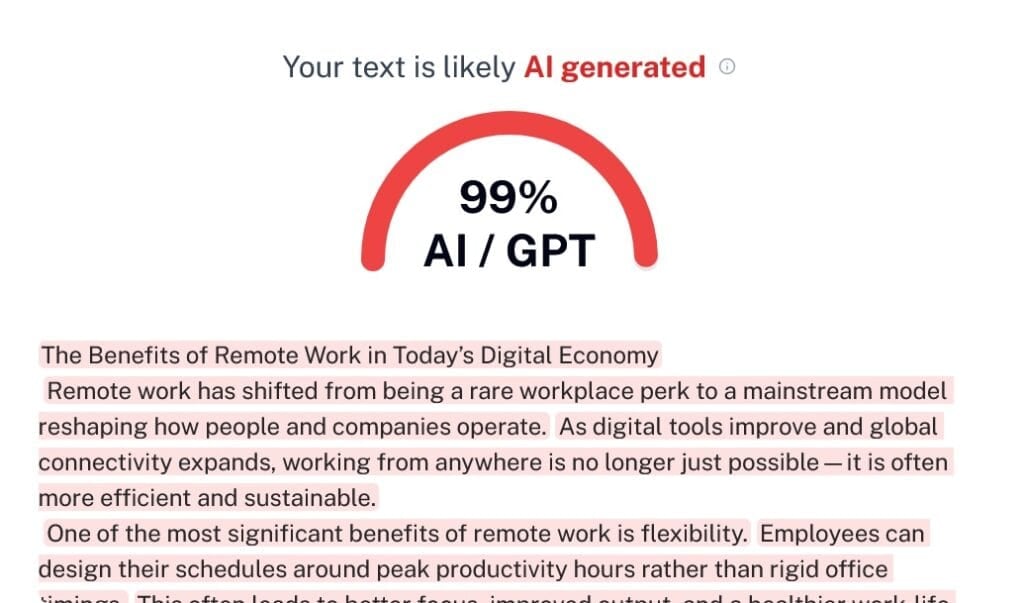
2. GPTZero
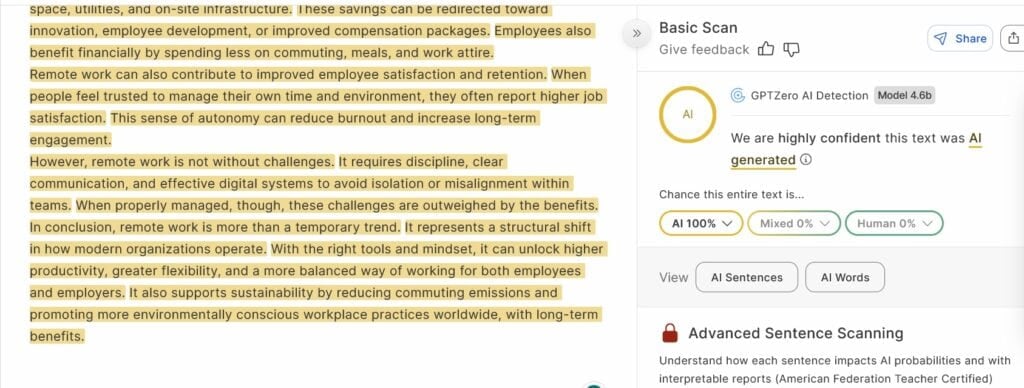
3. Originality.ai
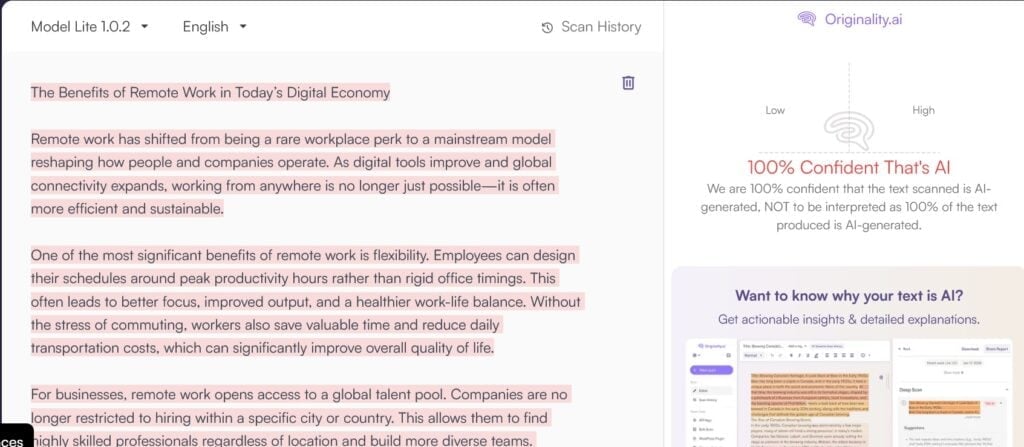
Une fois que les premiers tests ont confirmé que le texte de 400 mots généré par ChatGPT était le fruit de l'IA, j'ai appliqué chacune des étapes de la stratégie une par une à ce même brouillon, en le soumettant à nouveau aux trois détecteurs après avoir appliqué chaque stratégie séparément.
Les 7 stratégies pour écrire comme un humain lorsqu'on utilise l'IA
Voici quelques stratégies qui pourraient vous aider si vous cherchez à faire en sorte que ChatGPT écrive comme un humain :
Stratégie n° 1 : varier considérablement la longueur des phrases
C'est la modification la plus efficace que vous puissiez apporter à un texte rédigé par une IA, car celle-ci produit généralement entre 15 et 20 mots par phrase.
L'écriture humaine permet de composer des phrases courtes qui peuvent s'étendre en phrases longues, puis se diviser en fragments tout en conservant la même idée. Cette stratégie a permis de faire passer le brouillon de 100% AI à 92% AI sur Undetectable AI. Détecteur d'IA.
Avant :
“ Le télétravail a gagné en popularité ces dernières années. Il présente de nombreux avantages, tant pour les salariés que pour les entreprises. Des études ont montré que les télétravailleurs sont plus productifs que ceux qui travaillent au bureau. ”
Après :
“ Le télétravail a connu un essor fulgurant après 2020. La raison ? Plus personne n’a envie de passer 90 minutes dans les embouteillages. Et lorsque les entreprises ont constaté que la productivité ne baissait pas, voire qu’elle augmentait dans de nombreux cas, l’argument traditionnel en faveur des cinq jours au bureau a rapidement perdu de sa crédibilité. ”
Stratégie n° 2 : remplacer les exemples génériques par des exemples concrets et précis
Lorsque l'IA doit être précise, elle a tendance à recourir à des formules toutes faites telles que “ de nombreuses études montrent ”, “ les entreprises obtiennent de bons résultats ” ou “ les experts s'accordent à dire ”. L'IA utilise ces formules pour s'exprimer sans pour autant dire quoi que ce soit de significatif.
En ce qui concerne les êtres humains, nous précisons le nom de l'étude, de l'entreprise, l'année et les résultats. Les exemples concrets sont plus crédibles et plus utiles pour le lecteur. Lorsque nous avons apporté cette modification à notre première version, le score du détecteur s'est amélioré.
Avant :
“ Des études ont montré que les télétravailleurs sont souvent plus productifs que ceux qui travaillent dans des bureaux traditionnels. ”
Après :
“ Une étude menée en 2023 à Stanford par Nicholas Bloom a révélé une augmentation de la productivité de 13% chez les télétravailleurs d’un centre d’appels chinois, principalement due à une diminution du nombre de pauses et d’arrêts maladie. ”
Stratégie n° 3 : Supprimer la bibliothèque de phrases de l'IA
Certaines expressions sont déjà associées aux textes générés par l'IA, et leur simple apparition suffit à signaler l'ensemble du paragraphe.
Nous avons relu le projet et supprimé les éléments suivants :
- “ Dans le monde trépidant d'aujourd'hui. ” Il vaut tout simplement mieux le remplacer par le point en question.
- “ Il est important de le noter. ” Tu devrais aller droit au but, car le lecteur sait déjà que c'est important.
- “ En conclusion ” / “ Pour conclure ”.” Il vaut mieux utiliser une véritable conclusion.
- “ Indéniablement ”, “ certainement ”, “ absolument ”.” Exposer la vérité ou les faits tels qu'ils sont
- “ Tapisserie ”, “ se plonger dans ”, “ s'y retrouver dans les subtilités ”.”
Stratégie n° 4 : Intégrer une expérience personnelle ou une observation concrète
L'IA est incapable de vivre une expérience personnelle ; elle ne peut donc pas simuler une expérience vécue. Ainsi, le fait d'inclure ne serait-ce qu'une seule phrase décrivant une véritable expérience humaine change complètement la crédibilité d'un paragraphe.
Cette stratégie est également connue sous le nom de Stratégie E-E-A-T. À savoir : l'expérience, l'expertise, l'autorité et la fiabilité. C'est le type de stratégie que Google récompense le plus en 2026, car elle renforce votre crédibilité dans les résultats de recherche.
Avant :
“ Le télétravail peut avoir un impact positif sur le bien-être des salariés. De nombreux travailleurs déclarent se sentir moins stressés lorsqu’ils peuvent travailler depuis chez eux. À terme, cela peut contribuer à améliorer leur santé mentale. ”
Après :
“ Lorsque nous avons interrogé notre propre équipe après 18 mois de télétravail à temps plein, ce n’est pas la productivité qui a retenu notre attention, mais la baisse du nombre de cas de burn-out signalés. Soixante pour cent des personnes interrogées ont déclaré se sentir moins submergées qu’au bureau. Ce n’était pas le résultat d’une étude. C’était mardi. ”
Stratégie n° 5 : Utiliser des contractions et des tournures causales
Par défaut, l'IA écrit de manière formelle. Elle utilise un anglais formel d'une manière dont aucune personne réelle n'écrit. Au lieu de dire ‘ Don’t ‘, elle dit ‘ Do not ’. Elle utilise ‘ It is ’ au lieu de ‘ it’s ’.’
Pour donner à votre texte un ton plus naturel, vous devriez utiliser des contractions et des tournures plus familières, sans pour autant en modifier le fond.
Vous pouvez également ajouter de temps à autre des éléments tels que commencer une phrase par ‘ Et ’ ou ‘ Mais ’. C'est justement en enfreignant les règles de la rédaction générée par l'IA que vous montrez que votre texte est le fruit de votre travail.
Avant :
“ Le télétravail ne convient pas à tous les types d’employés. Il est important de prendre en compte les modes de travail individuels avant de mettre en place une politique de télétravail. Certains employés peuvent constater qu’ils ne sont pas aussi performants en dehors d’un environnement de bureau structuré. ”
Après :
“ Le télétravail ne convient pas à tout le monde. Certaines personnes ont réellement besoin de la structure qu'offre un bureau, et c'est tout à fait normal. Mais la politique ne devrait pas être élaborée en fonction de l'exception. ”
Stratégie n° 6 : Prendre position
Par défaut, l'IA ne prend jamais position. Elle s'efforce toujours de présenter un argumentaire équilibré. Elle dirait plutôt quelque chose comme “ Cette approche présente à la fois des avantages et des inconvénients ” plutôt que de choisir un camp.
C'est donc à vous maintenant de lui demander de choisir un camp et d'argumenter son choix, exactement comme le feraient les humains. Imposez-lui une position claire dans votre consigne et voyez quel genre de résultats vous obtiendrez.
Avant :
“ Le télétravail présente à la fois des avantages et des inconvénients. S'il offre une certaine flexibilité et peut améliorer la productivité de certains salariés, il peut également entraîner un sentiment d'isolement et rendre la collaboration plus difficile. La bonne approche dépendra des besoins de chaque organisation. ”
Après :
“ Le télétravail est plus adapté à la plupart des travailleurs du savoir. L’argument de l’isolement est réel, mais il existe des solutions. Quant à l’argument de la collaboration, il relève davantage d’un échec de gestion que d’un problème structurel. Les entreprises qui sont revenues à la norme des cinq jours de présence au bureau ne l’ont pas fait parce que les données leur dictaient de le faire. ”
Stratégie n° 7 : Effectuer une vérification du détecteur et « humaniser » si nécessaire
Une fois les six stratégies ci-dessus mises en œuvre, vous pouvez tester les résultats avant de publier.
Si le score est élevé, deux options s'offrent alors à vous : effectuer davantage de corrections manuelles ou utiliser un outil d'humanisation tel que Humanisateur d'IA indétectable. Ces deux options vous donneront de bons résultats, mais rien ne vaut la relecture humaine, même si cela vous prendra sans doute plus de temps si vous le faites vous-même.
Chez Undetectable AI, l'utilisation d'un détecteur fait partie intégrante de notre processus de travail interne. Aucun contenu n'est publié sans avoir été vérifié, en particulier le contenu généré par l'IA.
Avant/après concret : un projet, 7 stratégies, scores du détecteur
Voici à quoi ressemble concrètement la méthode pour “ apprendre à ChatGPT à écrire comme un humain ”. Même brouillon de 400 mots. 7 stratégies. Évolution réelle du détecteur.
| Stade | IA indétectable Détecteur | GPTZero | Originalité.ai |
| Version préliminaire de « Baseline AI » | 100% AI | 100% AI | 100% AI |
| + Stratégie n° 1 (variation de phrase) | 92% IA | 85% IA | 94% IA |
| + Stratégie n° 2 (exemples concrets) | 80% IA | 86% AI | 89% IA |
| + Stratégie n° 3 (éliminer les expressions de l'IA) | 75% IA | 80% IA | 80% IA |
| + Stratégie n° 4 (réelle (remarque) | 71% IA | 75% IA | 72% IA |
| + Stratégie n° 5 (contractions) | 68% IA | 72% IA | 71% IA |
| + Stratégie n° 6 (prendre position) | 65% IA | 50% AI | 35% IA |
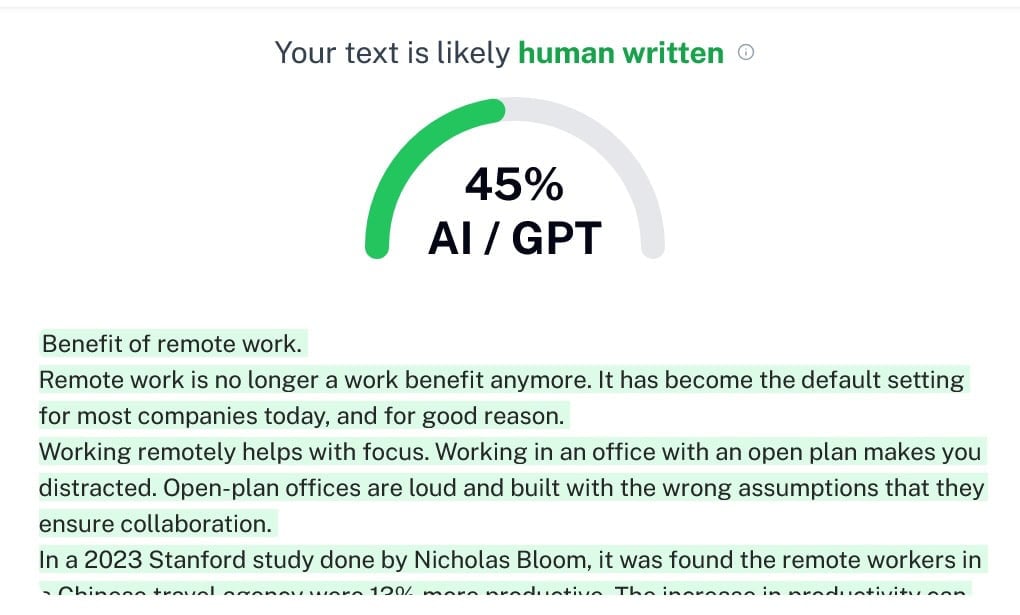
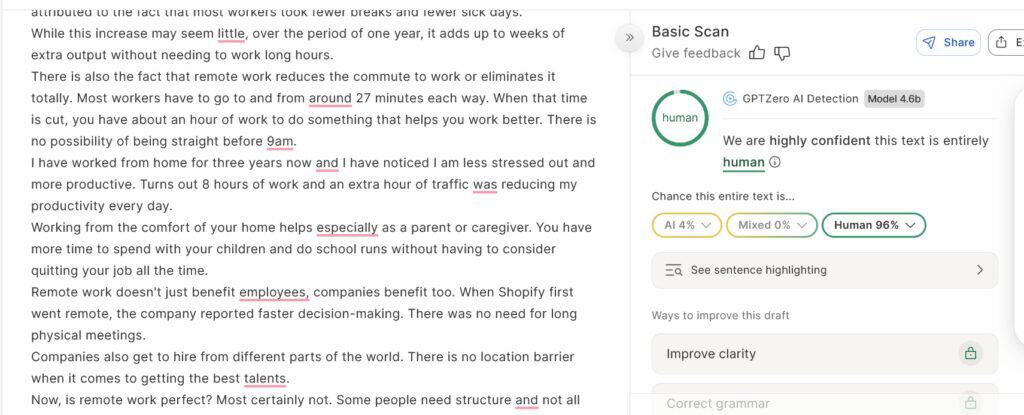
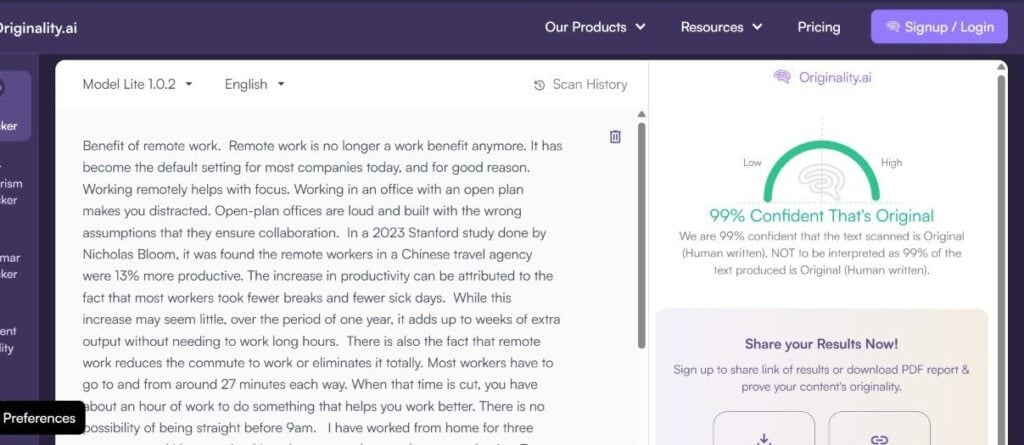
| + Stratégie n° 7 (humaniser le reste) | 45% IA | 4% IA | 1% AI |
Version finale (après les sept stratégies)
- IA indétectable
2. GPTZero
3. Originality.ai
Modèles de prompts permettant de générer des brouillons au style naturel
Même si les 7 stratégies ci-dessus s'appliquent à la phase de révision après la rédaction, vous pouvez tout de même réduire le temps consacré à la révision en utilisant les bonnes questions guides.
Voici trois modèles que vous pouvez utiliser pour créer des brouillons au style naturel :
- La consigne “ Personnage spécifique ”
Une chose que j'ai remarquée à propos des gens et de la façon dont ils utilisent l'IA, c'est qu'ils pensent qu'il leur suffit d'indiquer un sujet et un nombre de mots pour que le modèle d'IA se charge de l'essentiel du travail.
Cependant, ce qu'ils ne réalisent pas, c'est qu'en agissant ainsi, ils ont donné à l'IA la possibilité d'utiliser sa voix par défaut.
En d'autres termes, ils permettent à l'intelligence artificielle d'utiliser précisément ce rythme uniforme et formel dont nous avons parlé. Ainsi, lorsque vous donnez des instructions à l'IA, vous devez définir précisément le profil de l'auteur dont vous avez besoin avant de formuler toute demande de contenu.
Vous pouvez utiliser cette phrase comme introduction avant chaque consigne :
“ Vous incarnez Beth, une analyste financière qui écrit pour les passionnés de finance. Votre style d’écriture est conversationnel, direct et concret. Vous utilisez des contractions, variez la longueur de vos phrases et évitez les expressions génériques générées par l’IA, telles que “ dans le monde trépidant d’aujourd’hui ”. »
Une fois cette invite affichée, vous pouvez alors saisir votre demande de contenu.
- Le thème “ Prenez position ”
Les outils d'IA sont formés de manière à ne pas prendre position de manière catégorique. Ces outils s'efforcent d'éviter toute controverse en produisant des résultats qui tendent à présenter les deux points de vue.
Cet instinct permet à l'outil de produire des textes qui en disent long sans rien dire. Ainsi, pour obtenir le meilleur résultat possible, il faut demander à l'outil de prendre position,
Pour cela, vous pouvez utiliser cette commande :
“ Adoptez une position claire en matière de responsabilité financière. Expliquez votre raisonnement et les compromis impliqués. Utilisez la première personne si cela vous aide. Soyez direct. Évitez les formules évasives. Limitez la longueur de vos paragraphes à 4 lignes maximum. Évitez les tricolons et les clichés. ”
- L'invite “ Liste des éléments à éviter ”
Pour ne pas perdre votre temps, le mieux est d'indiquer précisément à votre outil ce qu'il ne doit pas faire. Vous pouvez créer une ‘ liste d'exclusions ’ qui lui permettra de savoir ce qu'il peut inclure et ce qu'il doit éviter. Au fil du temps, vous pourrez même enrichir cette liste à mesure que vous identifierez les schémas qui reviennent régulièrement dans votre brouillon.
Par exemple, vous pouvez utiliser une invite telle que :
“ Rédigez [la demande]. À éviter : dans le monde trépidant d’aujourd’hui, il est important de
” note, des tirets longs pour créer un effet dramatique, des tricolons (X, Y et Z), une tapisserie, se plonger dans, explorer les subtilités, en conclusion. »
Questions fréquemment posées
Comment donner un ton plus humain à un texte rédigé par une IA ?
La meilleure façon d’y parvenir est de modifier les modèles par défaut de l’IA. Vous devez identifier la longueur uniforme des phrases, les exemples génériques, les formulations formelles, les tricolons et les tirets longs qui caractérisent l’IA. Une autre option consiste à utiliser les sept stratégies présentées dans cet article.
Quel est le moyen le plus simple de détecter un texte rédigé par une IA ?
Il est facile de repérer un texte rédigé par une IA, car il suit des schémas et une structure prévisibles.
Ainsi, pour repérer facilement un texte rédigé par une IA, vous pouvez choisir d'utiliser des détecteurs d'IA tels que « Undetectable AI » ou de recourir à l'intervention humaine. Par « intervention humaine », j'entends le fait de lire chaque paragraphe à voix haute afin de repérer ce qui semble trop formel ou hors de propos.
Est-ce que Google va me pénaliser si j'utilise l'IA pour écrire ?
Google accorde davantage d'importance à la qualité et à l'utilité du contenu. La manière dont ce contenu a été produit n'est pas vraiment le plus important. Qu'il s'agisse ou non d'IA, il suffit donc de veiller à publier du contenu de grande qualité.
Faut-il utiliser un outil d'humanisation basé sur l'IA ou se contenter d'une correction manuelle ?
La révision manuelle peut vous aider à obtenir de meilleurs résultats. En effet, cela vous permet d'y apporter votre touche personnelle et d'être plus précis, deux aspects qu'aucun outil d'humanisation ne peut reproduire.
Toutefois, si vous travaillez dans l'urgence et que vous avez beaucoup de contenu à « humaniser », vous pouvez d'abord utiliser un outil d'humanisation basé sur l'IA, puis procéder à une révision manuelle par la suite. En fin de compte, c'est vous qui êtes votre propre « humaniseur ».
Les détecteurs peuvent-ils toujours déterminer si j'ai utilisé l'IA ?
Non. Il arrive parfois que les détecteurs aient du mal à repérer l'utilisation de l'IA dans des contenus bien rédigés. C'est pourquoi il existe un risque de faux positifs et de faux négatifs. Les détecteurs ne peuvent que repérer la présence de schémas et de répétitions associés à l'intelligence artificielle.
Quelle est la stratégie la plus importante ?
Si je devais vraiment choisir, je dirais la variation de la longueur des phrases. En effet, l'IA a tendance à écrire avec un rythme prévisible.
L'écriture humaine, en revanche, mêle phrases courtes et longues, captive l'attention des lecteurs et complique la tâche des détecteurs qui cherchent à identifier votre contenu comme ayant été rédigé par une IA.
Réflexions finales
Ce qu'il faut retenir de cet article, c'est que l'IA n'écrit pas mal, mais de manière uniforme. C'est précisément cette uniformité que les lecteurs perçoivent avant même de pouvoir identifier ce qui rend un texte maladroit.
Lorsque nous avons appliqué ces sept stratégies au même brouillon de 400 mots, le score obtenu par le détecteur est passé de 100% (IA) à 45% (IA indétectable).
Cependant, l'essentiel réside dans la manière dont le texte lui-même est passé d'un écrit techniquement correct à un texte qui valait réellement la peine d'être lu. Il est devenu plus précis, les phrases ont gagné en variété et le style a pris une touche plus humaine.
Si, après avoir suivi ces sept stratégies, vous souhaitez tout de même utiliser un détecteur pour garantir l'infaillibilité de votre travail, l'IA indétectable de Détecteur d'IA est accessible gratuitement.
Vous pouvez obtenir une analyse de la qualité de votre contenu grâce au quota gratuit que nous vous proposons avant d'y apporter vos propres modifications et votre point de vue.