
Do you know the first rule of Economics 101? It’s called Economies of Scale.
It means the more you produce something, the cheaper each unit becomes.
And this same rule applies to our content strategy.
The idea is to stop trying to invent a new wheel every day. Instead, you build one big wheel and let it roll everywhere.
Think of economics of scale like a factory…
- Video #1: This requires lighting, scripting, filming, and high energy. (High Effort)
- The 15 Clips/Tweets/Blogs from it: These require zero setup and minimal editing. (Low Effort, High Reward)
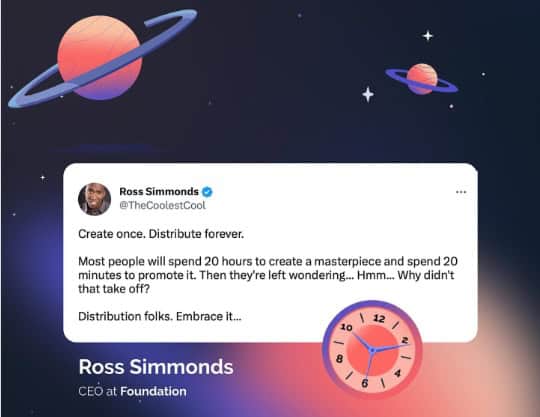
As marketing expert Ross Simmonds puts it: “Create once. Distribute forever.”
Today, we’re going to master this model. If you are wondering how to scale content creation for a growing saas?, or simply how to scale content creation with ai?, you are in the right place.
You’ll learn how to turn a single video into a week’s worth of content, identify key elements, optimize for SEO, follow best practices, and much more.
Let’s dive in.
Key Takeaways
- One pillar video can become 15+ different pieces of content.
- Scaling isn’t about doing more work. Use Economies of Scale to get more content from the same effort.
- Not every second of your video is useful. Look for key moments like “how-to” steps or bold statements, that can shine on different platforms.
- Use tools like transcribers and paraphrasers to turn video audio into SEO-ready blogs in minutes.
- You don’t need a huge team. A smart scheduler can share your content everywhere without keeping you stuck at your phone.
- AI can scale your content, but a human touch is essential to stay authentic and trustworthy.
Understanding Content Scaling Through One Video
Content scaling means increasing your content output without increasing your time, budget, or team at the same pace.
In plain English. It means more content, same effort.
If you are asking how to scale content creation for a growing saas?, the answer lies in leverage.


Never Worry About AI Detecting Your Texts Again. Undetectable AI Can Help You:
- Make your AI assisted writing appear human-like.
- Bypass all major AI detection tools with just one click.
- Use AI safely and confidently in school and work.
A growing SaaS company can’t afford to film five new videos a week, but they can afford to film one and slice it into twenty.
| The Old Way (No Scaling) | The Smart Way (Scaling) |
| Effort: 1 Hour | Effort: 1.5 Hours |
| Output: 1 Video | Output: 15 Pieces of Content |
| Vibe: Exhausting. You’re always chasing the next post. | Vibe: Efficient. You create once and distribute everywhere. |
Think of one long-form video as your core asset. Everything else branches out from it. One video can turn into:
- Short-form clips (Reels, Shorts, TikTok)
- Quote posts
- LinkedIn updates
- X (Twitter) threads
- Blog sections
- Email copy
You don’t create more content, you just repurpose the existing one.
- Concept of Scaling Content
Content scaling became necessary when content volume started growing faster than human attention.
That moment is now widely known as Content Shock.
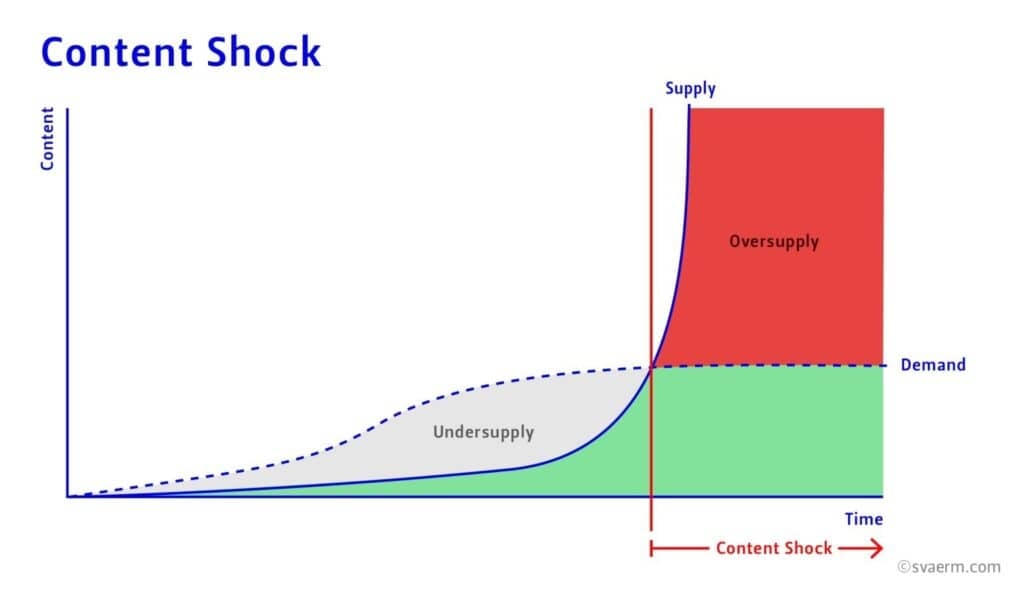
Around 2014, marketers realized that the internet was producing more content than people could possibly consume.
Mark Schaefer coined the term Content Shock to describe this imbalance. From that point on, brands had two options:
- Publish occasionally and disappear
- Or be everywhere, consistently
Scaling became the survival strategy.
But if we zoom out a bit, the roots of content scaling go back to the moment digital marketing began replacing traditional advertising.
Here’s the short timeline:
| Year | What changed |
| 1996 | The term “content marketing” is used for the first time |
| Early 2000s | Blogs and early social platforms explode content demand |
| 2010–2014 | Content Shock identified — supply outpaces demand |
| 2015–2020 | Repurposing becomes a mainstream strategy |
| 2020–Present | AI tools democratize content scaling |
If you want to see scaling in action, look at HubSpot.
How they evolved:
- 2010: 3–4 blog posts per week
- 2015 onward: Full repurposing engine
One asset became many:
- One blog post → 5–6 social updates
- Long-form content → Multiple short-form pieces
- Webinars → Blog series, infographics, social clips
They stopped being just a software company and became the educational standard for the industry.
Identify Key Elements of Your Video for Repurposing
Not all footage deserves repurposing. You need a system to find the segments that actually convert into posts, clips, or assets.
To scale effectively, you need to switch your brain from creator mode to editor mode.
You are looking for specific triggers that match user intent on other platforms.
Here is your content audit framework based on the type of video you shot.
- The “How-To” Video (Educational)
User Intent: “Teach me something quickly.”
What to Hunt For: Actionable steps and numbered lists.
The Play:
- If your video is “10 Ways to Scale a SaaS,” stop looking at it as one video. It is actually 10 separate LinkedIn Carousels and 10 Twitter Threads.
- Clip It: Isolate Step #3. Post it as a standalone tip. You don’t need the other 9 steps to make it valuable.
- The Hot Take Video (Conversational/Podcast)
User Intent: “Entertain me or validate my opinion.”
What to Hunt For: High emotion, controversial statements, or the “Mic-Drop” moment.
The Play:
- Scroll through your timeline and look for spikes in energy or laughter.
- Clip It: Did you say something that might make people argue in the comments? That’s your Instagram Reel. Controversy drives engagement; politeness drives scrolling.
- The Social Proof Video (Interviews/Partnerships)
User Intent: “Can I trust this person/product?”
What to Hunt For: Validation.
The Play:
- Ignore the generic chatter. Find the exact 15 seconds where the guest compliments your workflow, product, or strategy.
- Clip It: This is a sales asset. Put this clip on your Landing Page or in your Sales Emails to close deals faster.
This is also a perfect example of how to scale content creation using partnerships.
Transform Video Content into Multiple Formats
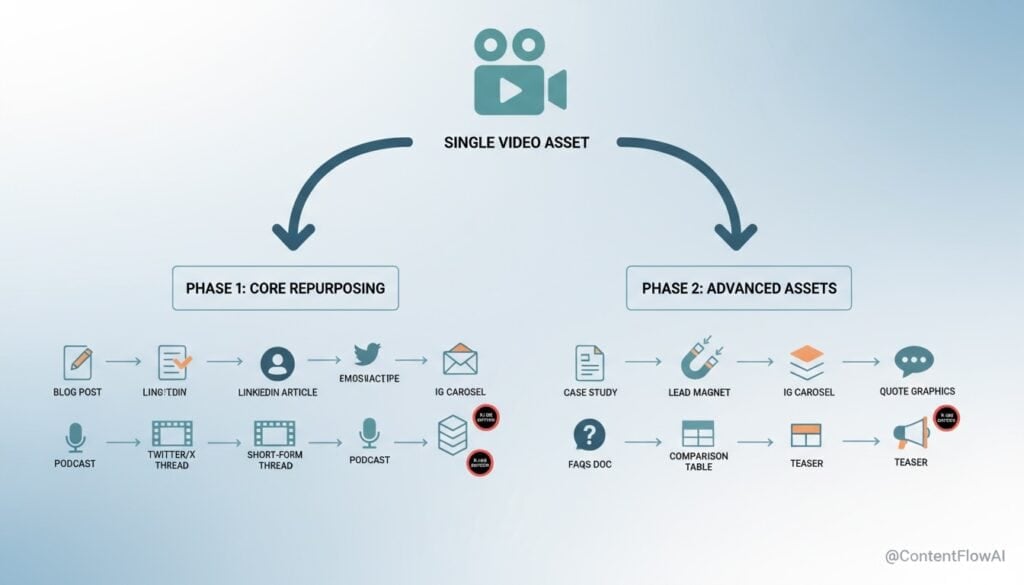
You’ve filmed the pillar video. The hard work is done. Now, it’s time to chop, slice, and dice that video until it fills your content calendar for the entire month. There are two phases in this:
Phase 1: Immediate Derivatives
The goal here is speed. Get these out while the topic is fresh.
| Format | The Playbook |
| The Blog Post | Transcribe the video, feed it to an AI Chatbot to smooth out the flow, and hit publish. |
| LinkedIn Article | Take the blog post and give it a suit and tie. Add a unique industry insight you didn’t cover in the video. |
| Email Newsletter | Send a teaser summary + key takeaways + a CTA to watch the video. |
| Twitter/X Thread | Break the script into 10–15 bite-sized tweets. Structure: Hook → Insights → CTA. |
| Short-Form Clips | Rip 5–10 vertical clips from the main file. Use AI Image Detector to ensure any graphics or screenshots you include are original and safe to use before publishing |
| IG Carousel | Turn your 5 main talking points into 6–10 clean Canva slides. Verify all visuals with AI Image Detector to keep content original and risk-free. |
| The Podcast | Rip the audio. Slap a standard intro/outro on it and upload to Spotify. |
| Quote Graphics | Did you drop a truth bomb? Put that text on a nice background for Stories. |
Phase 2: Advanced Derivatives (Weeks 2-4)
These are high-effort, high-value assets for lead gen and authority building.
| Asset Type | The Playbook |
| Case Study | Expand a specific example from the video into a full PDF breakdown. |
| The Lead Magnet | Turn the “How-To” steps into a downloadable Checklist or Worksheet. |
| FAQs Doc | Compile the comments/questions you got and write a dedicated FAQ page. |
| Comparison Table | If you compare X vs. Y in the video, make a spreadsheet or visual chart. |
| The Teaser | Use the end of this video to tease the next video in the series. |
Optimize Content for SEO and Discoverability
You can make the best video in the world, but if the algorithm can’t read it, it doesn’t exist. This is where learning how to scale content creation with AI? becomes a game-changer.
YouTube SEO
- Title: Place primary keyword within the first 5 words
- Description: Hook + keyword in first 2 lines (150 characters visible)
- Tags: 10–15 relevant tags (mix broad + specific)
- Timestamps: Add chapters in the description
- Captions: Upload accurate subtitles—helps search visibility
Pro tip: Well-structured titles + timestamps = higher watch time and discoverability.
Blog SEO
- Keyword placement:
- H1 (title) → main keyword
- First 100 words → naturally include keyword
- H2/H3 → variations of main keyword
- Internal linking: Link 2–3 related posts
- Meta description: 150–160 characters, include keyword + CTA
- Image optimization: Use descriptive keywords in alt text
Social Media SEO
- Hashtags (Instagram / LinkedIn): 3–5 highly relevant hashtags
- Mix popular (100K+ posts) + niche (10K posts)
- Captions: Hook + keyword in first line
- Profile optimization: Include searchable keywords in bio
Why write a blog from scratch when you already spoke the words? This is how to scale content creation with AI in under 20 minutes.

Step 1: Use a YouTube Transcript Generator to pull the raw text from your video.
Step 2: Take that raw, messy text and paste it into this AI tool. Use this exact prompt:
“Convert this transcript into a 1,500-word SEO blog post targeting [Your Keyword]. Include H2 headings, a meta description, and maintain a conversational, authoritative tone.”
Step 3: AI is great, but it can sound robotic. Use an AI Paraphraser to smooth out clunky sentences and add your personal flair.
Step 4: Always run a quick plagiarism check (just in case) and check the readability score. You want a Grade 8 reading level, not a Ph.D. dissertation.
This workflow is the backbone of how to automate content creation at scale.
Generate SEO-Friendly Content From One Video Using Paraphrasing Tool.
Best Practices for Scaling Content Efficiently
Scaling sounds great until you are drowning in 50 half-finished drafts. To pull this off without breaking your workflow, you need a system.
Here are the four golden rules to keep the machine running smoothly.
- Template Everything
If you are opening a blank Photoshop or Canva file every time you need a thumbnail, you are doing it wrong.
- Create “Master Templates” for quotes, carousels, and thumbnails.
- Leverage Partnerships
Wondering how to scale content creation using partnerships? Simple. If you are a growing SaaS, stop trying to be the loudest voice in the room. Invite the experts in.
- Interview an industry leader. When you repurpose that content into clips or quotes, tag them.
- They will likely reshare it to their audience. You just doubled your reach instantly for free.
- Automate Distribution
This is the answer to how to automate content creation at scale?, you don’t automate the creativity, you automate the delivery.
- Once your video is sliced into 10 assets, load them into a scheduler (like Buffer). You do the work on Monday; the internet sees you every day.
- Be Platform Native
A LinkedIn post is a conference room, TikTok is a house party. Don’t act the same in both places.
- LinkedIn: Keep it professional, text-heavy, and value-driven.
- TikTok: Keep it fast, visual, and unpolished.
- The Rule: Respect the platform’s culture. Copy-pasting the exact same caption everywhere makes you look like a bot.
Measuring Impact and Refining Your Strategy
So, you’ve turned one video into a content empire. But is it actually working? Or are you just making noise?
Don’t fly blind. Run your strategy through this checklist to ensure you are scaling results, not just tasks.
The Checklist
Check the Reach Multiplier: Compare the total views of your original video against the combined views of all your clips. If the clips have 10x the views of the main video, your scaling is a success.
Monitor Engagement Depth:Check the comments on your LinkedIn articles and Twitter threads. If the conversation has moved from the video to the text, you’ve won.
The AI Test: Read your captions out loud. If it sounds like a corporate press release or a Wikipedia page, you are in the danger zone. Audiences can smell AI speak from a mile away.
Keep humans in the loop: Never let AI hit publish. AI drafts the content. You add the flavor, the humor, and the stories.
One last safety check…
Efficiency is great, but losing your audience’s trust is fatal. Before you queue up those 20 posts, make sure they don’t sound synthetic.
Verify content authenticity using AI Detector before publishing updates. It flags the robotic parts so you can rewrite them and keep your brand sounding human.
Analyze Results And Refine Your Content Strategy Using AI Detector To Ensure Quality.
Test your writing through our AI Detector and Humanizer in the widget below!
FAQs
How do I change the scale of a YouTube video?
This generally refers to two things. If you mean the aspect ratio (shape), you cannot change a video once it is uploaded, but you can use editing software to crop a 16:9 video into a 9:16 Short.
If you mean the player size on your screen, you can use “Theater Mode” (rectangle icon) in the bottom right of the YouTube player or adjust your browser’s zoom settings.
What is the 8 minute rule on YouTube?
Previously known as the 10-minute rule, YouTube now allows creators to place mid-roll ads on videos that are 8 minutes or longer.
This is crucial for monetization scaling, as it allows for higher revenue potential per video compared to shorter uploads.
Final Thoughts
You can’t 3X your content output by working three times harder. This way, you can burn-out faster. But here’s what you can do…
Take one solid video and squeeze every drop of value out of it. Create one month of content from 90 minutes of work.
How to scale content creation for a growing SaaS? Build a repurposing engine.
How to automate content creation at scale? Let AI handle transcription and first drafts while you focus on strategy.
How to scale content creation using partnerships? Borrow audiences through guest content.
How to scale content creation with AI? Use smart tools, but keep your human voice intact.
The brands crushing it right now aren’t creating more, they’re repurposing smarter. Your turn.
Scale smarter and keep your content sounding human with Undetectable AI.