
How do AI detectors work? At the core, they don’t actually “know” anything. They score your text against statistical patterns, like perplexity and burstiness, learned from comparing millions of human-written and AI-written samples. The output isn’t a verdict. It’s a probability, and that distinction matters more than most people realize.
Many schools and writing jobs now use an AI detector as standard practice. It’s not because students or writers are banned from using AI writing tools (in fact, many universities and agencies encourage their use). What’s being watched is how they’re used.
AI detectors aren’t only there to catch people breaking a strict “no AI” rule. They’re also used to flag writing that feels too robotic and generic. AI can be a writing assistant, but the final piece should still sound like you.
Nowadays, it’s often easy to spot a purely AI-written piece just by reading the words that were used. But when it’s not obvious, AI detectors step in to estimate the likelihood that a platform like ChatGPT generated the content.
Here’s the part that follows you through the rest of this piece: no detector is reliable enough to serve as sole proof of anything. Schools, universities, and employers are increasingly acknowledging this too.
Below, we’ll break down how these tools actually work, where they fall short, how they compare to each other, and what to do if you’re caught in a false positive.
Key Takeaways
- AI detectors don’t read for meaning. They measure statistical patterns like perplexity and burstiness against huge training datasets, then output a probability score, not a definitive answer.
- False positives are common, especially for non-native English speakers, technical writers, and short pieces of text, so no single score should be treated as final proof.
- Detectors and plagiarism checkers solve different problems: one asks “was this artificially created,” the other asks “was this copied.”
- Google doesn’t penalize AI-generated content just for existing. It penalizes low-quality, unhelpful content, whether a human or a machine wrote it.
- Newer detection methods, like watermarking built directly into AI model outputs, are starting to compete with after-the-fact detection tools.
What Is an AI Content Detector?
An AI content detector is a tool that analyzes text to figure out whether a human or an AI model most likely wrote it. Think of it like a digital sniffer dog, trained to pick up on patterns, structures, and linguistic fingerprints that scream “a robot wrote this.”
These tools look at everything from sentence flow to word choice frequency. They hunt for signs that AI models tend to produce but humans typically don’t, like suspiciously perfect grammar, repetitive phrasing, or oddly balanced sentence structures.
This whole category of tool exists because of one product launch. When ChatGPT was released in late 2022, everyone suddenly had access to sophisticated writing help. Teachers started getting essays that read a little too polished. Content managers noticed their freelancers’ work turning oddly consistent.


Never Worry About AI Detecting Your Texts Again. Undetectable AI Can Help You:
- Make your AI assisted writing appear human-like.
- Bypass all major AI detection tools with just one click.
- Use AI safely and confidently in school and work.
AI detectors stepped in to fill that gap. Some work better than others, but they’re all chasing the same goal: telling machine-generated text apart from human writing in a world where the line keeps blurring.
Most AI detectors hand you a percentage score, something like “85% likely to be AI-generated.” These numbers look precise, but they’re really educated guesses built on pattern recognition, not hard fact.
How Do AI Detectors Work?
AI detectors rely on two main technologies to catch AI-generated content: machine learning and natural language processing.
Together, these let a detector spot predictable language patterns, syntax choices, and complexity levels in a piece of text. If it finds enough of these patterns, it assigns a likelihood that AI generated the content.
So what are these findings compared against? Most AI detectors are trained on massive datasets, often millions of writing samples. This lets the detector line your text up against thousands of known examples of AI-generated content it’s already learned from. The goal is spotting the gap between how humans write and how AI models build sentences.
Here’s what they typically look for.
Perplexity Scores
Perplexity measures how predictable a piece of text is. Human writing tends to be less predictable. We make odd word choices, start sentences awkwardly, and write in ways that surprise even us. AI models usually pick the most statistically likely next word, which makes their output easier to predict.
Burstiness Analysis
This looks at how much your sentence length varies. Humans write with a natural rhythm, mixing short, punchy sentences with longer, denser ones. AI often produces text with eerily consistent sentence lengths, which is a dead giveaway once you know to look for it.
Semantic Patterns
This examines how ideas flow from one to the next. Human writers make logical leaps, go on tangents, and sometimes circle back to a point they made three paragraphs earlier. AI tends to follow a more linear, predictable train of thought.
Vocabulary Distribution
This looks at word choice frequency. Humans have favorite words and phrases we lean on too much, and words we avoid without realizing it. AI models have their own vocabulary habits based on what they were trained on.
For academic work like research proposals, originality isn’t the only concern. Verifying that the claims inside the paper are actually true matters just as much.
That’s where TruthScan comes in. Built for the education sector, it doesn’t just flag AI-generated writing. It helps confirm your claims hold up, flags unsupported facts, and suggests revisions to keep research academically sound.
As schools experiment more with spoken assignments, podcast projects, and voice-based explanations, AI-generated audio has entered the classroom too. Undetectable AI’s AI Voice Detector helps educators check whether a voice clip was recorded by a real student or synthesized by an AI voice tool, a simple way to keep oral submissions honest.
What Counts as “AI-Generated” Anyway?
This is worth pausing on, because the term gets thrown around loosely. There’s a real difference between AI-assisted and AI-generated content, and most detectors, and most schools, treat them very differently.
AI-assisted usually means a human did the thinking and used AI for a narrower task: fixing grammar, brainstorming an outline, suggesting a better synonym, or cleaning up a rough draft. The ideas, structure, and voice still belong to the writer.
AI-generated means the tool produced the bulk of the actual text from a prompt, with little to no rewriting afterward. The writer supplied the topic. The model supplied the sentences.
Most detectors can’t reliably tell these two apart. A heavily AI-assisted essay that’s been rewritten by a careful human can score low for AI content, while a lightly edited AI draft can still score high.
That gap is exactly why detector scores get disputed so often, and why treating them as the sole piece of evidence causes real problems.
Common Problems with Most AI Checkers
AI detectors are not perfect. In fact, some of them are quite flawed, and understanding their limitations matters if you’re relying on them for anything important.
| Issue | Impact Level | Frequency |
|---|---|---|
| False Positives | High | Very Common |
| Training Bias | Medium | Common |
| Model Lag | High | Ongoing |
| Context Blindness | Medium | Universal |
| Threshold Confusion | Low | Common |
False positives are rampant. Many AI detectors flag perfectly human-written content as artificial. This happens especially with non-native English speakers, technical writing, or content that follows certain formatting conventions.
Training bias affects results. Most AI detectors were trained primarily on English content from specific sources. They struggle with other languages, cultural writing styles, or specialized domains. A technical manual might score high for AI detection simply because it uses precise, formal language.
Model lag is a constant issue. AI writing technology evolves fast, and newer models produce more human-like text. Detectors take time to catch up, so there’s often a delay before new AI-generated content gets flagged at all.
Context blindness trips up even good detectors. A medical research paper and a personal blog post follow completely different writing conventions, yet most tools apply the same analysis criteria to both, which leads to inconsistent results.
Threshold confusion creates its own problems. What percentage counts as “AI-generated?” 50%? 80%? 95%? Different tools use different thresholds, and most users have no idea what the number in front of them actually means.
Length also skews results. Short texts are harder to analyze accurately. A two-sentence response might get flagged simply because there isn’t enough content to establish a clear pattern. Longer pieces generally produce more reliable results.
Named Tools Compared
No two AI detectors score the same piece of text the same way, which is exactly why it helps to know what each major tool was actually built for.
| Tool | Built For | Known Issues |
|---|---|---|
| Turnitin | Academic institutions, plagiarism and AI checks bundled together | Higher false-positive rate reported on non-native English writing |
| GPTZero | Educators and general users, free tier available | Struggles with heavily edited or “humanized” AI text |
| Originality.ai | Content teams, agencies, and publishers | Built more for scale and SEO content than academic nuance |
| Copyleaks | Enterprise and education, multi-language support | Can flag formulaic business or technical writing as AI-made |
These tools rarely agree with each other. Run the same document through two or three of them and you’ll often get different percentages back. That inconsistency alone is a good reason not to treat any single score as final proof of anything.
When AI Detectors Get People Wrongly Accused
False positives aren’t hypothetical. They’ve cost real students real grades, and in some cases put their academic standing on the line.
One widely reported case involved a graduating class at Texas A&M–Commerce, whose diplomas were held after a professor ran their essays through ChatGPT itself and asked it whether it had written the papers. That method wasn’t a real detection tool.
ChatGPT was never designed to confirm authorship of a text, but the accusations happened anyway, and it took public pressure before the university stepped in.
Similar stories have surfaced at other schools, often involving non-native English speakers whose writing patterns, simpler sentence structures, more repetition, fewer idioms, happen to overlap with what detectors flag as “AI-like.” Several instructors have walked back accusations after students produced document version history or drafting timelines as proof.
The practical takeaway: if you’re a student or a writer, keep your drafts. Google Docs and Word both save version history automatically, and it’s often the fastest way to prove a piece was actually written over time by a person, not generated in one shot.
AI Detectors vs. Plagiarism Checkers
If you’ve been researching AI detectors, you’ve no doubt come across plagiarism checkers too. What’s the actual difference?
A plagiarism checker scans text and compares it to a massive database of published work online. It doesn’t care who or what created the content, only whether it was copied from another source.
An AI detector analyzes writing patterns instead. It doesn’t care if the content exists elsewhere. It wants to know if a human or a machine wrote it originally.
Think of it this way: plagiarism checkers ask, “Was this stolen?” AI detectors ask, “Was this artificially created?”
The technologies differ too. Plagiarism checkers rely on massive databases and string-matching algorithms. AI detectors use machine learning models trained on writing pattern recognition. Typically, if a phrase matches five or more consecutive words from another source, a plagiarism checker will flag it.
Can Plagiarism Checkers Detect AI-Generated Content?
Detecting AI content isn’t a plagiarism checker’s job, but the two occasionally overlap. Some AI language models have produced plagiarized content as an output, usually by accident, when the tool copies phrases from a source it was trained on without meaning to.
This is still a red flag for anyone passing off AI-generated content as their own. Writers should run their content through a plagiarism checker as a matter of habit. There’s a gray area here, but if you’re a paid writer publishing plagiarized work, there can be real consequences.
The Difference Between AI Content and Plagiarized Content
These two usually sit on opposite ends of the spectrum. AI-generated content tends to be original, if a little mechanical in style, and it still needs to be fact-checked and scanned for incidental plagiarism before it’s published.
Plagiarized content can come from either a human writer or an AI tool. When a human does it, it’s usually intentional. When an AI tool does it, it’s almost always accidental. Either way, content should be scanned for plagiarism regardless of who or what wrote it.
Does Google Penalize AI-Generated Content?

This one has some layered answers. On the surface, Google doesn’t penalize sites for publishing AI-generated content. Google’s updated policies don’t care whether you use AI text, AI images, or any other form of AI content on your site. Your page won’t get taken down, and your ad revenue won’t be touched just for that.
But there are important caveats.
Quality over source is Google’s official position. It cares more about whether content is helpful, accurate, and valuable to users than about who or what created it. The algorithm evaluates content based on E-E-A-T: Experience, Expertise, Authoritativeness, and Trustworthiness.
Disclosure isn’t required under Google’s guidelines. You don’t have to label AI-generated content as such. You’re still fully responsible for the quality and accuracy of anything you publish, though.
Mass-produced low-quality content is where problems start. If you’re using AI to churn out thin, unhelpful pages just to target keywords, Google will likely penalize that, the same way it penalizes any mass-produced content, human-written or not.
Recent algorithm updates have leaned harder into quality over quantity. Google’s helpful content system specifically targets material that looks like it was made for search engines rather than people, and AI content that falls into that bucket will struggle to rank.
Several prominent sites use AI tools to produce content and haven’t been punished for it. What Google has done instead is sharpen its guidance.
In its Search Quality Rater Guidelines, Google stresses that firsthand experience and demonstrated expertise, the “E” and “E” in E-E-A-T, are critical for a page to rank well.
Pure AI content can’t supply firsthand experience by definition. Only a person can have actually used the product, visited the place, or lived through the situation being described.
Does Google Penalize Plagiarized Content?
You’d think this would carry an obvious penalty, but Google generally doesn’t punish duplicate content outright.
Some studies estimate that a significant share of web content exists in duplicate form somewhere else online, which is part of why Google can’t treat every match as a violation; doing so would sweep in a huge portion of the internet.
Google Search Advocate John Mueller has said duplicate content on its own doesn’t hurt your ranking. If the algorithm finds the same content on multiple pages, it simply chooses which page to show based on which one seems most helpful to the reader.
The bad news: if someone copies your content, they could potentially outrank you using your own work. Prevention is straightforward, create original content, or properly attribute and license anything you pull from other sources. Most successful websites have strict internal policies against plagiarism for exactly this reason.
Undetectable AI’s AI Image Detector addresses a related and growing concern: synthetic visual content, which complements text-based detection.
For enterprise and large-scale verification, TruthScan’s AI Image Detector goes a layer deeper, identifying pixel-level manipulation, lighting inconsistencies, and AI-generated composites across photos and graphics, helping organizations verify image authenticity in real time.
Watermarking: The Detection Approach That Doesn’t Guess
Every method covered so far works after the fact: finished text goes into a detector, and the detector hopes the patterns line up. Watermarking flips that order. Instead of guessing whether text was AI-written after it’s published, the model embeds a signal into the content as it’s being generated.
Google’s SynthID embeds an invisible pattern directly into text, images, and audio produced by its Gemini models, one that a matching detector can confirm with far more certainty than a probability score ever could. OpenAI has experimented with similar approaches for its own models.
The catch: watermarking only works if the model that generated the content actually applied it, and only if the text hasn’t been rewritten, translated, or run through a paraphrasing tool afterward, all of which strip the invisible signal out.
It’s also not something every AI company has committed to yet, so most text generated today still isn’t watermarked at all. Even so, it’s the most concrete step the industry has taken toward provable detection instead of educated guessing, and it will likely reshape how this whole space works over the next few years.
Deepfake Detection: Verifying Audio and Video Content
Text detection only covers part of the picture. Today’s misinformation often extends well beyond writing. Undetectable AI’s Deepfake Detection tool expands the toolkit to audio and video, helping confirm whether content has been digitally manipulated or artificially generated.
By examining frame sequences, sound waves, and pixel-level patterns, it can catch signs of cloning, frame tampering, and synthetic motion that traditional text detectors miss entirely. Upload a file and you get a confidence score, with visual or audio highlights showing where manipulation may have occurred.
Used together, text, image, and deepfake detection give you a fuller authenticity check for whatever you’re evaluating, whether that’s a word, an image, or a clip.
How Do I Make AI Text Undetectable?
Up to this point, this has all been about catching AI writing. But plenty of people use AI the other way around: as a first draft that still needs to sound like a real person wrote it.
That’s not automatically dishonest. Editors have done the equivalent with human ghostwriters for decades. What matters is putting in the same effort a good editor would. Here’s what that honestly looks like.
Vary your sentence structure. AI tends to produce fairly consistent sentence lengths. Mix short, punchy sentences with longer, complex ones. Throw in a fragment here and there. Change your rhythm on purpose.
Add personal touches. AI content usually lacks personal anecdotes, specific examples, and human quirks. Drop in your own stories, opinions, and perspective. These are nearly impossible for AI to fake convincingly.
Introduce small imperfections. Humans make minor grammatical slips, use colloquialisms, and write with natural rough edges. Flawless grammar and structure can actually trigger detection. A little imperfection reads as human.
Choose unexpected words. AI models tend to reach for predictable vocabulary. Pick surprising synonyms, use slang where it fits, and skip the overly formal language unless the context calls for it.
Edit past the surface. Don’t just fix grammar and spelling. Restructure paragraphs, reorder ideas, and rewrite sections in your own voice. The more real editing involved, the less the AI origin shows through.
Break up predictable patterns. If your draft follows a very linear, logical structure, shake it up. Add a tangent, circle back to an earlier point, let your thoughts move the way they actually do when you think.
The goal isn’t to deceive anyone. It’s to end up with content that genuinely reflects how a person thinks and writes.
Ask AI to Re-Write Your Content
You can ask tools like ChatGPT or Jasper to rewrite their own output, and you can give specific instructions to push toward more natural language. Running the content back through the same tool a second or third time tends to produce noticeably better results when you check it against an AI detector afterward.
Use AI Scrambling Tools
If manually editing every article isn’t realistic, AI scrambling tools can save serious time. These tools take AI-generated content and rearrange it in ways built to pass AI detector checks.
Humanizing tools know what detectors are looking for and adjust accordingly. If you’re still getting flagged, running the content through again usually yields a more refined result and a better shot at passing.
The Best Tool to Make AI Content Undetectable
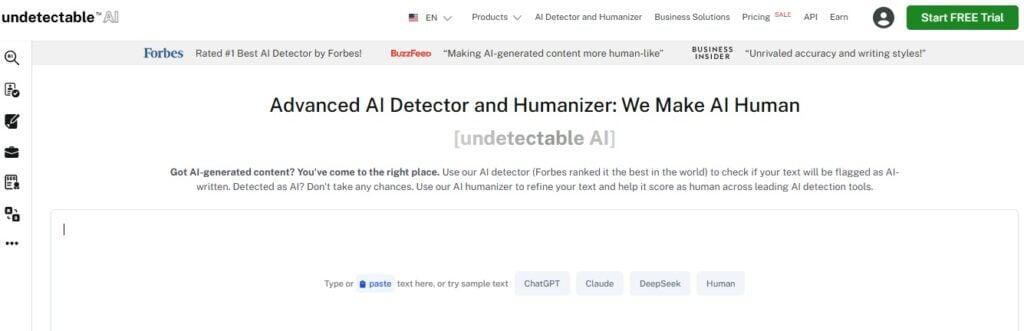
When it comes to making AI content undetectable while keeping the quality intact, Undetectable AI leads with a full suite of tools built for different needs.
Our AI Detector and AI Humanizer work together in one platform. The detector first flags which sections read as AI-generated, then the humanizer rewrites those sections to sound more natural while keeping the original meaning intact.
It’s not just randomizing words or inserting errors, it understands context, keeps things coherent, and reads like something a person actually wrote.
For marketers and content teams, our AI SEO Content Writer produces search-optimized content that naturally avoids detection triggers, handling keyword integration and structure while keeping the language natural.
Our AI Stealth Writer is built for academic and professional writing that needs to stay under the radar, adapting its output for research papers, business reports, or technical documentation.
Also, our AI Essay Writer builds original essays from scratch, incorporating research and structuring arguments the way a human writer would approach the same assignment.
Access the AI Detector and Humanizer directly through the widget below.
FAQs
How reliable and accurate are AI detector tools?
Accuracy commonly falls somewhere between 60% and 80% in controlled testing, though real-world performance is often lower. Text length, writing style, and how recent the AI model is all affect results.
Short texts and technical writing tend to produce false positives, while newer AI-generated content can slip through undetected. Treat these tools as a screening step, not definitive proof.
Can AI content detectors be wrong?
Yes, regularly. False positives can wrongly flag human work, especially technical writing or non-native English. False negatives let AI-written content slip through as models keep improving. Use detector results as one data point, not final evidence.
Which AI detector is most accurate?
None of them are consistently accurate across every type of writing. Turnitin and Originality.ai tend to perform well on longer, formal text, while shorter or heavily edited pieces trip up almost every tool. The most reliable approach is running content through more than one detector rather than trusting a single score.
Can Google Docs or Word version history prove I didn’t use AI?
It helps a lot, though it’s not airtight proof on its own. Version history shows that a document was built up over time with edits, pauses, and revisions, which is a pattern AI-generated text typically doesn’t show.
Many students and writers now keep this history specifically as a backup in case a detector flags their work incorrectly.
Do AI detectors work on paraphrased or “humanized” text?
Not reliably. Paraphrasing and humanizing tools are built specifically to break the statistical patterns detectors look for, like sentence length consistency and predictable word choice. The more editing a piece goes through after AI generation, the harder it becomes for any detector to flag it accurately.
Can AI detectors tell which AI model wrote something?
Generally, no. Most detectors can estimate the likelihood that something is AI-generated, but they can’t reliably identify which specific model, GPT-4, Claude, Gemini, or otherwise, produced it. Watermarking technology is the exception, since it embeds a signal tied to the specific model that created the content.
What percentage score counts as “AI-generated” for most schools?
There’s no universal standard. Some institutions treat anything above 50% as a concern worth investigating, while others set the bar much higher, around 80% or 90%, before taking action. Policies vary widely by school and even by individual instructor, so it’s worth checking your institution’s specific guidelines rather than assuming a number.
Is Turnitin’s AI detector mandatory or opt-in for universities?
It depends on the institution. Turnitin includes AI detection as part of its broader plagiarism-checking suite, but individual universities decide whether to activate that feature and how heavily to weigh its results in academic decisions. Some schools have paused using it altogether over false-positive concerns.
What is the future of AI-generated content detection?
It’s an arms race between smarter AI models and better detection methods. Multi-modal analysis and improved training data will help, but AI writing keeps evolving too. Expect deeper platform integration, wider adoption of watermarking, and clearer rules around AI disclosure as this space matures.
Conclusion
AI detectors work by measuring statistical patterns, not by understanding meaning, and that single fact explains almost everything about where they succeed and where they fall short.
They’re useful as a first screening step, unreliable as a final verdict, and increasingly being supplemented by newer approaches like watermarking that don’t rely on guesswork at all.
Whether you’re trying to prove your writing is genuinely yours or trying to make AI-assisted content sound more human, the honest version of that process comes down to the same thing: real editing, real judgment, and real ownership of the final piece.
If you want to check where your own content stands, Undetectable AI’s detector and humanizer tools are a good place to start.