
At some point, you realize language isn’t just about getting the grammar right or getting your point across.
It can also be clever, playful, and even satisfying. Palindromes perfectly fit those descriptors, which are words and phrases that read the same forward and backward.
Noon, racecar, “Was it a car or a cat I saw?” are all examples of palindromes, but what makes a palindrome actually work?
Why do we find them so satisfying? And how can you create your own without losing your mind in the process?
This guide breaks down everything you need to know about palindromes.
We’ll cover what they are, why they matter, and how to spot them in the wild.
You’ll learn the different types, look at real-world examples, and get practical tips for making your own.
Key Takeaways
- A palindrome is defined as any sequence (word, phrase, or number) that maintains identical spelling when read in reverse.
- The appeal of palindromes lies in satisfying the human brain’s natural preference for symmetry, structure, and compelling linguistic patterns.
- Beyond simple examples like “level,” palindromes appear across diverse fields, including literature, brand naming, music, and even molecular biology (DNA sequences).
- Creating effective palindromes is easiest when you begin by building outwards from a central letter or word, rather than attempting to construct a full sentence at once.
- There are different types, such as strict character-unit palindromes and more flexible word-unit palindromes, proving the concept is more varied than just letter reversal.
What Is a Palindrome?
For word nerds, creative writers, or anyone who enjoys clever language, palindromes can be considered as pillars of creative expression.
Palindrome Definition
A palindrome is a sequence of characters that reads the same way in both directions. Start from the left, read to the right, and you get one word or phrase.
Flip it around, start from the right, and you get the exact same thing.


Never Worry About AI Detecting Your Texts Again. Undetectable AI Can Help You:
- Make your AI assisted writing appear human-like.
- Bypass all major AI detection tools with just one click.
- Use AI safely and confidently in school and work.
The word itself comes from the Greek “palindromos.” To break it down, “palin” means “again” or “back,” and “dromos” means “running.” So literally, it’s something that runs back on itself.
Palindromes can be single words, multiple words, numbers, or even longer passages. The rules are simple: ignore spaces, punctuation, and capitalization.
What matters is the order of the actual letters or numbers.
Some palindromes are perfect mirrors. Others require you to squint a little and overlook the formatting. But the core concept stays the same: symmetry in sequence.
Palindrome Examples
Let’s start with the easy ones. Single words that work as palindromes:
- Noon. Read it forwards: N-O-O-N. Read it backwards: N-O-O-N. Perfect match.
- Radar. Same deal. R-A-D-A-R becomes R-A-D-A-R.
- Civic. Your city council’s favorite word. C-I-V-I-C works both ways.
Other classic single-word palindromes include mom, dad, pop, peep, kayak, level, rotor, refer, and stats.
These are the gateway palindromes. Easy to spot, easy to remember.
Now for the phrase palindromes, where things get interesting:
- “Was it a car or a cat I saw?” Strip away the spaces and punctuation. You get: WASITACARORACATISAW. Flip it backwards: WASITACARORACATISAW. Identical.
- “Never odd or even.” Remove spaces: NEVERODDOREVEN. Reverse it: NEVERODDOREVEN. Still works.
- “Do geese see God?” Clean it up: DOGEESESEEGOD. Turn it around: DOGEESESEEGOD. Checks out.
The longer the palindrome, the more impressive it becomes. Some writers have created entire paragraphs that function as palindromes.
Numbers can be palindromes, too. Think 121, 1331, or 12321.
Dates sometimes form palindromes: 02/02/2020 was a big one. People got weirdly excited about it.
Types of Palindromes
Not all palindromes follow the same rules.
Different types exist based on what you’re counting and how strict you want to be about them.
- Word-unit palindromes ignore individual letters and focus on whole words instead. The phrase “Fall leaves after leaves fall” works as a word-unit palindrome. The sequence of words reverses perfectly, even though the individual letters don’t.
Another example: “You can cage a swallow, can’t you, but you can’t swallow a cage, can you?” The word order mirrors itself, creating a palindromic structure at the word level.
- Character-unit palindromes are the strict version. Every single letter must match in reverse order. These are what most people think of when they hear “palindrome.” Examples like “A Santa at NASA” or “Madam, I’m Adam” fall into this category.
- Phonetic palindromes care about sound, not spelling. They’re rare and tricky. The phrase might not look like a palindrome on paper, but when you say it out loud, it sounds the same forwards and backwards. These are more theoretical than practical.
- Numeric palindromes work with digits instead of letters. 1221, 45654, and 9009 all count. Palindromic numbers show up in math problems, date formats, and even credit card security checks.
- Semordnilap is palindrome spelled backwards. It refers to words that form different words when reversed. “Stressed” backwards is “desserts.” “Live” reversed gives you “evil.” These aren’t true palindromes because they don’t read the same both ways, but they’re part of the same family of wordplay.
- Molecular palindromes exist in biology. DNA sequences sometimes form palindromic patterns. Restriction enzymes recognize these palindromic sequences and cut DNA at specific points. Scientists use this property in genetic engineering.
Some palindromes work in multiple languages, while others only function in one. The structure depends on the alphabet, character set, and linguistic rules you’re working with.
Why Palindromes Are So Popular
Humans love patterns because our brains are wired to find symmetry satisfying. Palindromes hit that sweet spot between order and surprise.
There’s something deeply pleasing about a word or phrase that loops back on itself. It feels complete. Intentional.
Like someone designed it specifically to mess with your head in the best way possible.
Palindromes are memorable. “Taco cat” sticks in your mind way better than “food feline.” The symmetry makes it easier to recall.
This is why brand names sometimes use palindromic structures.
They’re also challenging to create, which makes them impressive. When you encounter a long, elegant palindrome, you know someone spent serious time crafting it.
There’s artistry involved. It’s linguistic gymnastics.
Palindromes appear in puzzles, games, and riddles for this exact reason. They’re fun brain teasers. You can compete to find them or create them. Entire communities online share palindrome discoveries and creations.
Writers use palindromes as literary devices as they add a layer of sophistication to poetry or prose.
When used well, they enhance meaning without feeling forced. The structure itself becomes part of the message.
Mathematicians study palindromic numbers because they reveal interesting properties about number systems.
Some palindromic primes exist, and certain mathematical operations always produce palindromic results.
Pop culture embraced palindromes because they’re shareable. They work great in social media posts, memes, and viral content.
People love showing off clever wordplay, and palindromes are a great way to do so.
Palindromes in Language, Names, and Pop Culture
Palindromes show up in surprising places once you start looking for them.
- Names: Hannah is probably the most common palindromic name. Otto, Bob, and Anna are too. Some parents specifically choose palindromic names for their kids because they sound balanced and complete. Place names sometimes form palindromes. There’s a town called Yreka in California with a bakery called “Yreka Bakery.” Spell it backward, and you’ll see that it has a palindromic quality.
- Literature: Writers love sneaking palindromes into their work. James Joyce included palindromes in “Ulysses.” Vladimir Nabokov incorporated them into various novels. Modern poets often use palindromic structures to add complexity to their verses.
- Music: Some song titles are palindromes. “SOS” by ABBA is the obvious one. Composers sometimes create palindromic musical phrases where the melody reverses halfway through.
- Movies and TV: The movie “Tenet” is built around palindromic concepts. The title itself is a palindrome. The plot structure mirrors itself. Even some scenes play forwards and backwards.
- Brand names: Companies occasionally use palindromic names because they’re catchy and memorable. Civic (a Honda car model) is a palindrome, so is Xerox if you get creative with pronunciation.
- Technology: Palindromic usernames and handles are sought after on social platforms as they feel complete and official. People tend to pay premium prices for palindromic domain names.
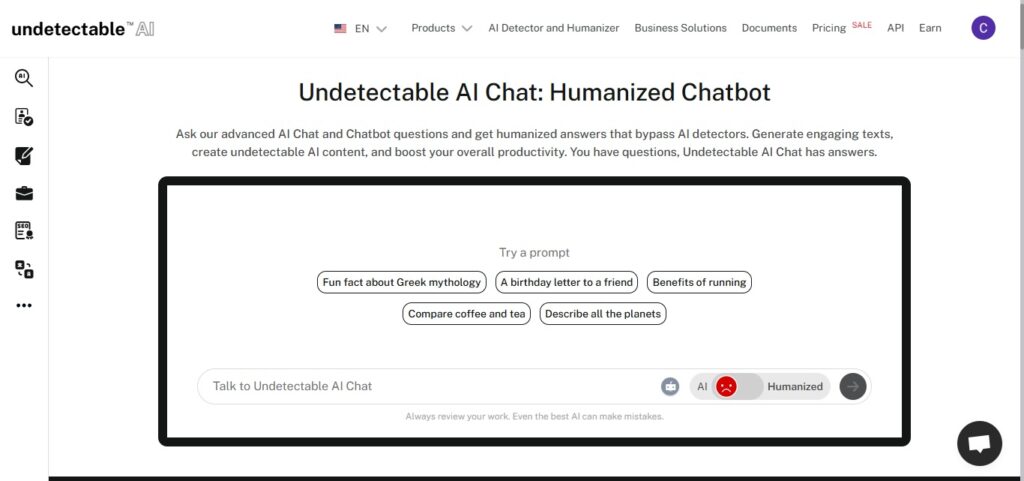
Want to brainstorm your own pop-culture-inspired palindromes or creative name ideas?
Undetectable AI’s AI Chatbot can help generate original examples and variations. It’s great for exploring different palindromic possibilities without getting stuck on a single approach.
The tool keeps ideas flowing while making sure you don’t accidentally copy existing examples.
How to Check If Something Is a Palindrome
The manual method is straightforward but tedious. Write out your word or phrase. Remove all spaces, punctuation, and capitalization.
Then compare the first character to the last, the second to the second-to-last, and so on. If they all match, you’ve got a palindrome.
For short words like “kayak,” this takes seconds.
For longer phrases, it can get tiring.
- The reverse test: Type your phrase into any text editor. Copy it. Paste it below the original. Now manually reverse the second version. Compare the two. If they’re identical, it’s a palindrome. This method works but involves a lot of manual labor.
There’s a better way.
- Online palindrome checkers exist for exactly this purpose. You paste in your text, hit check, and get an instant yes or no. These tools automatically strip out spaces and punctuation and handle the comparison for you.
Some checkers show you exactly where the palindrome breaks if it’s not perfect. This helps when you’re trying to fix an almost-palindrome.
For numbers, the process is even easier. Just look at the digits. 12321 is obviously symmetrical. 12345 is obviously not.
The tricky part isn’t checking if something is a palindrome. The tricky part is finding or creating palindromes in the first place.
How to Make Your Own Palindrome
Creating palindromes from scratch can be harder than it looks, but there are techniques that make the process easier.
- Start small. Don’t try to write a sentence-length palindrome on your first attempt. Begin with three or five-letter words. Once you master short palindromes, level up to phrases.
- Work from the middle out. Pick a central letter or word. Then build symmetrically on both sides. If your middle letter is “A,” try adding “T” before and after to get “TAT.” Add more: “TACOCAT.”
- Use common palindromic chunks. Certain letter combinations appear frequently in palindromes: “mom,” “dad,” “pop,” “eve,” “aha,” and “wow.” String these together with connecting letters that also work in reverse.
- Embrace the weird. Palindromes often sound unnatural. That’s okay. “A man, a plan, a canal: Panama” is famous precisely because it’s weird but functional. Don’t force normal sentence structure.
- Try word-unit palindromes first. These are more forgiving. “Never odd or even” works because you’re only reversing whole words, not individual letters, which makes them easier to play around with.
- Use a thesaurus strategically. Sometimes you’re one letter or one word off from a perfect palindrome. A synonym might save you. For example, if you need a word that ends with a certain letter to balance a palindrome, a slightly different word with the same meaning might do the trick.
- Test as you go. Don’t wait until you’ve written a whole sentence to check if it works. Test each addition. This prevents you from going too far down a dead-end path.
- Start with established patterns. Take an existing palindrome and modify it slightly. “Was it a car or a cat I saw?” could become “Was it a rat or a tar I saw?” You’re learning the structure by remixing.
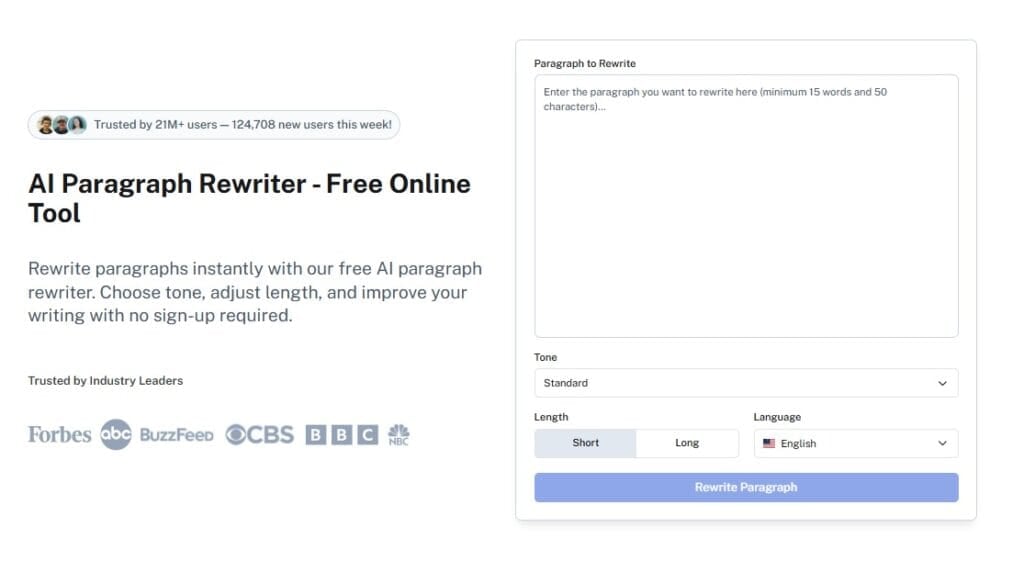
Once you’ve drafted a palindrome, Undetectable AI’s Paragraph Rewriter can help refine the phrasing while keeping the palindromic structure intact.
It’s useful when you have the bones of a palindrome, but the wording feels clunky.
The tool suggests alternatives that might flow better while maintaining the reverse-reading property.
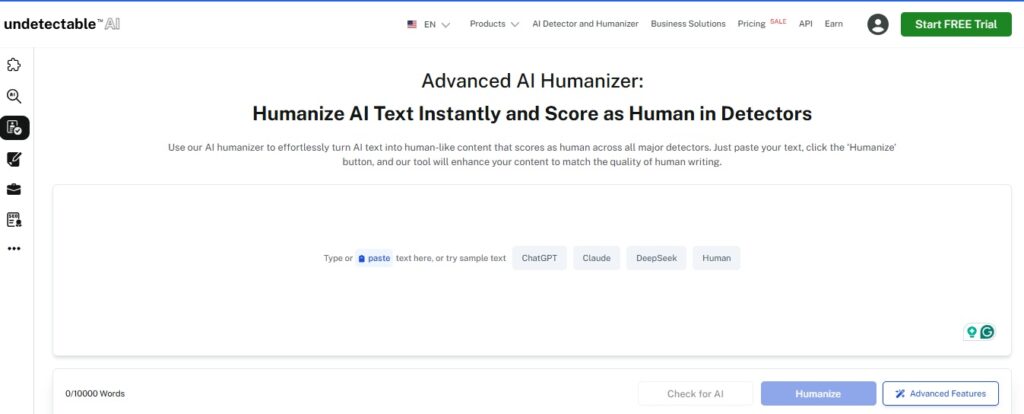
After you’ve got a working palindrome, you might want to make sure it reads naturally.
Undetectable AI’s AI Humanizer polishes the final version so it doesn’t feel overly mechanical or forced.
Palindromes can sound robotic by nature, but humanizing the text helps it feel more readable and less like a puzzle.
- Accept imperfection. Your first 10 palindrome attempts will probably fail. That’s normal. The eleventh might work. The twentieth might actually be good.
- Join palindrome communities. Online forums and subreddits exist where people share their creations and offer feedback. Scour them, and you might pick up tricks from experienced palindrome makers.
The key is practice. Like any wordplay skill, creating palindromes gets easier the more you do it.
Eventually, you’ll start spotting palindromic possibilities everywhere.
Input your text into the AI Detector and Humanizer widget below!
The Joy of a Perfect Brain U-Turn
Palindromes are more than just linguistic curiosities. They’re puzzles, art forms, and memory devices all rolled into one.
They challenge us to think about language in reverse and force creativity within strict constraints.
Whether you use palindromes in creative writing, brand naming, or just to impress friends at parties, they’re worth understanding.
They represent a unique intersection of logic and creativity. Master them, and you’ll add a powerful tool to your linguistic toolkit.
So go ahead.
Try making one and use Undetectable AI tools to help you out. See how far you can push the concept.
Who knows?You might create the next “A man, a plan, a canal: Panama.”