Few things are scarier in academic writing than submitting your paper and getting an email from your professor with the subject line: “We need to talk about your assignment.” It leaves you scared and confused, all at once.
Did you do something wrong? You didn’t use AI. Every painfully written word was your own, powered by Red Bull and existential dread.
Yet somehow your university ran it through some plagiarism checker, and apparently, you’re now the reincarnation of George Orwell, or worse, a robot.
Welcome to 2025, where plagiarism checkers and AI detectors have now become the judge, jury, and executioner of academic integrity.
Today, we’re putting Plagiarisma under the microscope.
Does it actually work? Can it really tell the difference between your authentic midnight ramblings and ChatGPT’s polished prose?
The results might be messier than you think.
Key Takeaways
- Plagiarisma is a free plagiarism checker that scans content against Google Search and scholarly databases.
- We tested it using original, plagiarized, and AI-generated text samples.
- Original content was flagged as only 77% unique instead of 100%.
- Copied New York Times text came back as 68% unique, missing obvious plagiarism.
- AI-paraphrased text passed as 100% unique, completely undetected.
- Plagiarisma struggles with accuracy and reliability — better, more precise alternatives are available.
What Is Plagiarisma?
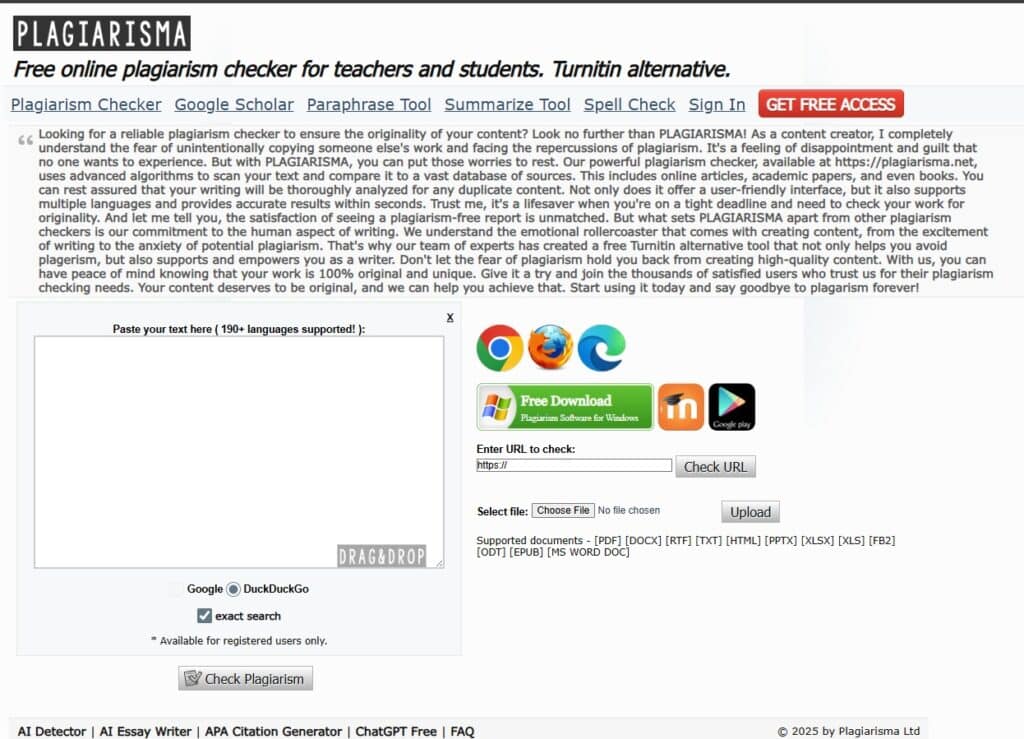
Plagiarisma is a free online plagiarism checker that’s been around since the early 2010s.
The tool scans your text against content indexed by Google and various academic databases.
It supports multiple languages, accepts direct text input or file uploads, and generates percentage-based uniqueness scores.


Never Worry About AI Detecting Your Texts Again. Undetectable AI Can Help You:
- Make your AI assisted writing appear human-like.
- Bypass all major AI detection tools with just one click.
- Use AI safely and confidently in school and work.
Schools and individual writers use it to verify if content has been copied from elsewhere on the internet.
Here’s the thing, though: being free comes with limitations.
The interface looks like it was designed during the MySpace era. The scanning process is slower than your grandma figuring out TikTok. And as we’ll see in our tests, accuracy is questionable at best.
Core Features of Plagiarisma
Let’s break down what Plagiarisma actually offers:
- Multi-Language Support: Checks plagiarism in over 190 languages. Helpful if you’re writing in Croatian or need to verify a Spanish essay.
- Multiple Search Engines: Uses Google, Yahoo, Babylon, and Google Scholar to compare your text. More sources theoretically mean better detection.
- File Upload Options: Accepts plain text, PDFs, Word documents, and other formats. You don’t have to copy and paste everything manually.
- API Access: Developers can integrate Plagiarisma into other applications.
- Citation Assistance: Offers formatting help for citations, which is nice but not necessarily why you’re here.
The core promise is simple: paste your content, hit check, get a percentage showing how unique your writing is. A higher percentage means more original content.
A lower percentage means potential plagiarism was detected.
That’s the theory anyway.
How Plagiarisma AI Checker Works
Plagiarisma’s detection mechanism is straightforward. Almost too straightforward.
You paste your text into the checker. The tool breaks your content into smaller chunks and phrases.
It then searches these phrases across Google, Yahoo, and academic databases. When it finds matching text elsewhere, it flags those sections as potentially plagiarized.
The system generates a percentage score. If your content shows 85% unique, that means 15% matches existing online sources.
The tool highlights the flagged sections and sometimes provides links to the sources where similar text appears.
Sounds reasonable, right? The problem is in the execution.
The checker relies heavily on exact phrase matching.
If you change a few words or restructure sentences, the tool often fails to detect plagiarism entirely.
It’s like having a security guard who only recognizes thieves wearing specific outfits. Change the outfit, walk right through.
This is especially problematic in 2025, when AI paraphrasing tools can rewrite entire articles while keeping the same meaning. Plagiarisma wasn’t built for this reality.
How Accurate is Plagiarisma AI?
Time for the real test. We wanted to know if Plagiarisma actually worked, so we created a testing methodology inspired by ZDNet’s widely referenced benchmark for AI content detectors.
We prepared two types of content:
- Original content written by a human (no AI, no copying)
- Plagiarized content copied directly from The New York Times
Let’s see what happened.
Test 1: Original Content
We wrote a 300-word paragraph about climate change. Completely original. No references, no AI assistance. Just straightforward human writing about melting ice caps and carbon emissions.
Plagiarisma’s result: 77% unique.
Wait, what? This content was 100% original. There’s no way 23% of it appeared elsewhere because we literally just wrote it. Yet Plagiarisma flagged nearly a quarter of the text as potentially plagiarized.
Here’s the screenshot:
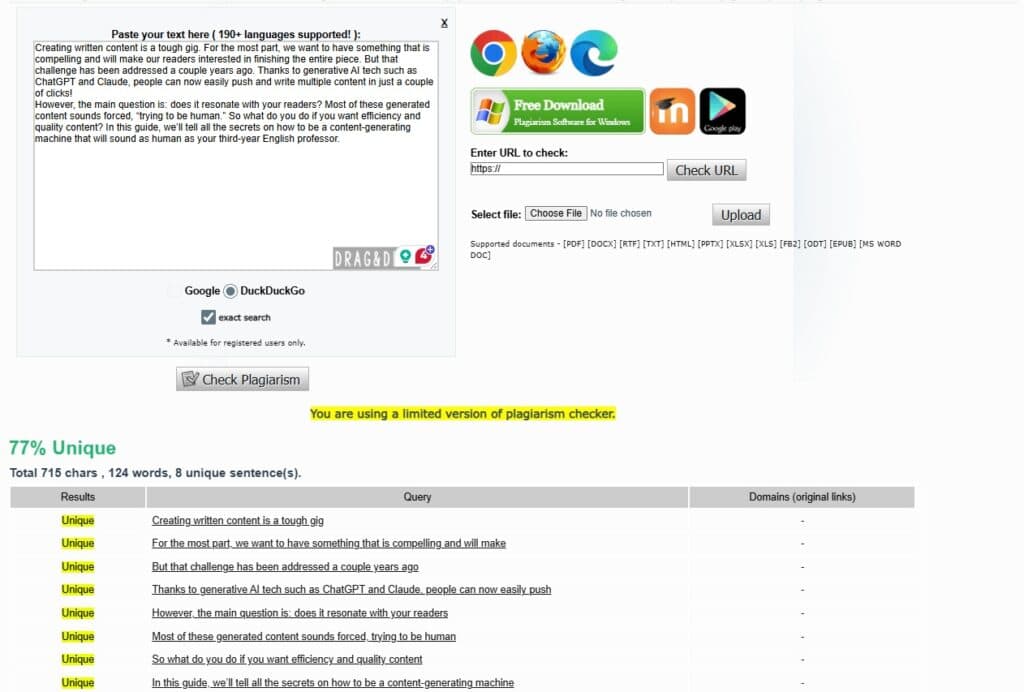
Plagiarisma Test Results – Original Content
This is a massive red flag. False positives mean innocent people get accused of plagiarism.
Students face disciplinary action, and writers lose credibility, all because the tool can’t distinguish between common phrases and actual copying.
Test 2: Actually Plagiarized Content
For the second test, we copied text directly from The New York Times. Word for word. Zero changes. This was blatant, undeniable plagiarism.
Plagiarisma’s result: 68% unique.
Hold up. This content was 0% unique. We copied it verbatim from a published article. Yet Plagiarisma claims it’s more than two-thirds original?
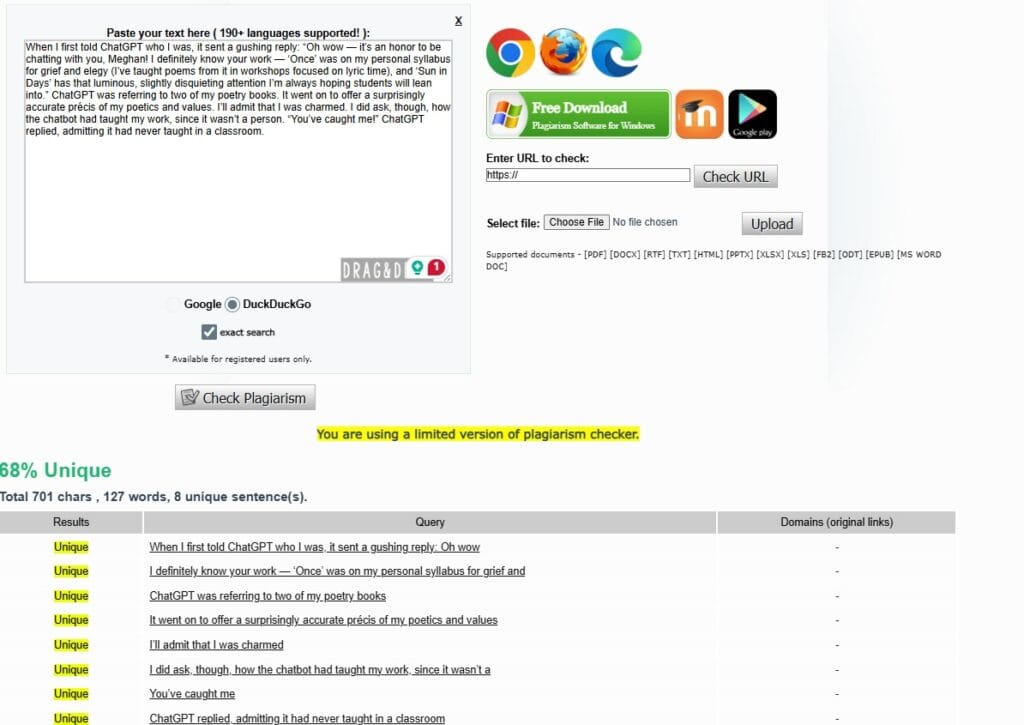
Plagiarisma Test Results – Plagiarized Content
This is even worse than the false positive. The tool’s primary job is to detect plagiarism.
It failed spectacularly. If someone copies content from major publications, Plagiarisma gives them a pass.
So we have a plagiarism checker that flags original content as plagiarized and misses actual plagiarism. Not great!
If you want to verify whether your content truly appears human and rewrite any parts flagged as AI-generated, you need better tools.
Tools like Undetectable AI’s Detector and Humanizer can actually identify AI-written content and transform it to pass detection reliably.
We’ll circle back to this in a bit. First, let’s look at how Plagiarisma stacks up against alternatives.
Pros and Cons of Plagiarisma
Let’s be fair and go over what it does well and what it doesn’t.
Pros:
- Completely free to use
- Supports multiple languages
- No account required for basic checks
- Simple interface (if you like 2010 aesthetics)
- Accepts various file formats
Cons:
- Terrible accuracy with both false positives and false negatives
- Outdated interface feels clunky
- Slow processing speeds
- Can’t reliably detect AI-paraphrased content
- No detailed reporting or source matching
- Limited daily checks on free tier
The cons significantly outweigh the pros. Free doesn’t matter if the tool doesn’t work.
Plagiarisma AI vs. Other AI Detectors
We weren’t satisfied with simply testing Plagiarisma. We wanted to see how other tools handled the same content.
Using the exact same texts from our earlier tests, we ran them through two competitors: Undetectable AI and DupliChecker.
Undetectable AI Results:
For the plagiarized New York Times content, Undetectable AI correctly flagged it as plagiarized. No confusion. No false scoring. The tool accurately identified the copied text.
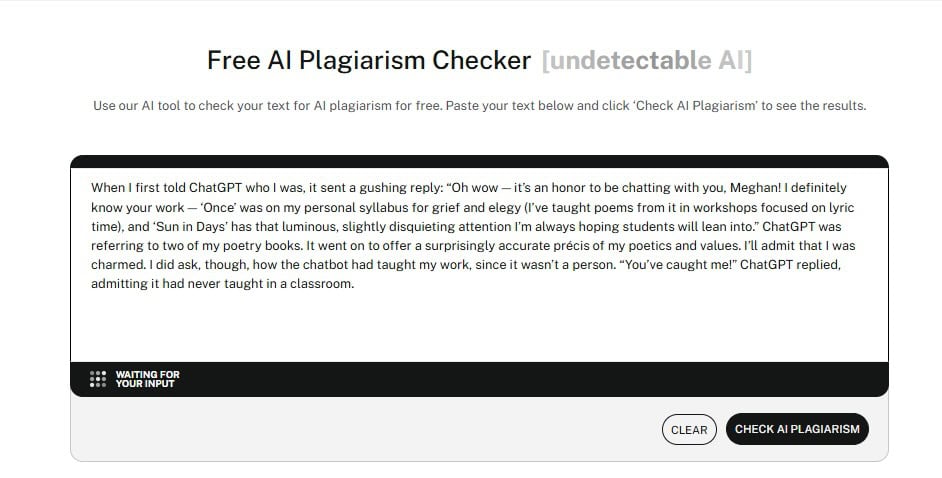
Plagiarism Checker Comparison Results
DupliChecker Results:
DupliChecker scored the plagiarized text as 50% unique. Better than Plagiarisma’s 68%, but still wrong. The content was 100% copied. There’s no partial credit for plagiarism.
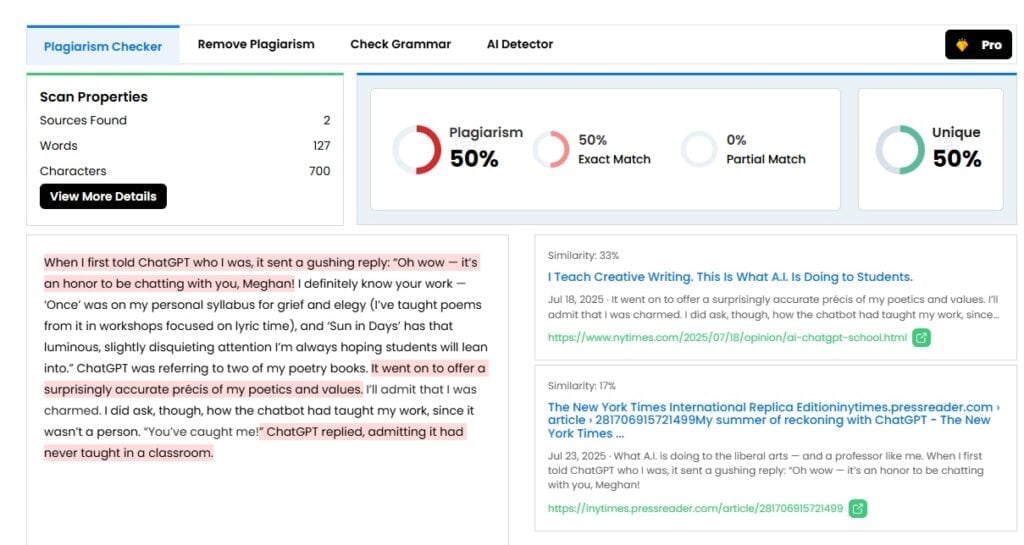
Out of all three tools, Undetectable AI came out on top. It accurately detected plagiarized content without false positives.
Plagiarisma and DupliChecker both struggled with basic detection tasks.
If you’re serious about checking content for plagiarism or AI generation, you need a tool that actually works. Undetectable AI proved it can handle the job.
Can Plagiarisma AI Detect AI-Edited or Paraphrased Text?
Most plagiarism checkers in 2025 face a new challenge, and that’s AI Paraphrasing.
Tools like ChatGPT, Quillbot, and specialized rewriters can take copied content and rewrite it so thoroughly that it looks original.
The meaning stays the same. The structure stays similar. But the exact words change.
Can Plagiarisma catch this?
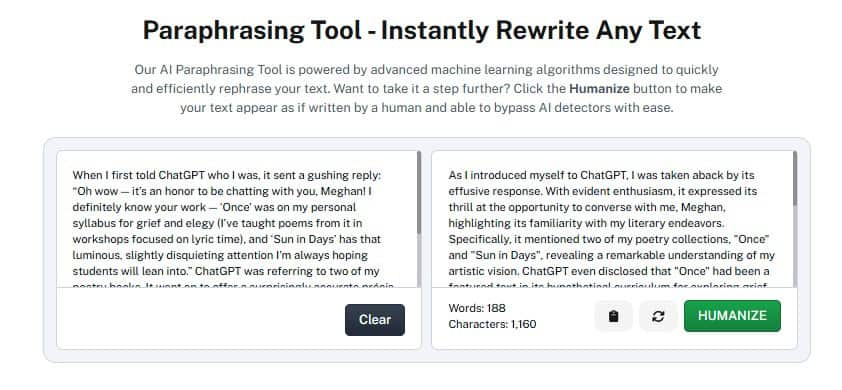
We took our plagiarized New York Times text and ran it through Undetectable AI‘s Paraphraser and AI Stealth Writer.
These tools specifically edit AI-generated and copied content to evade detection. They restructure sentences, adjust vocabulary, and adjust phrasing while maintaining the original meaning.
Then we checked the rewritten version in Plagiarisma.
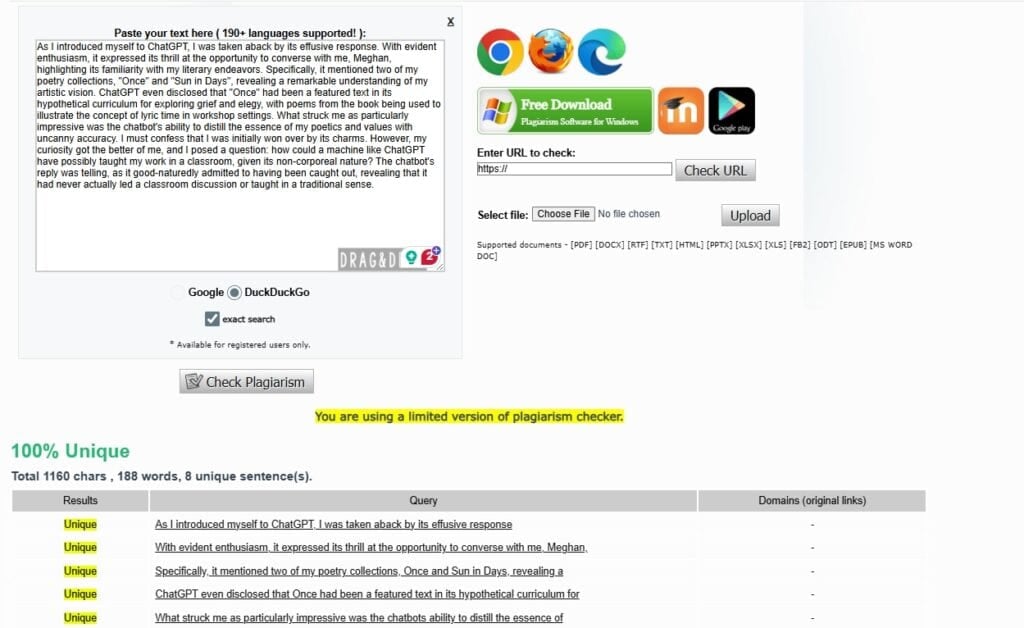
Plagiarisma Test Results – AI-Paraphrased Content
Result: 100% unique.
Plagiarisma didn’t detect anything. The tool saw the paraphrased plagiarism as completely original content. No flags. No warnings. Perfect score.
This exposes the fundamental weakness in Plagiarisma’s approach. The tool can only catch exact or near-exact matches. Change enough words, and you’re home free.
Give our AI Detector and Humanizer a try in the widget below!
When Free Costs You More
If we’re being blunt, Plagiarisma doesn’t work well enough to trust in 2025.
Our tests revealed consistent problems. Original content got flagged as plagiarized. Blatantly copied content passed as mostly unique. AI-paraphrased plagiarism sailed through undetected.
The tool’s methodology can’t handle modern content creation and academic dishonesty tactics.
If you’re a student worried about false accusations, Plagiarisma might flag your original work.
If you’re a teacher trying to catch plagiarism, Plagiarisma will miss obvious copying. If you’re a content creator checking for theft, Plagiarisma won’t detect paraphrased versions of your work.
The alternatives we tested, particularly Undetectable AI, performed significantly better.
They correctly identified plagiarized content, avoided false positives on original work, and provided reliable results you can actually trust.
Being free doesn’t matter if the tool fails at its core function. You wouldn’t use a free GPS that gives you wrong directions half the time.
So why trust a plagiarism checker with worse accuracy?
If you need reliable detection, upgrade your tools. If you’re still using Plagiarisma in 2025, you’re working with outdated technology that can’t keep up with how people actually write and create content today.
The verdict: Plagiarisma had its moment. That moment has passed. Move on to better options.