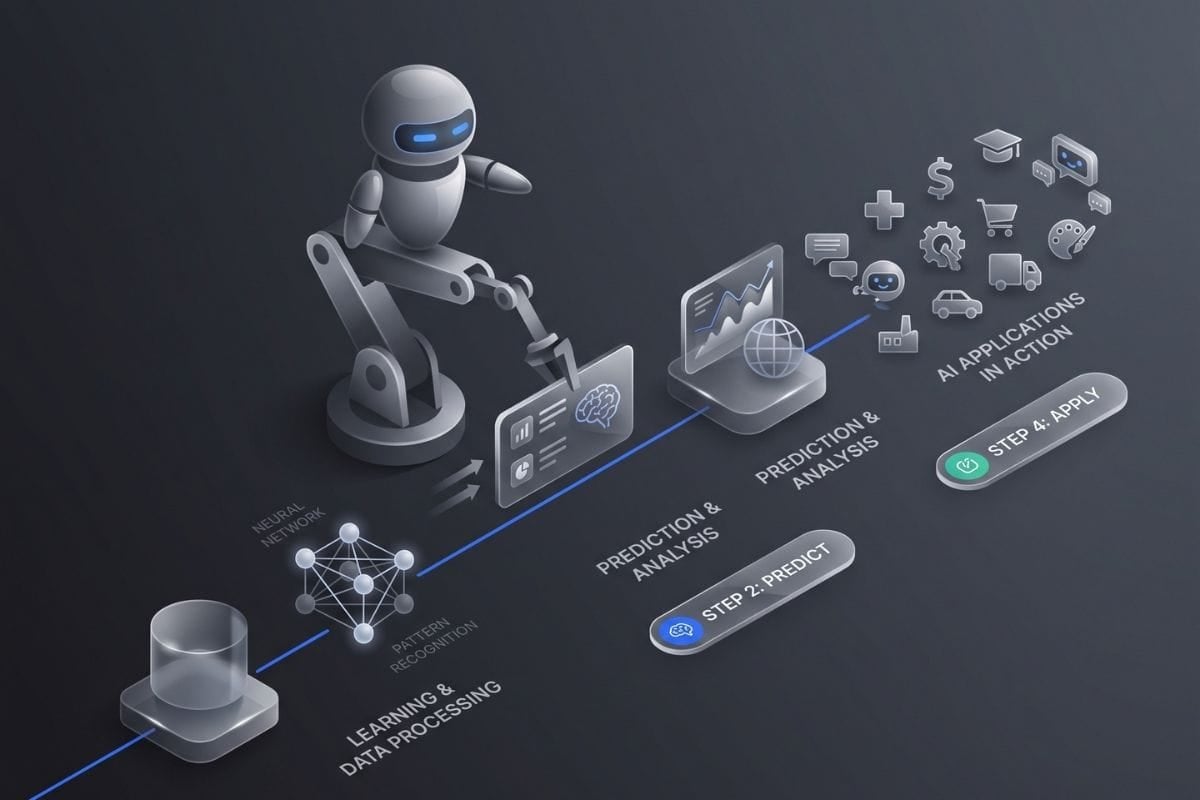
AI, or artificial intelligence, is the field of building machines and software that can perform tasks normally requiring human intelligence, like recognizing speech, making decisions, and generating new content. It now touches nearly everything, from the emails your inbox sorts automatically to the cars that can drive themselves.
Yet somewhere between the hype and the headlines, plenty of people are still unclear on what AI actually is and how it works.
So what is AI, really, and why does it feel like it’s suddenly everywhere? This guide answers that without drowning you in technical jargon.
By the end, you’ll understand what AI is, how it works, the difference between AI, machine learning, and deep learning, where it shows up in everyday life, and what its real limitations are.
Let’s start.
Key Takeaways
- AI is the science of building machines that can be trained to perform tasks we usually associate with human intelligence, like reasoning, learning, and problem-solving.
- Machine learning, deep learning, and generative AI are not separate things from AI. They’re nested inside it, each one a more specific approach.
- Most AI in use today is narrow AI, built for specific tasks. General AI (AGI), which would match human ability across every domain, remains theoretical.
- Large language models work by predicting the next word (technically the next “token”) in a sequence, based on patterns learned from massive amounts of text.
- AI comes with real limitations, including hallucinations, bias, and heavy energy use, so it’s worth understanding both what it can do and where it falls short.
What Does AI Stand For?
AI is short for artificial intelligence, and it refers to a machine’s ability to do things we normally think require a human brain, such as:
- Perceiving
- Reasoning
- Learning
- Interacting with the world
- Solving problems
- Showing a spark of creativity
You’ve probably run into AI with these capabilities without realizing it.
For instance, when you ask Siri a question or chat with a website’s support bot that somehow knows exactly what page you’re stuck on, you’re interacting with AI.


Never Worry About AI Detecting Your Texts Again. Undetectable AI Can Help You:
- Make your AI assisted writing appear human-like.
- Bypass all major AI detection tools with just one click.
- Use AI safely and confidently in school and work.
But what actually makes AI able to recognize speech, identify images, and understand human language? That comes down to a mix of algorithms, models, and some fairly advanced math. Some of the core building blocks include:
- Machine learning
- Neural networks
- Deep learning
- Natural language processing
AI vs Machine Learning vs Deep Learning vs Generative AI
This is probably the most confused set of terms in the entire topic, so it’s worth untangling clearly. The simplest way to think about it is as a set of nested circles, with each term sitting inside the one before it.
Artificial Intelligence (AI) is the broadest term. It covers any system designed to perform tasks that would normally require human intelligence, regardless of how it’s built. This includes simple rule-based systems as well as far more advanced ones.
Machine Learning (ML) is a subset of AI. Instead of following rules a programmer wrote by hand, ML systems learn patterns directly from data. The more relevant data they’re trained on, the better they generally get at their task.
Deep Learning (DL) is a subset of machine learning that uses layered neural networks, loosely modeled on how neurons in the brain connect to each other. These layers let deep learning models find much more complex patterns in data, which is why they power things like image recognition and speech-to-text.
Generative AI sits inside deep learning. It refers specifically to deep learning models trained to produce new content, whether that’s text, images, audio, video, or code, rather than just classifying or predicting a single outcome.
So when someone asks “is ChatGPT AI or machine learning?” the honest answer is: it’s all four. It’s AI, built using machine learning, using deep learning architecture, applied to a generative task.
Human Intelligence vs Machine Intelligence

AI is getting better, but it’s still not on par with human intelligence, and whether it ever will be is genuinely up for debate.
For decades, the go-to benchmark for this question was the Turing test, a method Alan Turing proposed for judging whether a machine’s conversation is convincingly human. Whether any AI has actually passed it is more contested than people assume.
Some researchers have reported that participants couldn’t reliably tell a chatbot apart from a human in controlled settings, while others argue that no AI tool so far has passed the Turing test in the way Turing originally intended, since the test says more about how easily people are fooled in a short conversation than about genuine understanding.
Either way, there’s no consensus that any AI truly understands context, nuance, and meaning the way people do.
Most experts believe true human-equivalent AI is still decades away, and some say it may never happen. That’s part of why AI readiness matters for organizations adopting these tools: realistic expectations, strong governance, and clear use cases matter more than assuming AI can already think like a person.
Generative AI tools like ChatGPT and DALL·E can do remarkable things, but under the hood, they’re prediction machines. They’ve been trained on massive datasets that let them guess the most likely response to a prompt with impressive accuracy.
That’s useful, sometimes even uncanny, but it isn’t the same thing as human intelligence.
A Brief History of AI
While the idea of “machines that think” goes back to ancient philosophy, the modern history of AI begins in the mid-20th century.
| Year | Milestone |
|---|---|
| 1950 | Alan Turing publishes Computing Machinery and Intelligence and proposes the Turing Test. |
| 1956 | John McCarthy coins the term “artificial intelligence” at the Dartmouth Conference. The first AI program, Logic Theorist, is created. |
| 1967 | Frank Rosenblatt develops the Mark 1 Perceptron, an early neural network that demonstrated machine learning through trial and error. |
| 1980 | Backpropagation becomes widely used for training neural networks. |
| 1997 | IBM’s Deep Blue defeats chess champion Garry Kasparov, showing AI could surpass human expertise in a complex task. |
| 2004 | John McCarthy publishes What Is Artificial Intelligence?, offering a widely cited definition of AI during the rise of big data and cloud computing. |
| 2011 | IBM Watson wins Jeopardy! against top human champions. |
| 2015 | Baidu’s Minwa supercomputer achieves human-surpassing image recognition. |
| 2016 | DeepMind’s AlphaGo defeats Go champion Lee Sedol. |
| 2022 | Large language models like ChatGPT emerge, dramatically expanding public awareness of generative AI. |
| 2024 | Growth of multimodal and smaller, more efficient AI models. |
| 2025 | Rapid adoption of agentic AI systems, alongside major investment from tech companies and governments in AI chips, infrastructure, and development. |
| 2026 | Agentic AI moves further into everyday enterprise workflows, AI regulation matures across more countries and regions, and competition over AI infrastructure and compute continues to intensify. |
Key AI Terms, Explained
If you’re new to this space, the vocabulary can feel like a wall. Here’s a plain-language glossary of the terms you’ll run into most often.
Model – The trained system itself. It’s the mathematical structure that has learned patterns from data and can be used to make predictions or generate outputs.
Parameter – An internal value inside a model that gets adjusted during training. Modern language models can have billions of parameters, which is part of why they’re so resource-intensive to build.
Training – The process of feeding a model large amounts of data so it can learn patterns and relationships within it.
Inference – What happens after training, when a model is actually put to use, taking a new input and producing an output based on what it learned.
Token – A chunk of text, often a word or part of a word, that a model breaks language into before processing it.
Prompt – The instruction, question, or input you give an AI system to get a response.
Hallucination – When an AI system generates information that sounds confident and plausible but is actually false or made up.
Fine-tuning – Taking an already-trained model and training it further on a narrower, more specific dataset so it performs better at a particular task.
RAG (retrieval-augmented generation) – A technique where a model pulls in outside information, like documents or a database, at the moment it’s answering, instead of relying only on what it learned during training.
Agent – An AI system that can take actions and make decisions on its own, with minimal human input, in order to complete a task.
Multimodal – An AI system that can work with more than one type of data, such as text, images, audio, or video, rather than just one.
Context window – The amount of text or information a model can “see” and consider at once when generating a response.
How AI Works
Now that we’ve covered what AI is and how it compares to human intelligence, here’s a bird’s-eye view of how it actually works. There are five key stages:
Inputs: Every AI system needs data to exist. This can come from just about anywhere, including text, audio, video, and sensor data.
Processing: Once data is available in a usable format, the AI applies its programmed algorithms to identify patterns and relationships within it. This is called training, and it’s what lets the system recognize similar patterns in new data later on.
Outcomes: After analyzing the data, the AI produces its predictions or classifications, such as deciding whether a piece of data matches a previous pattern.
Adjustments: When the AI gets something wrong, that error becomes a learning point. The system loops back to recheck its decisions under updated rules. This can involve tweaking the algorithm’s rules, changing how data is interpreted, or refining the conditions under which it processes inputs.
Assessments: In the final stage, the AI evaluates its overall performance, factoring in the results of previous adjustments and using them to improve future predictions.
How a Large Language Model Actually Works

If you’ve read this far because you specifically wanted to understand how something like ChatGPT works, here’s the short version.
Step 1: Text becomes tokens. Before a large language model (LLM) can do anything with your prompt, it breaks the text down into tokens, small chunks that might be a whole word or just part of one.
Step 2: The model predicts the next token. At its core, an LLM is a next-token prediction system. Given the tokens it has seen so far, it calculates the most statistically likely next token, then the one after that, and so on, building a response one piece at a time.
Step 3: Training builds that ability. To get good at this, the model is trained on enormous amounts of text, learning patterns in grammar, facts, reasoning, and style by repeatedly trying to predict the next token and adjusting its internal parameters when it gets it wrong.
Step 4: Fine-tuning and RLHF shape behavior. Raw next-token prediction alone tends to produce something unpredictable or unhelpful. Most modern models go through additional stages like fine-tuning and reinforcement learning from human feedback (RLHF), where human reviewers rate outputs and the model is nudged toward responses people actually find helpful, accurate, and appropriate.
Step 5: Inference generates your answer. When you actually use the model, it isn’t learning in real time. It’s applying everything it learned during training to predict, token by token, the response most likely to satisfy your prompt.
None of this means the model “understands” your question the way a person does. It’s an extremely sophisticated pattern-matching and prediction system, which is exactly why it can be remarkably useful and still occasionally confidently wrong.
Types of AI
Narrow AI vs General AI
When people first ask what AI is, they’re often thinking of the version they’ve already seen in action: narrow AI, also called weak AI. It’s built to perform a very specific task or a defined set of tasks, like spotting fraudulent transactions, powering voice assistants such as Siri and Alexa, or running the natural language processing behind a chatbot. Most AI you interact with today is narrow AI.
On the other hand, Artificial General Intelligence (AGI), sometimes called strong AI, would learn and apply knowledge across a wide variety of tasks and match or surpass human capability at all of them. Right now, AGI is still theoretical. No AI system has reached that level.
Agentic AI
If you’ve been hearing the term “agentic AI” and wondering what it means, the simplest way to put it is that it’s a system built from AI agents. AI agents are autonomous programs that perform tasks and make decisions with minimal human assistance. The “agent” in their name refers to the agency these tools can exercise.
Agentic AI builds on that idea by coordinating multiple AI agents to work together toward a bigger goal that no single agent could pull off alone.
Reactive Machines, Limited Memory, and Theory of Mind
There’s another way to classify AI, based on whether it can retain information and how it interprets its environment. This splits AI into three categories:
Reactive machines are the most basic form of AI. They respond only to the current input they receive, without storing any memory of what happened before. After processing an input, they discard it and move on with a blank slate.
Limited memory machines store past data internally, letting them recognize patterns and correlations over time and use that understanding to improve their responses in dynamic conditions. Most AI in wide use today, including self-driving car systems and chatbots, falls into this category.
Theory of mind describes AI that could understand the existence of other agents, human or machine, and infer their internal states, like beliefs, intentions, or emotions. This isn’t possible yet, because it requires recognizing that actions often have unseen causes rooted in another mind, something current systems can’t genuinely do.
AI by Industry
AI isn’t confined to chatbots and recommendation feeds. It’s now embedded in the daily operations of nearly every major industry.
Healthcare
AI is used to analyze medical images like X-rays and MRIs, helping radiologists catch things like early-stage tumors that can be easy to miss. It’s also used in drug discovery, where AI models help researchers predict how molecules will behave, cutting years off early-stage research.
Finance
Banks and payment processors use AI to flag fraudulent transactions in real time, often catching patterns a human analyst would never spot fast enough. AI also powers algorithmic trading and increasingly plays a role in credit scoring and risk assessment.
Education
Adaptive learning platforms use AI to adjust the difficulty and pacing of lessons based on how a student is performing, rather than teaching everyone at the same speed. AI tools are also used for grading assistance and generating practice material.
Legal
Law firms use AI to review contracts and flag risky clauses far faster than a team of junior associates could manually. It’s also used in e-discovery, sorting through massive volumes of documents during litigation, and in legal research tools that summarize case law.
Retail
Retailers use AI for personalized product recommendations, demand forecasting, and dynamic pricing that adjusts based on demand and inventory. Customer service chatbots, many of them AI-driven, now handle a large share of routine support questions.
Manufacturing
On factory floors, AI-powered computer vision inspects products for defects far faster and more consistently than manual inspection. Predictive maintenance systems analyze sensor data from machinery to flag likely failures before they happen, reducing costly downtime.
Creative Work
Writers, designers, and musicians increasingly use generative AI tools to draft copy, generate concept art, or produce rough audio tracks. It doesn’t replace creative judgment, but it does speed up the early, exploratory stages of a project considerably.
Examples of AI
Autonomous Vehicles
Self-driving cars rely heavily on machine learning trained on enormous datasets that include everything from traffic patterns to road sign recognition.
Developers often use artificial simulations to evaluate performance before vehicles ever hit the road. Black-box testing is common here too, a method where testers probe the system’s behavior to identify weaknesses without direct access to its inner workings.
Text Editors and Autocorrect
If you’ve ever used Grammarly to check an essay or relied on autocorrect while texting, you’ve interacted with AI. Just as you learned grammar rules in school, AI algorithms are trained to recognize proper language use and spot deviations from it. When you misuse a comma or pick the wrong word, the editor flags it and suggests a fix.
Virtual Assistants
Virtual assistants like Amazon Alexa, Google Assistant, and Apple’s Siri help with everyday tasks. They learn from your usage patterns over time and adapt to your preferences, getting better at anticipating what you need.
Search and Recommendation Algorithms
When you browse a streaming service and find a row of suggestions that feel surprisingly on point, or an online store shows products that match your recent searches, you’re seeing AI-driven recommendation systems at work.
These systems track your interactions over time and analyze them using machine learning and deep learning models to predict what you’ll want next.
What Is Generative AI?
There’s a particular category of AI that has gained major attention for its ability to create entirely new content on demand. This is generative AI, or gen AI, and it refers to deep learning models that produce original outputs in response to a user’s prompt.
These systems can create:
- Long-form text
- High-quality images
- Realistic video
- Lifelike audio
- Functional code
The latest generative AI models can even build interactive simulations right inside a chat window.
The quality of a generative AI system’s output depends on how sophisticated the model is and how closely your prompt aligns with what it was trained on.
For example, ChatGPT can produce a clear, well-structured essay on theories of nationalism in seconds, while image-based systems like DALL·E 2 can create unusual but visually striking compositions, like a Renaissance-style painting of a Madonna and child eating pizza.
For people interested in applying generative AI to writing, tools like AI Humanizer, AI Essay Writer, and AI SEO Writer offer practical ways to create high-quality written content.
Limitations and Risks
It’s easy to get swept up in what AI can do and skip past what it can’t, or what it costs to run at scale. A realistic picture of AI includes its downsides.
Hallucination: AI models can generate information that sounds completely confident and coherent while being factually wrong. This is a known, ongoing issue, not a rare glitch, and it’s part of why AI outputs still need human review, especially for anything factual or high-stakes.
Bias: Because AI models learn from existing data, they can pick up and even amplify biases present in that data, whether that shows up in hiring tools, lending decisions, or content moderation.
Privacy: Training data often includes vast amounts of information scraped from the internet, and AI tools that process personal data raise real questions about consent, data retention, and how that information might be reused.
Energy and water use: Training and running large AI models, especially large language models, requires significant computing power. That translates into real electricity consumption and, in the case of many data centers, substantial water use for cooling.
Labour displacement: AI will replace some repetitive or routine jobs, even as it creates new ones in fields like AI engineering and data science. The transition isn’t always smooth, and it doesn’t affect every industry or role equally.
Concentration of capability: Building and training frontier AI models requires massive amounts of compute, data, and capital, which means the most advanced AI systems are currently concentrated among a small number of large companies. That raises questions about competition, access, and who gets to shape how these tools are built and used.
How to Tell If Something Was Made by AI
As generative AI gets better, spotting AI-made content with the naked eye gets harder. A few manual signs can still help:
- Text that feels oddly generic, repetitive in structure, or overly balanced in tone, without a clear point of view
- Images with subtle inconsistencies, like odd hands, mismatched lighting, or text that looks garbled
- Video with unnatural blinking, lighting that doesn’t quite match, or audio that’s slightly out of sync
That said, manual guessing gets less reliable every year, especially with newer models. Dedicated detection tools are far more consistent.
Undetectable AI’s AI Detector, AI Image Detector, and AI Video Detector are built specifically to flag AI-generated text, images, and video, so you’re not relying on guesswork to verify whether something is authentic.
Frequently Asked Questions
Is AI the Same as Machine Learning?
No. AI is the broad field of creating machines that mimic human intelligence, while machine learning is a subset of AI that teaches machines to learn from data without being explicitly programmed for every scenario.
What Is the Difference Between AI and Automation?
Automation follows pre-set rules to perform repetitive work the same way every time. AI can learn from data, make decisions, and adapt its behavior over time based on experience.
Can AI Think Like Humans?
AI can simulate some aspects of human thinking, like recognizing patterns, making predictions, and solving problems. It doesn’t truly think or feel the way humans do. It processes information based on algorithms and data, not emotions or consciousness.
Will AI Replace Human Jobs?
AI will replace some repetitive or routine jobs but will also create new ones. While certain roles may disappear, AI is also generating demand for positions like data scientists, AI engineers, and AI ethics specialists. The shift is more about changing the nature of work than eliminating it outright.
Who Invented AI?
There’s no single inventor. Alan Turing laid early theoretical groundwork in 1950, and the field was formally named by John McCarthy at the 1956 Dartmouth Conference, alongside contributors like Marvin Minsky, Allen Newell, and Herbert Simon.
Is AI Conscious?
No. Current AI systems don’t have subjective experience, self-awareness, or genuine understanding. They generate responses based on statistical patterns learned from data, not conscious thought.
What Is AGI?
AGI stands for Artificial General Intelligence, a hypothetical form of AI that could match or exceed human capability across virtually any task, rather than being limited to specific functions. It doesn’t exist yet.
How Is AI Trained?
AI is trained by feeding it large amounts of data and letting it adjust its internal parameters based on how close its predictions come to the correct answer. This process repeats many times until the model’s performance improves to an acceptable level.
What Data Does AI Use?
AI models are trained on a wide range of data, including text, images, audio, video, and sensor data. This often comes from publicly available internet content, licensed datasets, and, in some cases, user-generated content.
Is AI Safe?
It depends heavily on the specific system, how it’s built, and how it’s used. AI safety is an active area of research, and responsible development includes testing, guardrails, and human oversight, though no AI system is entirely without risk.
What’s the Difference Between AI and a Chatbot?
A chatbot is one application of AI, an interface for conversation. AI is the much broader field of technology that can power a chatbot, along with countless other applications like image recognition or recommendation systems.
What Is the Turing Test?
The Turing test, proposed by Alan Turing in 1950, is a method for evaluating whether a machine’s conversation is convincing enough to be mistaken for a human’s. Whether any AI has genuinely passed it remains debated among researchers.
Do I Need to Know How to Code to Use AI?
No. Most everyday AI tools, from chatbots to writing assistants to image generators, are designed for anyone to use through plain text prompts. Coding knowledge only becomes relevant if you’re building or customizing AI systems yourself.
Conclusion
AI has gone from a research curiosity to something woven into daily life, powering everything from autocorrect to medical diagnostics to the recommendations in your streaming queue.
Understanding what it actually is, how it works, and where its limits are puts you in a much better position to use it well, instead of just reacting to the headlines.
When you’re ready to put that understanding to work, Undetectable AI‘s writing and detection tools can help you create and verify content with confidence.