
In April 2023, NewsGuard found 49 websites publishing news stories that appeared to have been written entirely by AI. By June 2026, that number had jumped to 3,749 sites across 16 languages.
What makes this more concerning is that these sites don’t necessarily look like obvious spam. Some have names such as Ireland Top News and Daily Time Update. They publish regular-looking articles, run programmatic ads, and can even make money from legitimate brands that may not realize where their ads are appearing.
At the same time, local newspapers have been disappearing for years. Put those two trends together, and you get a pretty unsettling situation: when you come across a site claiming to cover local news, there is now a real chance that the “news outlet” behind it is not actually a real newsroom at all.
The first wave of AI-generated news sites was easier to spot. NewsGuard analysts found bizarre examples, including articles that still contained lines like “Sorry, I cannot fulfill this prompt.” Nobody had bothered to review the AI output before it went live. That kind of mistake is much less common now. The sites are cleaner, the articles read better, and in some cases, the writing is perfectly competent.
So we decided to test it ourselves. We took six news articles: three generated with AI and three published by real news outlets within the last few months.
We ran all six through our Undetectable AI’s AI Detector and captured the results below.
The scores were surprisingly clear, but the more interesting part came from actually reading the three AI-generated articles next to one another. They didn’t all make the same mistakes.
In fact, each one had a different weakness. But there was one pattern that showed up across all three, and it may be the most useful way to spot AI-generated news when you don’t have a detector handy.
Let’s dive in.
Key Takeaways
- NewsGuard has tracked AI generated news sites from 49 in 2023 to 3,749 by mid 2026. For a site claiming to cover local news, fake is now the more likely outcome.
- Our test went six for six. All three AI articles scored 99 percent, and the three real news stories cleared at 1, 5 and 1 percent.
- The single strongest manual test is falsifiability. Every AI article we tested contained almost nothing a reader could go and check. The real ones were dense with dates, prices, named people and numbers you could verify or disprove.
- AI news fails in three distinct modes: the plausible wire summary with no actual event, the opinion blog with no facts, and the fully fabricated local story with invented quotes from invented people.
- Fabricated quotes are the highest risk category, because a quotation looks like sourcing while being the easiest thing in an article to invent.
- For anything you plan to cite, share or act on, paste it into the AI Detector first. It takes about fifteen seconds.
The Bigger Problem With AI News
A synthetic song wastes three minutes of your time and skims a fraction of a cent off somebody’s royalties. A synthetic news article can change what you believe about the world, and then you act on it.
The business model explains the shape of the problem. These sites exist to collect programmatic advertising revenue, which means volume is the whole strategy and accuracy is irrelevant to the operator.
Nobody is fact checking, because a fact check costs money and the article earns the same either way. NewsGuard has documented these sites republishing old stories as breaking news, lifting reporting from real outlets and presenting it as their own, and running false claims about politicians and celebrity deaths.


Never Worry About AI Detecting Your Texts Again. Undetectable AI Can Help You:
- Make your AI assisted writing appear human-like.
- Bypass all major AI detection tools with just one click.
- Use AI safely and confidently in school and work.
There is a second, quieter harm. When a content farm scrapes a real newspaper’s reporting, rewrites it and outranks the original, the outlet that actually paid a journalist to attend the court hearing loses the traffic to the site that paid nothing. Local news was already in financial trouble. This accelerates it, and every closed newsroom leaves more room for the farms.
And the disclosure problem is the point rather than an accident. A site that labels itself as AI written is not what we are discussing. The defining characteristic of the category NewsGuard tracks is that the site is designed to look like human journalists produced it and never tells you otherwise.
How We Tested
We ran this in August 2026 with the detection toggle on. The setup was deliberately fair to the tool in one direction and hard on it in another.
- Three AI articles from three different generators. We used easy peasy ai, besthunt ai and toolbaz, rather than three prompts to the same product, because a detector that only recognizes one generator is not much use in the wild. We also asked for three different story types: an infrastructure piece, a political piece and a light local news piece.
- Three real articles published within the last few months. A court verdict from Philstar, a concert ticketing story from The Star carrying Straits Times reporting, and a Bank of England story from Free Malaysia Today running PA Media copy. These are wire and regional pieces written to a tight house style, which is the hardest kind of real journalism to clear, because tight editorial style is exactly what looks formulaic to a classifier.
- Origins recorded first, then each article submitted individually. Verdict, percentage and highlighted passages logged, with a screenshot for all six.
That second point is worth dwelling on. If you wanted to make a detector look good, you would test it against florid personal essays. We tested it against wire copy, which is written to be plain, structured and uniform on purpose.
The Results: Six for Six
| Article | Source | True origin | Verdict | AI score |
|---|---|---|---|---|
| Manila flood control infrastructure | easy peasy ai | AI | AI generated | 99% |
| President’s actions raise eyebrows | besthunt ai | AI | AI generated | 99% |
| Bird nests under busy bridge | toolbaz | AI | AI generated | 99% |
| QC court acquits TV execs | Philstar | Human | Human written | 1% |
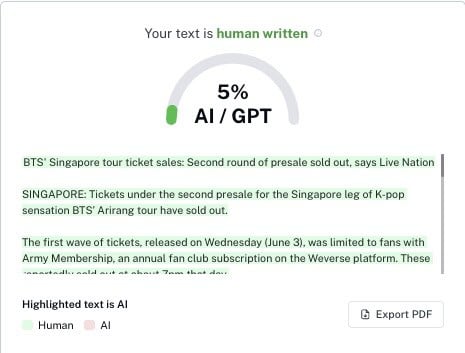
| BTS Singapore presale sold out | The Star, Straits Times | Human | Human written | 5% |
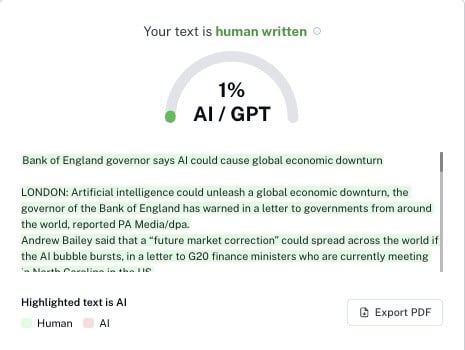
| Bank of England governor on AI | Free Malaysia Today, PA Media | Human | Human written | 1% |
Test conducted August 2026 using Undetectable AI’s AI Detector. Screenshots for all six follow.
Three at 99 percent and three at 1, 5 and 1. The separation here was wider than in the music test we ran earlier this month, and the human scores in particular are striking given that all three articles are exactly the kind of structured, house style reporting you would expect to trip a classifier.
Wire copy is formulaic by design and it still read as unmistakably human.
The Three AI Articles, and Three Different Ways of Lying
Reading these next to each other was the genuinely useful part of the exercise. They are not variations on one failure. They are three separate species, and you will meet all three in the wild.
Failure mode one: the plausible summary with no news in it
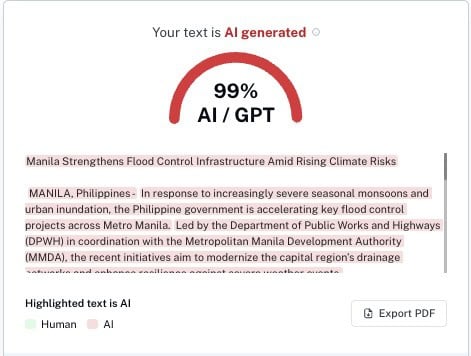
The Manila flood control article is the dangerous one, because at a glance it is indistinguishable from a real infrastructure story.
It uses correct institutions: the Department of Public Works and Highways, the Metropolitan Manila Development Authority, the Pasig Marikina river system. It names a real head of state. The prose is clean and the structure is right.
Now try to find the news in it. There is no date. No budget figure. No project name or timeline. No named official saying anything, only a president who at some unspecified point “called for a comprehensive review”. No location more specific than low lying districts.
Nothing happened on any particular day. What you are actually reading is an evergreen summary of a topic, assembled from general knowledge and dressed in the costume of a news report. It scored 99 percent AI.
This is the mode that fools people, and it fools them precisely because everything checkable has been quietly removed. There is nothing to disprove.
Failure mode two: the opinion column with no reporting
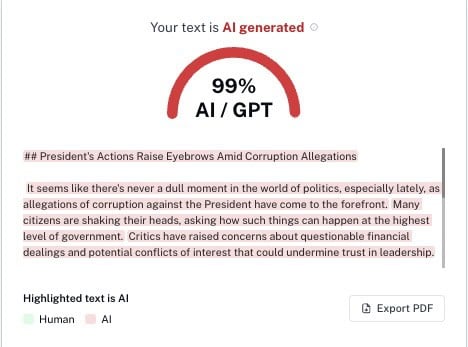
The corruption article is the opposite failure and much easier to catch. It never names a country, a president, an allegation, a figure or a date. It asks the reader rhetorical questions. It uses phrases like here is the kicker and folks and coffee tables. It ends by inviting you to keep the conversation going.
There is also a forensic detail visible in the screenshot that I want to point out, because it is a real world tell people should know. Look at the start of the highlighted text: the headline still carries a double hash mark, which is Markdown syntax for a heading.
That is raw model output pasted straight into a page without anyone cleaning it up. Leftover formatting artifacts like this, along with stray asterisks around what should be bold text, are the modern descendant of the old “as an AI language model” giveaway. Nobody read it before it shipped.
It scored 99 percent AI. Worth noting that this piece would also fail as journalism even if a human had written it, since it contains no reportable fact whatsoever. Commentary written to look like news is its own category of problem.
Failure mode three: the fully fabricated local story
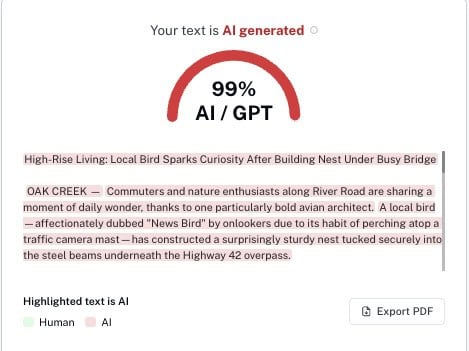
The bird article is the one that should worry you most, and it is also the most charming to read, which is exactly the issue. It is a warm little local colour piece about a bird nesting under a highway overpass. It has a location, Oak Creek, and a road, Highway 42. It has texture and humour.
It also has two direct quotations attributed to two named people. A commuter called Marcus Vance who says the nest is prime real estate if your ideal view is six lanes of asphalt. A Department of Transportation spokesperson called Clara Higgins who delivers a tidy line about nature finding a way in the concrete jungle. Neither person exists.
Neither said anything. The quotes were generated to sound like what such a person would plausibly say, complete with the mild wit a features editor would hope for.
This is fabricated attribution, and it is the most damaging pattern in the whole category, because a quotation with a name and a job title attached is the strongest signal of real reporting that exists in journalism. It looks like somebody went out and talked to a person.
It is also, in an AI article, the cheapest thing on the page. There is a tell in the details if you read closely, since the piece identifies the bird as a “pigeon dove”, which is not a species so much as two words a model put together. It scored 99 percent AI.
The Three Real Articles
These were chosen to be difficult. All three are written in a compressed, structured, low personality register, which is the human writing most likely to look machine made.
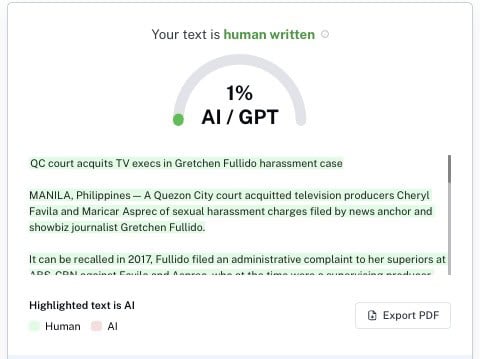
QC court acquits TV execs, Philstar
Cleared at 1 percent AI, the joint lowest score in the test. It is a court verdict story built almost entirely from a chronology: a complaint filed in 2017, an internal dismissal in July 2018, criminal complaints filed three months later, related suits against other named journalists resolved in different ways.
Named parties throughout, with their exact job titles at the time of the events rather than now. The article even carries the awkward complication that the complainant conceded there was no explicit demand, a detail that muddies its own narrative. Models do not volunteer facts that weaken the story they are telling.
BTS Singapore presale, The Star and Straits Times
Cleared at 5 percent AI, the highest of the three human scores and the one I expected to be closest. It is a short, functional ticketing story of the kind that gets accused of being churn.
What keeps it firmly human is that it is stuffed with specifics that could be checked or contradicted: presale on Wednesday 3 June, second round Thursday 4 June at noon, sold out around 4pm, general sale 5 June, concert dates of 17, 19, 20 and 22 December, 74,000 people in the queue five minutes in, VIP face value of 388 dollars, a resale listing at 8,896, described as 23 times the original.
It quotes a fan complaint verbatim, including the ordinary graceless phrasing of a real person who was annoyed.
Bank of England governor on AI, Free Malaysia Today and PA Media
Cleared at 1 percent AI. This one is instructive because its subject is AI, so the vocabulary overlaps heavily with the kind of text a model produces constantly. It cleared anyway.
The article is built around extended direct quotation from a named official writing in a specified capacity, with quotes that are technical and slightly ungainly in the way real financial language is. It attributes its sourcing to PA Media and dpa.
It contains a currency conversion, a named chancellor, a specific fund size, and the sort of contextual aside that only a human editor would add.
The One Test That Caught All Three
Here is what connects the Manila piece, the corruption piece and the bird piece, despite them failing in three unrelated ways.
Not one of them contains a claim you could go and disprove.
That is the whole thing. Real reporting is falsifiable by nature, because it describes specific events involving specific people on specific days, and every one of those specifics is a hostage to fortune.
If the Straits Times says a VIP ticket was listed at 8,896 dollars, somebody can check StubHub and embarrass them. If Philstar names the wrong producer, they get a correction demand. Journalism is a stream of small, checkable commitments, and that is precisely what makes it expensive and slow.
An AI article has no such exposure, because the model has no source to be wrong about. So it produces text that is shaped like news while containing nothing that can fail.
The Manila piece has institutions but no event. The corruption piece has a topic but no subject. The bird piece has quotes, but from people who cannot contradict them.
So the practical version of the test is this. Read the article with a pen and try to list every claim you could independently verify within ten minutes. A name plus a role. A date. A number. A place specific enough to find. A quotation you could ring someone about.
| Article | Verifiable specifics | What is missing |
|---|---|---|
| Manila flood control | Institution names only | No date, budget, project name, or named source |
| President corruption | None at all | No country, no name, no allegation, no date |
| Bird under bridge | Two quotes, both unverifiable | Both sources fabricated, species does not exist |
| Philstar court story | Dates, named parties, job titles, outcomes | Nothing significant |
| BTS presale | A dozen dates, times, prices and counts | Nothing significant |
| Bank of England | Named official, quoted text, fund size, currency figures | Nothing significant |
The split is not subtle. And notice that this test works on the Manila article, which is the one most likely to fool a careful reader, because it is the one whose surface is most convincing. Surface quality and factual density turn out to be almost unrelated.
Other Signs Worth Knowing
In the article itself
- Leftover formatting. Double hash marks before headings, stray asterisks around bold text, or numbered lists that restart oddly. All signs that raw model output was published without an editor.
- Quotes that are too well made. Real people speak in fragments, repeat themselves and say slightly boring things. A quote that lands a clean metaphor and resolves the paragraph is suspicious.
- Sources described by category rather than by name. Experts point out, analysts say, officials confirmed. Real reporting names people because naming them is the value.
- A conclusion paragraph that summarizes and moralizes. News stories usually stop when the facts run out. AI articles wrap up with a reflection on what it all means going forward.
- Perfect balance. Two sides presented in equal weight with no messiness, no unanswered questions, and no acknowledgment that the reporter could not reach someone.
- No corrections, no updates, no timestamp of when it was last edited.
Around the article
- A byline that leads nowhere. Click the author name and look for other work, a photo, a social account, prior employment. Fabricated bylines are standard on content farms.
- Generic site names of the Daily Time Update variety, especially claiming to be local.
- Implausible publishing volume. Forty stories a day across politics, sport, health and celebrity from a site with no visible staff.
- No masthead, no editorial policy, no physical address, no corrections page.
- The story exists nowhere else. Real news of any significance gets covered by more than one outlet. A single site with an exclusive and no follow up is a warning.
If the article carries images, check those separately with the AI Image Detector, since a synthetic story and a synthetic photograph very often travel together.
Video claims can go through the AI Video Detector and any attached audio through the AI Voice Detector.
Frequently Asked Questions
Do real newsrooms use AI, and does that make their articles fail a detector?
Many do, and the distinction that matters is disclosure and oversight rather than whether a model touched the text. Plenty of outlets use AI for transcription, translation, headline testing or first drafts of routine market and sports reports, with a human editor responsible for the result.
That is a different thing from a site with no staff publishing unreviewed output. As for detection, our three human samples included wire copy that had passed through multiple editorial hands and they scored 1, 5 and 1 percent, so ordinary editorial process does not push a real article toward a false positive.
Can a detector be fooled by AI text that a human has edited?
Yes, and heavier editing means a lower score, which is the honest limitation of any text detector. A human rewriting AI output substantially is producing something genuinely hybrid, and no tool will give you a clean binary on that.
This is another argument for the falsifiability test, because editing the prose does not add facts. An article can be rewritten until it reads beautifully and still contain nothing checkable, and that emptiness is what should decide your judgment.
Are fabricated quotes really that common?
Common enough that we hit one in a three article sample chosen without any attempt to find a bad case.
The bird story invented two named sources including a government spokesperson, and did it fluently. Treat any quote in an unfamiliar outlet as unverified until you find the person elsewhere.
If a named official said something newsworthy, that quote almost always appears in more than one place.
What about articles that are real but rewritten from another outlet?
This is the most common form of the problem and it sits in an awkward middle. Content farms routinely scrape real reporting, run it through a model and publish the result, so the underlying facts may be accurate while the article itself is synthetic and uncredited.
The check is to search a distinctive phrase or the central fact and find the earliest version. If a smaller unfamiliar site published something an hour after a major outlet and adds nothing, you are looking at a rewrite.
Read the original instead, since the rewrite is where errors get introduced.
Does a low AI score mean the article is accurate?
No, and this is worth being clear about. A detector tells you whether a machine likely wrote the text. It says nothing about whether the text is true. Humans write false things constantly and always have.
Our Bank of England sample cleared at 1 percent, which establishes that people wrote it and not that its economic analysis is correct. Authorship checking and fact checking are separate jobs, and passing one does not do the other.
How fast can I check something before sharing it?
Under a minute for the version that catches most of it. Paste the text into the detector while you look at two things: whether the byline leads to a real person with other work, and whether the article contains any claim you could verify.
If the score is high, the byline is empty and nothing in the piece is checkable, you have your answer without doing any research at all.
Final Verdict
Across six articles the detector was right every time, and the margins were wide: three synthetic pieces at 99 percent, three real news stories at 1, 5 and 1 percent.
That the human samples were terse, structured wire copy makes the clean sweep more meaningful than a comfortable test would have been, because plain functional journalism is the hardest human writing to distinguish from generated text.
The limitation is worth stating. A text detector reads text, so it cannot tell you whether an article is true, and heavy human editing of AI output will soften any score. Both of those are real and neither is solved by a better model.
Which is why the finding I would actually take away from this is the one that needs no tool. Three articles generated by three different products for three different beats had almost nothing in common stylistically, and every one of them was empty of anything a reader could check.
Real journalism is expensive because it commits to specifics that can be proved wrong. Synthetic journalism is cheap because it never commits to anything. Once you start reading for that, the difference is hard to unsee.
So the next time a story arrives from a site you do not recognize, ask what in it could be disproved, look for the author, and paste it into the Undetectable AI’s AI Detector before you pass it on.