
You’ve seen it in movies: after surviving an explosion, a chase, and maybe even a near-death fight, the hero casually shrugs it all off by saying, “Just a scratch.”
It gets a laugh because the words massively downplay what just happened.
This is how an understatement works. Unlike an exaggeration (which makes something seem bigger or more dramatic than it is), an understatement deliberately minimizes the seriousness of a situation to soften the tension or spark humor.
So why does this technique work so well? And how can you start using it in your own writing?
Let’s take a look.
TL;DR – An understatement is a figure of speech that downplays the seriousness of a situation. It’s a staple in comedy and literature because it creates opportunities for humor, irony, and emphasis.
Key Takeaways
- An understatement is a form of verbal irony that intentionally downplays the significance or severity of a situation to create humor, irony, or a more subtle emphasis.
- Unlike hyperbole, which relies on exaggeration, understatement works by creating a noticeable gap between the calm words used and the intense reality they describe.
- Writers use this device across various genres to soften harsh criticisms, add dry comedic timing, or maintain a sense of professional composure during a crisis.
- Specific forms like litotes and meiosis offer different ways to minimize a point, such as using “not bad” to mean “excellent” or “just a scratch” to describe a major wound.
- To ensure your understatements land with the right tone and don’t come across as dismissive or cold, you can use Undetectable AI to polish and humanize your phrasing for a more natural delivery.
What Is Understatement?
An understatement is a form of verbal irony where a speaker (or writer) intentionally downplays the very thing they are describing to create a rhetorical effect.
Here’s a closer look at how understatements work and how they compare to hyperboles (i.e., overstatements).
Understatement Meaning: The Art of Downplaying
The easiest way to understand the power of understatement is by comparing it to a hyperbole.


Never Worry About AI Detecting Your Texts Again. Undetectable AI Can Help You:
- Make your AI assisted writing appear human-like.
- Bypass all major AI detection tools with just one click.
- Use AI safely and confidently in school and work.
Hyperboles exaggerate reality, while understatements do the exact opposite by making a situation seem smaller or less important than it really is.
Both are used to create emphasis or humor, but they achieve it in completely different ways.
For example, if you get a perfect score on a difficult exam, you could say:
- Hyperbole: “I’m literally a genius.”
- Understatement: “I’m pretty pleased with how it went.”
The first statement is an obvious exaggeration. The second is an ironic understatement that makes the achievement sound modest and almost casual.
Why Writers Use Understatement
So, why would a writer choose to say less when they actually mean more?
It all depends on the context. Here are four of the most common examples of when understatement is used.
| When Understatement Is Used | ||
| Purpose | Why It Works | Examples |
| To add humor and create comedic effect | The contrast between a dramatic situation and a calm response creates dry, ironic humor. | Calling a serious injury “just a scratch.” Describing a disastrous day as “not ideal.” Saying “I’ve been better” after something goes wrong. |
| To add emphasis or provoke thought | Downplaying something can actually make it stand out more, forcing the reader to recognize its true importance. | Referring to a major achievement as a “small feat.” Calling a life-changing event “an adjustment.” Describing a huge success as “pretty decent.” |
| To be polite or avoid expressing too much distress | Understatement helps ease tension and avoid embarrassment in uncomfortable situations. | Saying “It’s just a little water” after a spill. Responding “No worries” after being inconvenienced. Brushing off a mistake with “It happens.” |
| To soften strong or controversial opinions | Minimizing intensity makes ideas feel less aggressive and more approachable. | Introducing criticism with “This might not be perfect.” Saying “There’s room for improvement” instead of harsh critique. Framing a disagreement as “a different perspective.” |
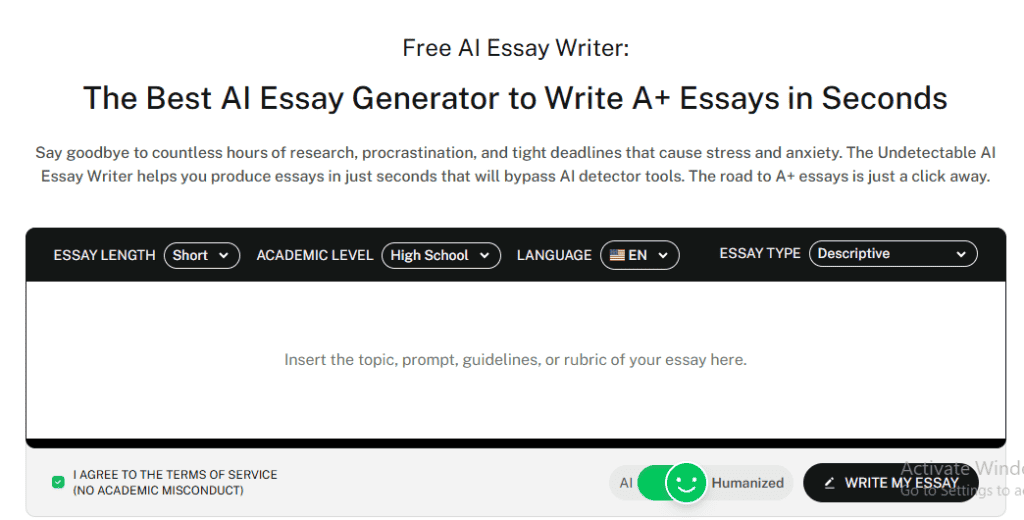
Pro Tip: If you want to get better at using understatement in your own writing, tools like Undetectable’s AI Essay Writer can break down the different ways an understatement can convey subtlety, irony, or emphasis.
Understatement Examples in Practice
Understatements are subtle, but once you know what to look for, you’ll start to notice them everywhere.
Here are some of the most common examples you’ll find in writing and conversation.
| Understatement Examples | ||
| Type of Understatement | What It Does | Examples |
| Litotes | Emphasizes a positive idea or emotion by negating its opposite. | Saying “It’s not bad” instead of “It’s great.” Calling a strong performance “not terrible.” |
| Meiosis | Downplays something serious or dramatic using mild language. | Calling a deep sword wound “a scratch.” Referring to a major problem as “a small issue.” |
| Everyday/Idiomatic Understatements | Softens reality in casual speech, often for humor or composure in everyday conversations. | Saying “It’s a bit chilly” in freezing weather. Describing chaos as “not ideal.” Calmly announcing a “small problem” during a crisis. |
Common Pitfalls of Understatement
Understatements can be effective, but they’re also easy to get wrong.
One of the biggest risks is being too subtle.
For example, if your audience isn’t fully tuned in (or doesn’t share the same cultural context), they may take your words literally and completely misinterpret what you’re trying to communicate.
Another common issue is tone. In the wrong situation, an understatement can feel dismissive or even insensitive.
For example, if you use muted language to describe something serious or emotionally charged, you may come across as rude or insensitive.
This is why context is everything, and why it’s important to always consider your audience before using understatement to make your point.
Tips for Using Understatements Effectively
Understatements work best when used with intention. Here are a few tips to bear in mind when using understatements in your own writing.
- Know your audience: Understatements rely on shared understanding. If your audience doesn’t recognize the irony or fully understand the situation, the impact of your understatement will be lost.
- Use understatements sparingly: Understatements are most effective in small doses. If you use them too often, they can start to feel overused and cliché.
- Lean into contrast: The strongest understatements create a clear gap between the words and the reality. The more dramatic the situation, the more of an impact an understatement can have.
- Pay attention to tone: In more serious situations, understatements can come across as insensitive or cold if you’re not careful. If you’re not sure about the appropriateness of an understatement, ask yourself, “Will this statement make sense to my audience, or could it be interpreted as dismissive or rude?”
Notable Real-World Examples
Writers and filmmakers have long used understatement to add humor, irony, and emotional weight to certain situations.
Here are a few well-known examples of understatements in literature and film, and why they work so well.
| Examples of Understatements in Literature and Film | ||
| Work | Example | Why It’s an Understatement |
| Monty Python and the Holy Grail | When King Arthur fights the Black Knight, the knight loses multiple limbs. He then insists its “’Tis but a scratch” while also dismissing it as “just a flesh wound.” | Treating an obviously severe situation as no big deal creates absurd, dry humor through extreme contrast. |
| Shakespeare’s Romeo and Juliet | After becoming fatally wounded, Mercutio refers to his injury as “a scratch.” | Downplaying a serious injury adds irony and dark humor. |
| Shakespeare’s Hamlet | Hamlet’s final line is “The rest is silence.” | Instead of dramatizing his death, Hamlet plays it down and lets the weight of the situation speak for itself. |
| F. Scott Fitzgerald’s The Great Gatsby | Nick Carraway describes wartime trauma as feeling “simply restless.” | Something deeply serious is brushed off in a way that fits the novel’s distant, reserved tone. |
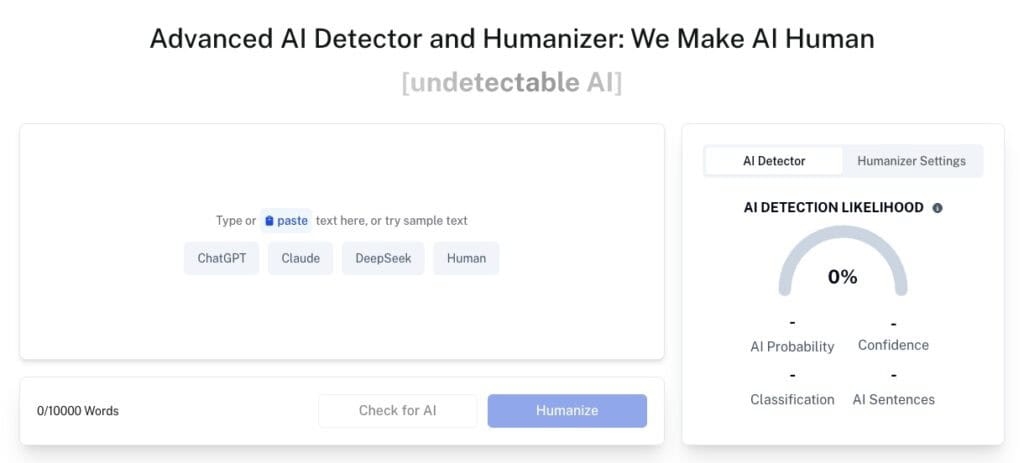
Pro Tip: If you plan to use understatements in your own writing, tools like Undetectable’s AI Detector and Humanizer can help you make sure your phrasing feels authentic and reads naturally for your audience.
Start using our AI Detector and Humanizer in the widget below!
Frequently Asked Questions About Understatements
What is the understatement definition in literature?
In literature, an understatement is when a writer intentionally describes something as less serious or important than it really is.
The goal isn’t to mislead or trick the reader; it’s to create humor or irony by letting the reader read between the lines and spot the contrast on their own.
What’s the difference between an understatement and a euphemism?
An understatement downplays something for effect, often relying on irony or contrast. A euphemism, on the other hand, is mainly about softening language to avoid discomfort. The two can overlap, but understatement is more about meaning and tone, while euphemism is about politeness.
How do litotes work?
Both understatements and litotes rely on minimization. However, litotes express meaning by negating the opposite of what’s intended, while understatements more broadly downplay the seriousness or importance of a situation.
Here’s a quick example of each:
Litote: “The movie wasn’t bad,” meaning it was actually good.
Understatement: “It was a bit chilly,” said during freezing weather to downplay the fact that it’s very cold.
What is a meiosis?
Meiosis is a particular form of understatement that minimizes something serious or dramatic, often for humorous effect. Common meiosis examples include calling a serious injury “a scratch” or a major crisis “a small issue.”
What is an ironic understatement?
An ironic understatement happens when the difference between the words used and the reality is especially obvious.
The audience knows the situation is far more intense than the language suggests, which creates humor, tension, or emotional impact.
Final Thoughts on Understatements
Understatements remind us that not every moment needs to be dramatic to be meaningful.
By deliberately holding back, writers can create humor, tension, or emotional depth… without having to spell everything out for the audience.
In fact, saying less often draws people in more, giving them space to feel and interpret the moment in their own way.
Keep your subtlety intact while sounding genuinely human with Undetectable AI.