
You know that one person who refuses to make two trips to the car, so they try to carry twelve grocery bags, a gallon of milk, and their dignity all at once?

In the world of grammar, that is called a Zeugma.
So, what is zeugma?
We’ll cover it in detail in the upcoming section, but for a bird’s-eye view, it’s the art of making one single word do all the heavy lifting for two completely different ideas.
It’s efficient, and impressive, and if you do it wrong, it can get messy.
In this blog, we’re going to cover the zeugma meaning with clear examples of zeugma. We will explore why writers use them, the common pitfalls to avoid, and much more.
Let’s dive in.
Key Takeaways
- Zeugma is a literary device where one word (usually a verb) links two different thoughts (typically one physical and one emotional).
- Zeugma meaning is derived from the Greek word zeugnynai (to yoke), it “yokes” two ideas together for efficiency and impact.
- Writers use it for shock value, humor (irony), or to give emotional concepts physical weight (e.g., carrying a backpack and regret).
- Avoid mismatching prepositions or tones (e.g., pairing a tragedy with something trivial), which can confuse the reader.
- Zeugma is high-risk; use grammar checkers and AI tools to ensure your sentence structure supports the twist without breaking logic.
What Is Zeugma?
What is zeugma exactly?
Zeugma is like “killing two birds with one stone” in a sentence. It is when a writer uses a single word to link two very different thoughts together.
Let’s break it down properly.


Never Worry About AI Detecting Your Texts Again. Undetectable AI Can Help You:
- Make your AI assisted writing appear human-like.
- Bypass all major AI detection tools with just one click.
- Use AI safely and confidently in school and work.
Defining Zeugma
The word Zeugma (pronounced zoog-muh) comes from the Greek word zeugnynai.
- Zeugnynai → “to yoke” or “to join together.”
Just like a yoke joins two oxen together to pull a cart, a Zeugma uses one word (usually a verb or an adjective) to join two separate nouns.
That is where the literal zeugma definition comes from.

Example of Zeugma: He lost his coat and his temper.
- You physically lose a coat, but you emotionally lose your temper. The word lost is doing heavy lifting for both. This dual usage is the core of the zeugma meaning.
Why Writers Use Zeugma
Writers use Zeugma because it catches the reader off guard.
When you read a sentence, your brain predicts where it is going. If I say, “He opened the door,” your brain expects a physical action.
But if I provide an example of zeugma like, “…and his heart,” your brain forces you to pause and think. And that’s why writers use Zeugma in their writing because it creates an impact.
It allows you to describe a physical setting and an emotional state simultaneously, without writing a whole paragraph about it.
Zeugma Example
Scenario: A soldier returning from war.
- Without Zeugma: He carried his heavy backpack through the mud, and he also carried a deep sense of regret for what he had done.
- Grammatically correct, but it drags on. It treats the backpack and the regret as two separate problems.
- With Zeugma: He carried his backpack and his regret.
- The regret feels just as heavy and physical as the backpack. The Zeugma tricks your brain into weighing the physical and emotional pain on the same scale.
How Zeugma Functions in Writing
To fully understand what is Zeugma, look at its three main functions.
- The Shock Factor (Surprise)
The primary goal of any zeugma definition is to disrupt predictions. Your brain naturally predicts the end of a sentence.
Zeugma disrupts that prediction by pivoting from a physical object to an abstract concept.
- Example:She opened the door and her heart to the orphan.
- You expect her to open another physical object (like a window). When she opens “her heart” instead, it surprises you and forces you to pay attention.
- Making Feelings Heavy (Emotional Weight)
The zeugma meaning often involves giving weight to invisible emotions.
- Example:He stole my wallet and my trust.
- Stealing a wallet is a petty crime. Stealing trust is a betrayal. By linking them with the same verb (stole), the author makes the loss of trust feel just as tangible and criminal as the theft of the wallet.
- The Comedic Twist (Irony)
Because Zeugma connects two things that don’t belong together, it is often used for humor or irony. It creates a mismatched pair that sounds witty.
- Example: He lost his coat and his temper.
- Losing a coat is an accident, losing a temper is a choice. Putting them together makes the character’s anger seem sudden and slightly ridiculous.
Here is the catch though…
Even if you know what is zeugma, it is high-risk, high-reward.
Because you are intentionally bending the rules of logic, it is very easy to mess up the sentence structure.
If your punctuation is off, or if the verb doesn’t technically fit both nouns, your clever sentence will just look like a mistake.
For example, a missing comma or a clunky transition can kill the joke instantly.
To pull this off without confusing your reader, you need precision. This is where the Undetectable AI’s Grammar Checker comes in.
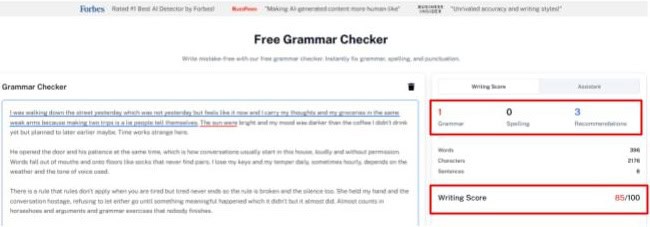
It ensures:
- Your creative sentence structures remain grammatically sound.
- Your punctuation hits the right mark so your Zeugma lands with maximum impact.
Check Your Grammar & Style Now
Common Pitfalls of Zeugma
Understanding what is zeugma also means knowing what isn’t working.
Here are common pitfalls of zeugma:
- The Preposition Trap (Grammar Mismatch)
This is the most common mistake. Sometimes, a verb requires a specific helper word (preposition) to make sense.
If you delete that helper word to create a Zeugma, the sentence becomes grammatically broken.
🚫Bad Example of Zeugma: He worked for the money and his fitness.
- You can say “He worked for money,” but you cannot say “He worked for his fitness.” You work on your fitness. The grammar creates a pothole.
✅ The Correction: He worked for the money and on his fitness.
(Note: Sometimes you have to sacrifice the Zeugma to save the grammar. Or, change the verb entirely.)
Better Zeugma: He built his fortune and his muscles. (The verb “built” works perfectly for both).
- The Tone Deaf Clash
Zeugma connects two ideas. If those two ideas are too different in seriousness, it can sound unintentional or offensive rather than clever.
🚫Bad Example of Zeugma: She lost her whole family and her car keys.
- Losing a family is devastating. Losing keys is annoying. Putting them next to each other will be disrespectful.
✅ The Correction: She lost her family and her will to live.
- Both nouns (family and will) carry heavy emotional weight. The tone matches.
- The Forced Zeugma
Writers sometimes try so hard to be clever that the reader has to read the sentence three times to understand it. If the Zeugma is too abstract, the connection breaks.
🚫Bad Example of Zeugma: He executed the prisoner and a dance move.
- The word “executed” technically works for both, but the mental image is too confusing. Is he dancing while killing someone? It’s just weird, not witty.
✅ The Correction: He killed the mood and the bottle of wine.
- The connection is clear. Killing a bottle is a common idiom, so the brain easily links it with killing the mood.
Using Zeugma Effectively
You shouldn’t use Zeugma in every paragraph, or it gets annoying.
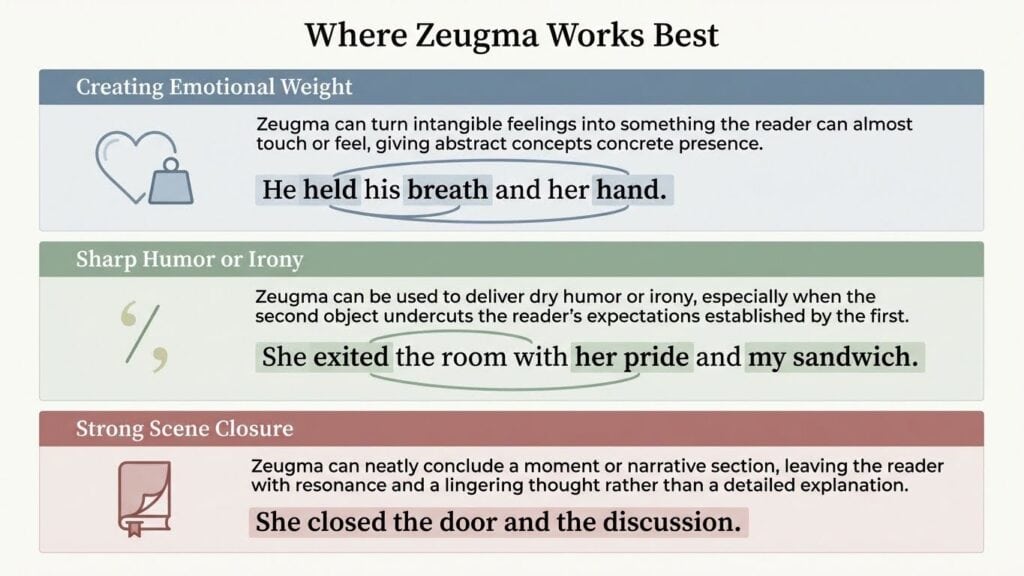
Save it for these 3 specific moments:
- For the Emotional Hook
Use it when you want to make an abstract feeling (like grief, love, or fear) feel physical and heavy. It forces the reader to feel the emotion as if it were a solid object.
- Example: He held his breath and her hand.
- For the Comedic Mic Drop
Use it to make a character sound witty, snarky, or dismissive. It works best when the second item is trivial or unexpected.
- Example: She left the room with her dignity and my sandwich.
- For the Chapter Ending
Zeugma is great for sticking the landing at the end of a scene. It sums up a situation neatly and leaves the reader with a thought-provoking puzzle.
Well-Known Examples of Zeugma
You will find Zeugma everywhere, from classic books to the songs on your Spotify playlist.
Here are five well-known Zeugma examples:
- Literary Fiction (Tim O’Brien)
But Ted Lavender, who was scared, carried 34 rounds when he was shot and killed outside Than Khe, and he went down under an exceptional burden, more than 20 pounds of ammunition, plus the flak jacket and helmet and rations and water and toilet paper and tranquility and a desperate desire to live. — The Things They Carried
- Physical gear + Desire to live → Makes the invisible emotional burden of war feel just as heavy as the backpack.
- Pop Culture & Modern Romance (Alanis Morissette)
You held your breath and the door for me. — Head Over Feet
- Holding the door (Polite) + Holding breath (Nervous) → Perfectly captures the awkward, butterflies-in-stomach excitement of a new crush.
- Children’s Literature (Lemony Snicket)
He had a very heavy heart and a very heavy suitcase. — A Series of Unfortunate Events
- Sci-Fi (Star Trek: TNG)
You are free to execute your laws, and your citizens, as you see fit. — Captain Picard
- Literature (Charles Dickens)
Miss Bolo rose from the table considerably agitated, and went straight home in a flood of tears and a sedan chair. — The Pickwick Papers
- Riding a carriage + Riding a flood of tears → Creates a hilarious mental image of a dramatic, weeping exit.
Here is the danger zone.
When you try to write a clever sentence like the ones above, it often comes out sounding stiff, forced, or just plain weird.
If the Zeugma meaning feels clunky, it trips the reader up instead of impressing them. It sounds like you are trying too hard.
To fix this, run your creative writing through the Undetectable AI’s AI Humanizer.
- It adjusts the flow so your sentence sounds like a natural, witty thought.
- It helps you find that sweet spot between clever and readable.
Make Your Writing Flow Naturally
Use our AI Detector and Humanizer right in the widget below!
Conclusion
So, now that you know the zeugma definition, are you ready to use it?
Zeugma is the linguistic equivalent of a magician pulling a rabbit out of a hat.
It surprises, it delights, and when done right, it leaves the audience wondering, “How did they do that?”
You don’t need to be Shakespeare or Dickens to pull it off. You just need to be willing to break a few rules.
So go ahead. Break the rules, and while you’re at it, break some hearts.
Any guesses what we did here?
Make your writing as seamless and human as your zeugma with Undetectable AI.