
“Is it color or colour?” That is probably the question on your mind when autocorrect changes a spelling you are familiar with to something different.
The truth is, auto-correct is not entirely wrong; it is probably just your language setting.
The debate over the spelling is not strange. It is actually the doing of a dictionary writer who chose to give English spelling varieties.
Americans accepted this change, but the British decided they were fine with the spelling they had. However, this change has left the rest of the world second-guessing ever since.
Let’s jump in.
Key Takeaways
- Color is the American English spelling
- Colour is used in British English
- The spelling you choose should be based on your audience, not personal preference
What Is the Difference Between Color vs Colour?
There isn’t much difference between color vs colour. The only thing you would find separating both spellings is the letter ‘u.’
The difference is just the spelling, not the meaning. You can use both spellings to refer to the visual characteristics of things. Either spelling does not prevent a blue ball from changing its colour.
So if anyone walks up to you to ask, “color or colour which is correct?”


Never Worry About AI Detecting Your Texts Again. Undetectable AI Can Help You:
- Make your AI assisted writing appear human-like.
- Bypass all major AI detection tools with just one click.
- Use AI safely and confidently in school and work.
Your answer should be both, and the only thing that sets one apart from the other is the letter ‘u.’ It is not a matter of correctness; it is a matter of location.
- In the US, it is spelled as “color” (no “u”)
- In the UK, it is “colour” (with a “u”)
Meaning and Background
The word colour or color comes from the Latin word colōs, which means a ‘covering,’ ‘skin on boiled milk,’ or ‘appearance’. This Latin derivative made its way into Old French as ‘colur’, before finally settling into Middle English as ‘colour.’
No matter how you choose to spell it, color and colour mean the same thing. That is, the property of objects which we see as they reflect or emit light.
Whether you are talking to a friend of yours about a blue ocean or about yellow autumn leaves, you are speaking of the same thing.
The difference in the spellings is quite interesting. The purposeful alteration of American spellings to simpler and more phonetic ones was done by Noah Webster in the early 19th century.
Upon publishing his dictionary in 1828, Webster had different spellings of numerous words, such as colour, honour, favour, labour, as well as neighbour, but eliminated the letter u in them.
However, the British did not embrace the variations of the Webster dictionary. Although no meaning changed, they remained loyal to their traditional spellings.
When to Use Colour vs When to Use Color
People get confused when the “is it colour or color” question comes up. While it may seem confusing, there are several tips to help do away with the confusion surrounding the “is it color or colour” question.
This is how to know the right spelling to use:
Use Color when:
- You are writing for an American audience
- You are using an American English style guide like AP or Chicago
- You are submitting your work to a US-based company
Use Colour when:
- You are writing for people living in the United Kingdom, Canada, Australia, or New Zealand
- You are working with international organizations that use British English
- Your publication aligns with British English conventions
- You are writing academic papers for non-US institutions
Regardless of the spelling you use, your writing may not receive the required attention when it is fully AI-written. This is the reason why you need the Undetectable AI’s AI Humanizer.
Our AI Humanizer helps you maintain a natural and clear tone for your global readers to understand.

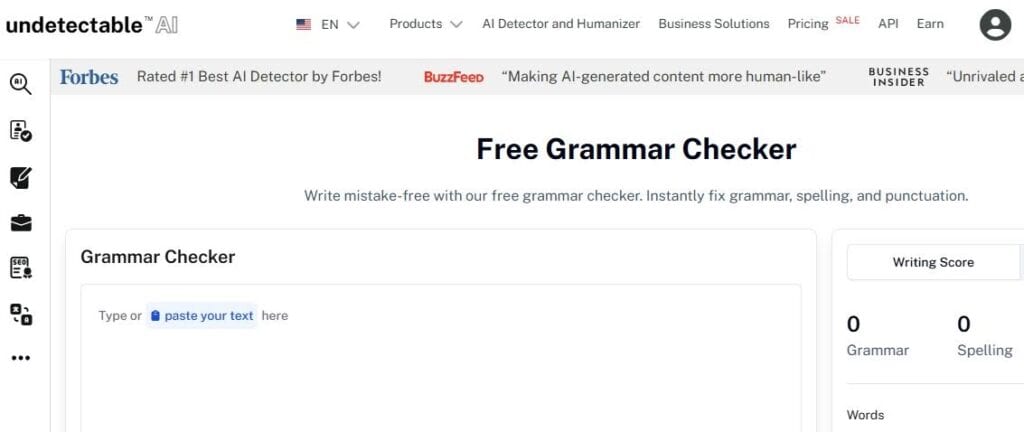
After passing your work through the Undetectable AI Humanizer, you can move over to the Undetectable AI’s Grammar Checker to ensure all definitions and spellings are grammatically accurate.
Our Grammar Checker can help you catch inconsistencies if you make the mistake of mixing spellings in the same document.
Choosing the Right Spelling for Your Audience
There is a need to match your spelling with your audience when deciding on the appropriate spelling.
Some of the considerations to make when choosing the correct spelling include the following:
- Be familiar with your Analytics: Before you choose a spelling, try to find out where most of your readers live or which country reacts well to your content. For instance, if about 85% of your traffic comes from the US, you should know that spelling with ‘u’ is wrong.
- Be sure which your Client Prefers: It is not always up to you, and particularly when you are writing for someone. Remember to ask them and determine the best style guide that suits them.
- Stay on Course: When you have decided on the correct decision to make with your client, remain with it. One of the things that makes you look unprofessional is when you are interchanging between spellings.
So, before you publish or send in that work, ask yourself
- Who is reading this?
- Where are they located?
- Is this academic, casual, or professional?
These questions are important, especially if you are trying to decide which to rank, color or colour in USA. The appropriate selection of spelling helps provide visibility to your work.
Common Mistakes to Avoid
The pitfalls to watch out for when using colour or colour are as follows:
- Concluding that there is a wrong Spelling: The one error that you will make is to assume that since one of the spellings is right, then automatically the other spelling is wrong. Both spellings are right, and the fact that you add or leave out u does not matter.
- Confusion of Spellings Within the Same Paper: This is a very common mistake. Sometimes it is not your fault. You may start with ‘colour’ and auto correct changes it to ‘color halfway through. The best way to prevent this is by doing a final check.
- Forgetting Related Words: Always remember that there are other variations of color/colour. So if you choose ‘colour’ for instance, you also have to use the same thing when spelling, ‘colourful,’ “colourless,” and “colouring.” Always stay consistent with the whole word family.
- Ignoring your Spell-Checker Settings: Even if you use the right spelling and your spell checker is not set to the right English region, you might be wasting your time. You will just realise that you are clicking “ignore” on the correct words.
- Using British spelling for American Publications or Vice Versa: To avoid this, always check the publication’s style before submitting.
Examples of Color vs Colour in Sentences
This is how each spelling works in sentences:
Color (American English)
- “The color of the sunset yesterday was absolutely breathtaking”
- “I have to color-code my outfits for the week-long seminar I have to attend.”
- “I know my favorite color is blue”
- What is your favorite color?”
- The artist used bold colors to make a statement about children’s right”
- “This app allows you to choose your preferred background color to reduce eye strain.”
- “The logo stands out because of its bright colors”
Colour (British English)
- “The colour of the sunset yesterday was absolutely breathtaking”
- “I have to colour-code my outfits for the week-long seminar I have to attend”
- “I know my favorite color is blue”
- “What is your favorite colour?”
- “The artist used bold colours to make a statement about children’s right”
- “This app allows you to choose your preferred background colour to reduce eye strain.”
- “The logo stands out because of its bright colours”
From the examples, the sentences are the same, have the same meaning, but just different spellings. The context remains the same whether you add ‘u’ or not.
Here are other examples of the spelling in sentences using the Undetectable AI Chat:
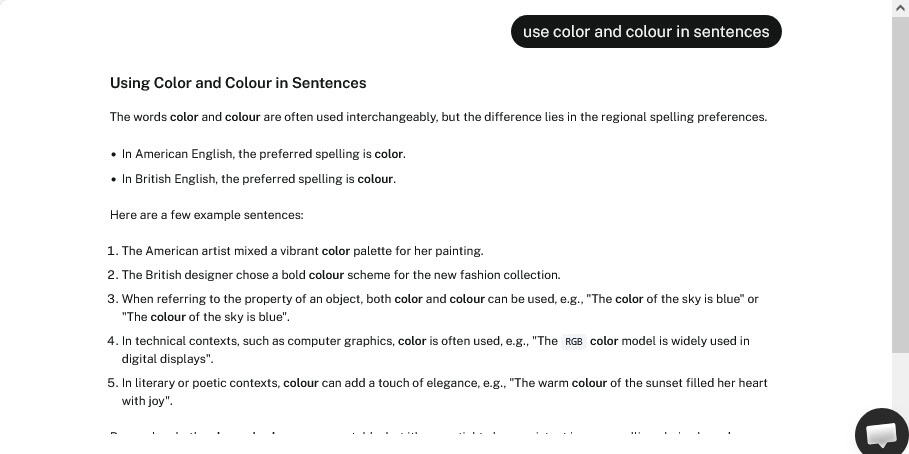
Color vs Colour in Idioms and Phrases
There are many English idioms and expressions involving this spelling, they include:
| Idioms | Meaning | Examples |
| To see someone’s true color/colour | It means to see a person’s true character, and it is mostly, but not always, used to describe negative behaviour. | ‘I know her true color/colour now” |
| Looking at the world through rose-colored/coloured glasses. | It means to see something from a naive perspective. | ‘Ben sees the world through a rose coloured/colored lens” |
| To pass with flying colors/colours | To do exceptionally well or with distinction | ‘My son passed his SATs with flying colours/colors’ |
| Off color/colour | It describes something inappropriate or feeling unwell | ‘I feel off colour/color.’ |
| Color/colour me surprised | To say something made you surprised | ‘Wow, color/colour me surprised” |
| Lend color/colour to | It means to make something seem more believable | ‘She lent color/colour to his story’ |
| Paint something in a bad color/colour | To describe something negatively | ‘She painted the story in a bad color/colour’ |
| A splash of color/colour | It means a small but noticeable improvement | ‘My bad was a splash of color/colour’ |
| In living color/colour | To see something clearly or vividly | ‘She is living in color/colour’ |
| Nail your colors/colours to the mast | It means to publicly commit to a position | ‘The politician nailed his colors/colours to the mast’ |
| A Local color | This is used to describe details that give a place its unique character | ‘The travel writer added local color/colour to her story with the descriptions’ |
| A horse of a different color | It means something completely different from what was being discussed | ‘You are talking about a horse of a different color/colour’ |
| Color commentary | It describes expert analysis during sports broadcasts | ‘That was a color/colour commentary’ |
| Colorful language | It explains swearing or profanity | ‘He is known for his colorful/colourful language’ |
| The color/colour of money | This is another way to talk about financial gain | ‘I have seen the colour/color of money’ |
| Colorful/colorful character | It means an eccentric or interesting person | ‘He has a colourful/colorful character’ |
| Lose color/colour | To become pale as a result of shock or fear | ‘Her face lost color/colour’ |
The meaning of an idiomatic expression does not change depending on where you are. Also, just like regular usage, you have to be consistent.
Do not write “true colors” in one paragraph and “off colour” in the next, unless you want your readers to think you are having an identity crisis.
Check out our AI Detector and Humanizer in the widget below!
FAQs
Which is Correct Color or Colour?
The two spellings are correct. It just depends on the variant you are using. Color belongs to American English, and Colour is for British English. There is no right or wrong answer when it comes to the spelling. All you need to do is choose the spelling that matches your audience and be consistent with it.
Is it Color or Colour in Canada?
Canada mostly follows British spelling conventions, even though the country is right next to the United States of America. So for Canada, it is ‘colour’ with the letter ‘u. ’
However, with the American influence too, you will sometimes see Canadians use “color” too, especially in business settings. You can say Canada actually uses both, but colour is more common in formal writing.
When in doubt, “colour” is the safer bet for Canadian readers.
Is it Color or Colour in Australia?
Australians are loyal to British English spelling rules. So the right one for them is ‘colour.’ The same goes for “favour,” “honour,” and all those other “u” words.
Final Thoughts
The debate on color or colour is not about who is right or wrong, it is about knowing your audience and choosing the spelling that fits. So whether you are team color or team colour, what matters is consistency and clarity. You just have to pick the spelling peculiar to your readers and don’t stray from it.
Even if you use the “wrong” spelling, people will still understand you perfectly. That is the beauty of the English language: it evolves and adapts. These spelling differences are just part of the language.
Now, when someone tries to correct your spelling, you can easily tell them that both versions are correct and you are only using the spelling that matches your audience.
Match your spelling to your audience with confidence. Undetectable AI helps you keep tone, style, and regional consistency perfectly aligned.