
My old boss loved motivational speeches. Every Monday, he would gather us and begin with something like, “Do you know what separates leaders from followers?”
Before anyone could sacrifice themselves by replying, he would answer, “They think long term.”
That was his routine. Every. Single. Monday.
I used to sit there wishing my stapler were a teleportation device.
After two years (one hundred five Mondays), I finally gathered the courage to ask, “Why do you always ask if you are determined to answer yourself?”
He smiled, “Because it gives the illusion of interaction. It keeps people listening even if they don’t want to.”
That day, I learned about hypophora. I had been hypophora’d for years. And it worked. I was always listening.
Let me tell you more about it in this blog.
Key Takeaways
- Hypophora is a literary technique or a rhetorical device in which someone asks a question and immediately follows it with the answer. It builds interest and gives the illusion of interaction, so readers/listeners are more engaged and attentive.
- It’s different from a rhetorical question. Rhetorical questions leave the answer implied, whereas hypophora provides the answer immediately. This small difference ensures your point lands clearly every time.
- Hypophora can be easily found in question-answer pairs. A good hypophora can anticipate what the reader is thinking, provide the answer immediately, and have a smooth flow.
- To use hypophora in your own writing, you must begin with a question that ignites curiosity. Then, follow it with a clear and concise answer. Make sure it flows naturally.
What Is a Hypophora?
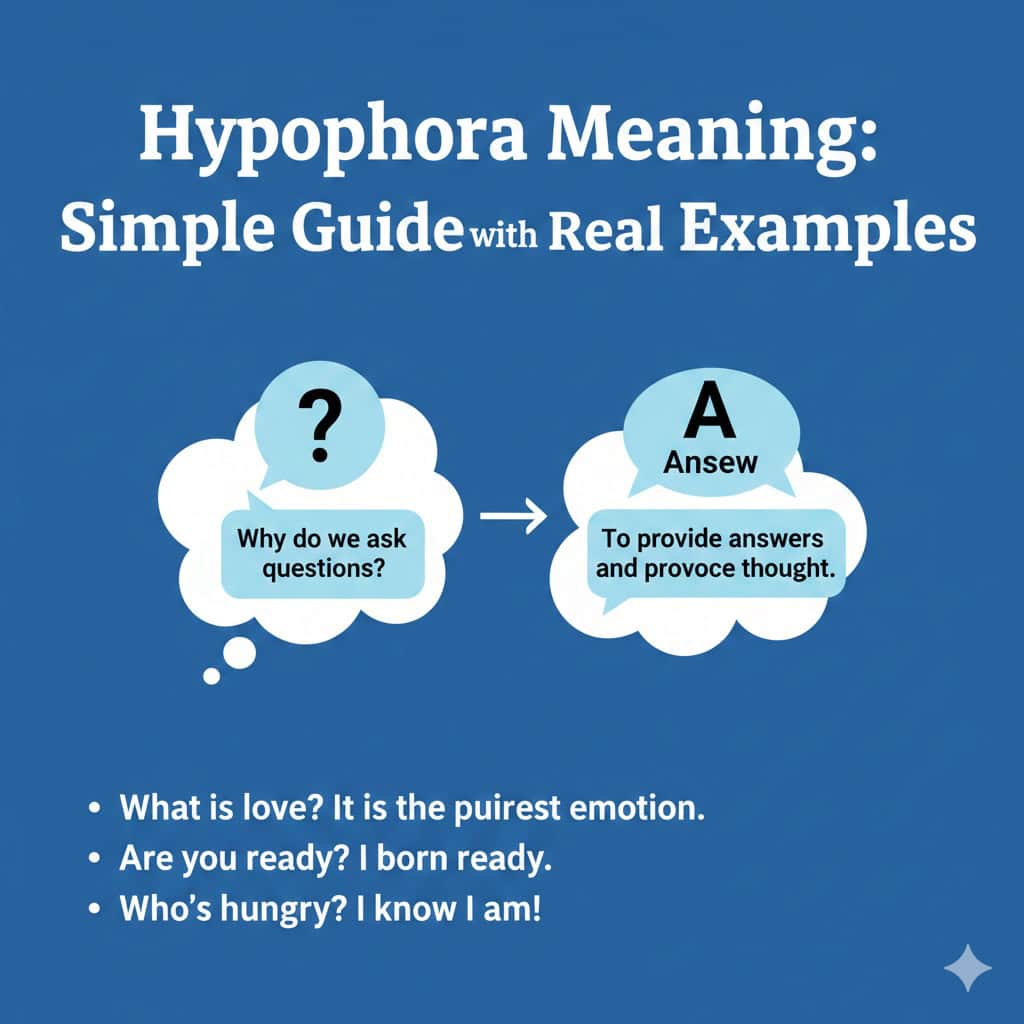
I had no idea what is hypophora the first time I heard of it. I just knew it felt familiar.
It’s when someone asks a question and then gives the answer right away. You don’t get a chance to speak. The answer is already there.
And weirdly, it works. It grabs your attention, makes you lean in, and somehow convinces you to listen even when you weren’t planning to.


Never Worry About AI Detecting Your Texts Again. Undetectable AI Can Help You:
- Make your AI assisted writing appear human-like.
- Bypass all major AI detection tools with just one click.
- Use AI safely and confidently in school and work.
It is a smart way to control the conversation. You get the curiosity of the question and the satisfaction of the answer, all in one shot.
Hypophora Definition
If I were to give you the dictionary’s hypophora definition, I’d say it is a figure of speech in which a question is posed and then immediately answered by the same person.
That’s all.
It is just a little trick that writers, speakers, and storytellers use to make a point hit harder.
Hypophora Examples
Let me give you some real examples so it makes more sense.
- Alfred to Bruce Wayne, Batman Begins: “Why do we fall? So that we can learn to pick ourselves up.”
- Martin Luther King Jr., “I Have a Dream”: “When will you be satisfied?” He doesn’t leave the question hanging. He immediately answers it in a way that drives the whole point home. Powerful, persuasive, and unforgettable.
- Shakespeare, Hamlet: “What a piece of work is man! How noble in reason, how infinite in faculties!” Here, Hamlet asks and answers himself, guiding the audience through his own thoughts.
- Winston Churchill: “What are we to do? We shall fight on the beaches, we shall fight on the landing grounds, we shall fight in the fields and in the streets…”
How Hypophora Works in Writing and Speech
Hypophora works because it guides the audience through an idea without making them guess or pause too long. In a way, it gives the writer or speaker control while keeping the listener engaged.
In writing, you will notice it in blog posts, essays, or articles. A good writer will open a section with a question that makes you curious.
Then, instead of leaving it hanging, they answer it in a way that feels natural and clear.
It feels like a conversation. You are reading along, nodding, and suddenly the point lands. You do not even notice that the writer has been steering you the whole time.
In speeches, it is even more obvious. I remember listening to a talk where the speaker asked, “What makes a team truly great?”
The pause that followed was long enough to make me wonder, and then he answered, “Trust and communication, nothing else.”
That moment sticks because the question made me think, and the answer gave me a satisfying conclusion immediately. It felt intentional, like I was being led through a thought experiment.
Hypophora works in part because it anticipates what the audience is thinking. The speaker or writer puts the question into words, effectively voicing the audience’s curiosity, and then answers it before the audience’s attention drifts.
It is like answering questions I did not even know I had, but suddenly feel like I did.
It also gives a rhythm to writing or speech. Questions create tension or interest. Answers release that tension.
The back-and-forth, even if it is only one person talking, keeps the audience from zoning out.
What fascinates me most is how subtle it can be. Hypophora does not have to be dramatic. Even a single line can be enough to pull the audience forward.
It feels natural, conversational, and somehow persuasive without being pushy.
Hypophora vs. Rhetorical Questions
At first, hypophora meaning can sound a lot like a rhetorical question. But the difference is actually pretty simple, once you notice it.
A rhetorical question is one where the speaker or writer asks a question but does not expect an answer. It is meant to make you think, emphasize a point, or create a dramatic effect.
Hypophora, on the other hand, is different because the speaker or writer asks a question and then answers it.
It is almost like they are having a conversation with themselves, but the audience is invited along for the ride.
That answer is the difference. Without it, the question is just rhetorical. With it, the question becomes a way to guide the audience, explain a point, or deliver information in a way that feels deliberate.
How to Identify Hypophora in a Passage
Spotting hypophora in articles, day-to-day conversations, and speeches isn’t tricky at all as long as you know what to look for.
Question and Answer Pairs
The first thing I do is read carefully for any sentence that asks a question. The key is what comes next.
If the author or speaker answers the question right away, that’s your clue that you are dealing with hypophora.
For example,
“Why do people keep coming back to this website? Because it delivers exactly what they need.”
The question is obvious, but the answer is just as clear. That combination is the heart of hypophora. If the question is left hanging, it is probably just a rhetorical question.
Watch Out for Rigid Patterns
Sometimes, it is not immediately obvious. A passage might have several question-answer pairs that feel unnatural or mechanical.
I use Undetectable AI to flag question-answer patterns that feel too rigid.
It helps me distinguish true hypophora (flows naturally) from unrelated Q&A that just feels like a list of questions with answers tacked on.

Reader Guiding Questions
One particular thing to look for is if the question is leading the reader toward an idea. In good hypophora, the question anticipates what the audience is thinking and then delivers the answer in a natural way.
If a passage asks a question that seems random or doesn’t connect to what follows, it might not be hypophora.
But if the question frames the point and the answer makes the argument or story clearer, then you have found it.
Smooth Transitions
Even when a passage has question and answer pairs, sometimes the flow can feel stiff or awkward.
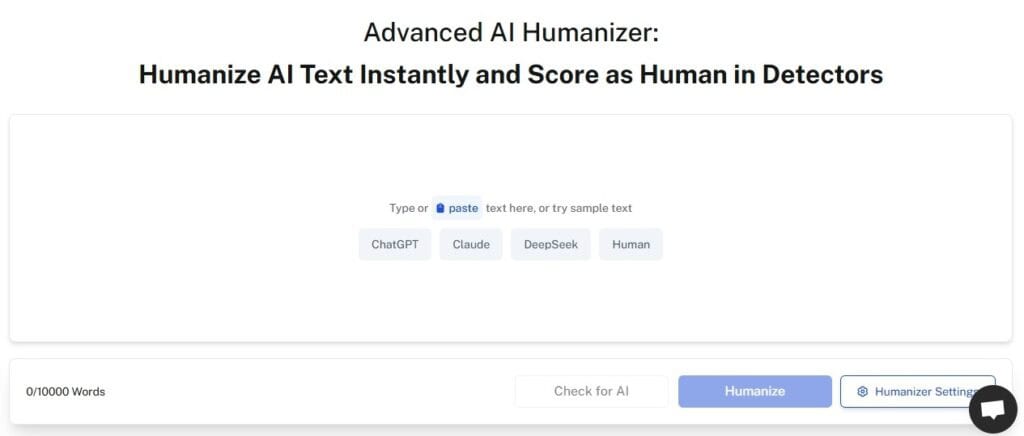
The AI Humanizer at Undetectable AI can smooth transitions and make the hypophora feel conversational.
A Quick Checklist
Whenever I want to identify hypophora in a passage, I ask myself:
- Is there a question?
- Does the author immediately answer it?
- Does the question guide the reader toward the point?
- Does the flow feel natural, or does it need smoothing?
If the answer is yes to all four, congratulations. You have just spotted a hypophora!
How to Use Hypophora in Your Own Writing
The only way hypophora works is when it is not forced. Let me share some tips that always work for me.
Lead with an Attention-Grabbing Question
Turning a random part of your piece into a Q and A won’t work. Brainstorm questions your audience will actually care about.
If you are running short on time, use this AI Chatbot by Undetectable AI. Ask it to suggest interesting questions relevant to your topic.
Questions that will hook your audience.
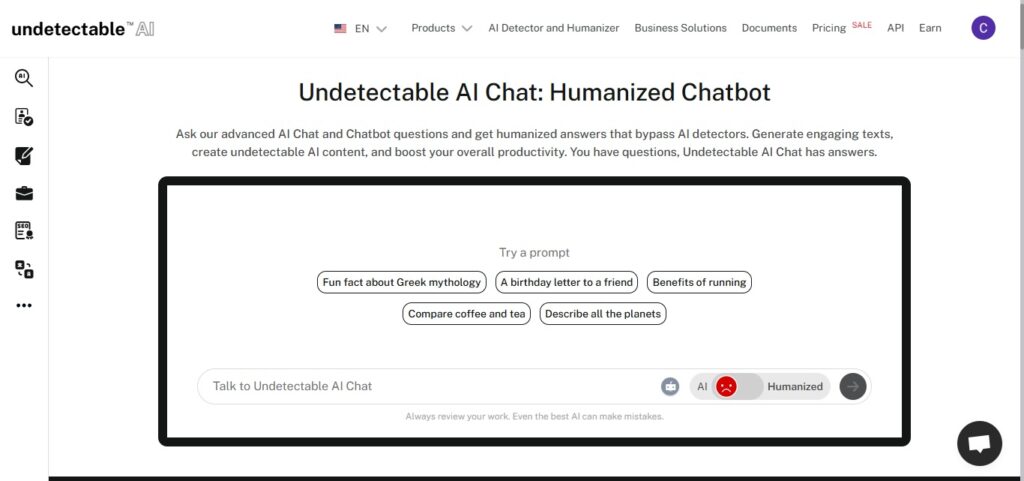
Granted, it might not give you perfect, ready-to-use questions. But that’s fine. At least you have a starting point now.
Immediately Follow With a Clear, Strong Answer
You have the question now, what you want to do next is answer it. Right away. Don’t talk in circles. Give a direct and clear answer for maximum impact.
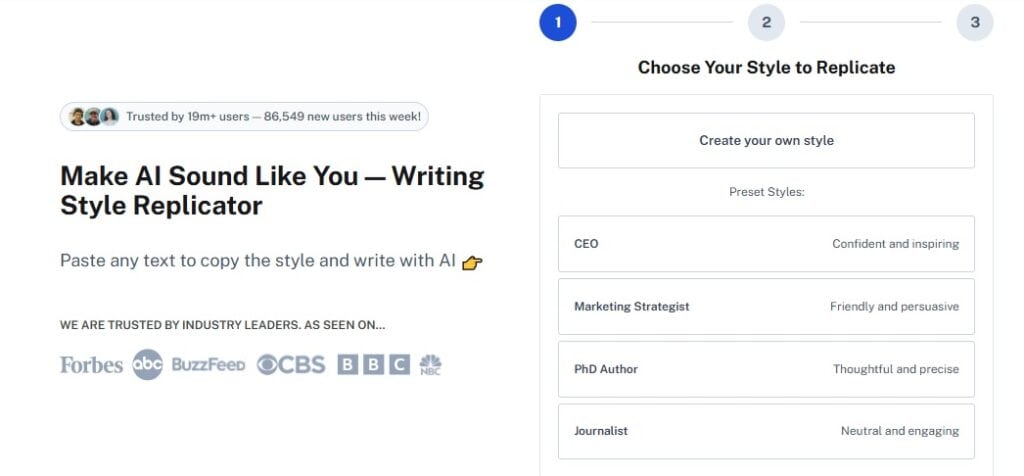
If you struggle in that area, try out this Writing Style Replicator. It can refine your answer’s tone and make it more confident and punchy.
Keep it short and specific. Your answer should feel like it completes the thought. Pick up any hypophora example, and you will notice the same pattern.
Make the Flow Smooth and Natural
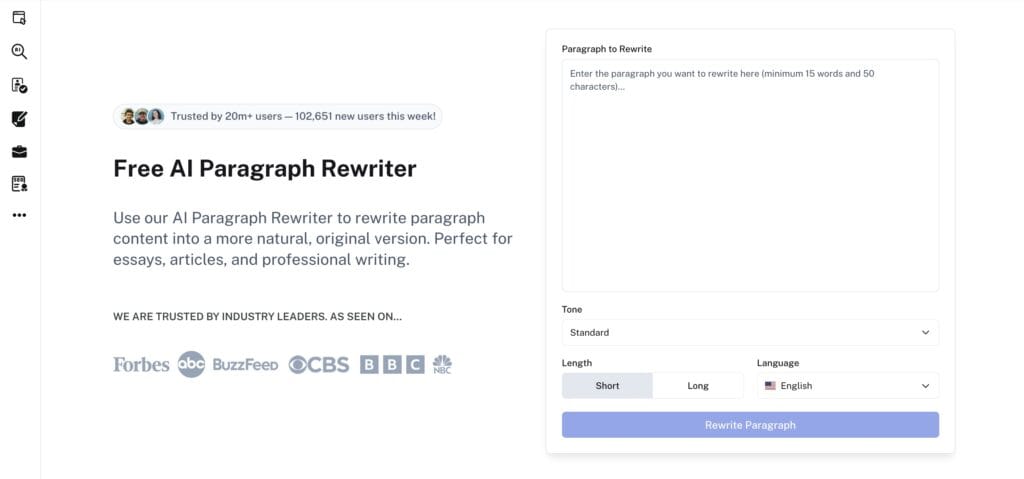
Even when the question and answer are solid, sometimes the paragraph feels off. If it happens to you, use the Paragraph Rewriter.
Just paste the text in, and it will strengthen transitions and tighten sentences.
Keep It Relevant and Short
One thing I’ve been saying time and time again is DO NOT let the question-answer section drag. Your attempt at hypophora will miserably fail if it does not deliver value quickly and circumlocutes.
Just ask one question, answer it clearly, and move on. Yes, you can work around multiple-layered questions, but I don’t recommend it.
It can be hard to ensure every answer remains concise and meaningful, so better to avoid that route altogether.
Test It Out
Always read your hypophora passages aloud. See if you naturally pause at the question. Did the answer make you feel satisfied? If yes, bingo!
But if the answer feels too forced, tweak it. Use the tools above until your answer reads like part of a conversation.
Try our AI Detector and Humanizer in the widget below!
Conclusion
We use hypophoras daily without even realizing. It’s a powerful technique because it mirrors how we actually think.
We ask ourselves questions all the time, sometimes quietly, sometimes out loud. (I know I do!) And when someone else asks and answers for us in writing or speech, it feels familiar.
If you want to make that same connection in your own writing, tools like Undetectable AI can help you get started.
Just remember, a well-placed question and answer can do more than explain something. It can make your reader stop, smile, or even nod quietly to themselves.
And if that happens, you’ve just done what every writer wants, i.e., made someone feel understood.