
In the famous TV show Friends, we often heard Joey say, “How you doin’?”
The first time I heard that line, I thought he was genuinely just asking how someone’s day was going. Fast forward to a few episodes, and I finally realized it was an innuendo.
A flirty invitation hidden inside a casual greeting. It implied his interest without stating it directly.
That was the first time I learned what an innuendo is. It is a language that carries a second meaning beneath the surface.
You hear one thing, but the speaker means something a little more playful, suggestive, or risky.
What can I say, the English language loves beating around the bush. It’s confusing, yes. But once you break it down, it gets much easier to understand.
This blog is my attempt at explaining innuendo to you.
Key Takeaways
- An innuendo is an indirect remark on something that suggests a different meaning than what’s being said. It is often used to avoid direct confrontation and keep your words honest on the surface.
- It can be tricky to understand innuendos because they are suggestive. They can hide behind innocent words and be open to interpretation. The meaning can also change according to the situation or context.
- Innuendo comes in many forms, including flirtatious, humorous, critical, sarcastic, cultural, and social innuendos.
- Innuendo is different from double entendre because it is subtle and relies on implied meaning for the reader or listener to understand it. Double entendre is comparatively more straightforward and has a suggestive meaning.
- It’s not that hard to identify innuendos if you pay attention to the tone, context, setting, and expressions/wordings of the speaker/writer.
What is Innuendo?
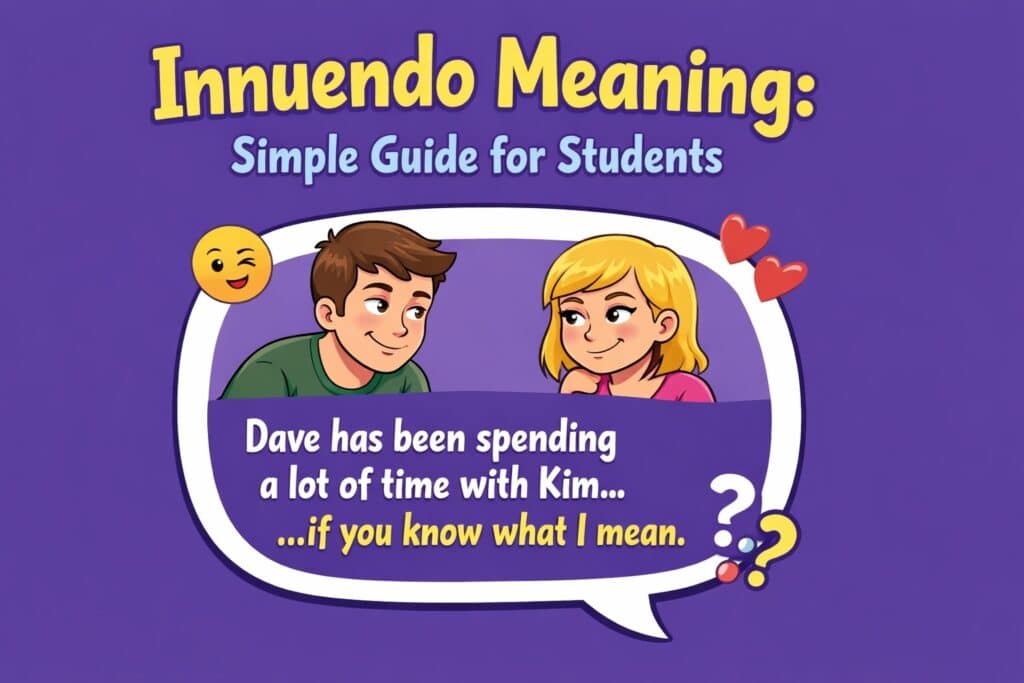
It can be a bit complicated to define innuendo. Most definitions make it feel more confusing than it needs to be.
Innuendo Definition
If I had to give an easy innuendo definition, I would put it like this.
Innuendo is indirect communication that hints at something without directly mentioning it. It might be humorous, flirty, sarcastic, or lightly offensive.


Never Worry About AI Detecting Your Texts Again. Undetectable AI Can Help You:
- Make your AI assisted writing appear human-like.
- Bypass all major AI detection tools with just one click.
- Use AI safely and confidently in school and work.
You understand the real message not by the words alone, but by the context, the tone, or what is being implied.
Sometimes it is used to stay polite. Other times it is used to be clever. And sometimes (let’s be honest), it is used to get away with saying something that would sound rude if said directly.
Innuendo Examples
Looking at some innuendo examples might help you understand better.
- A friend says, “You spend a lot of time with your coworker,” with a raised eyebrow and a smile.
- A character in a movie says, “We should hang out sometime,” but the implication is clearly romantic.
- A manager says, “Look who decided to show up,” when you arrive late. The literal meaning is not the real message at all.
These are basic innuendo examples that show how innocent words can carry a hidden message.
The meaning is not always written, but it is felt. And once you start paying attention, you will notice innuendo everywhere in everyday conversations, movies, and even social media captions.
How Innuendo Works In Language
The interesting thing about innuendo is that it does not rely on the words alone. If it did, we would all understand it instantly.
Innuendo works because our brains are always connecting dots. We take the words we hear, combine them with the moment, the tone, the look on someone’s face, and then we build the real meaning in our head.
Indirect meaning is where it starts. The sentence is ordinary, but the situation gives it a twist. Someone says, “You two seem close,” right after you walk in together. Suddenly, it sounds different.
Then comes the implication. The speaker leaves space for your mind to wander.
That little space is where the mind wanders, where the listener fills in the blanks. It can be clever, playful, or just vague enough to be maddening.
Tone is the amplifier. The same line can come off as sweet, sarcastic, flirtatious, or biting, depending on the delivery.
A raised eyebrow can rewrite an entire sentence. A pause can act like punctuation. Sometimes the silence after the words says more than the words themselves.
If you write essays, stories, scripts, or even social posts, understanding innuendo gives you a type of power. You can say more while technically saying less.
And when you want to refine that subtle edge, tools like the AI Essay Writer from Undetectable AI can help you smooth your language so the meaning stays implied, not obvious.
The Key Features of Innuendo
Innuendo has a few distinct features that make it stand out from regular speech. For example:
- Hidden meaning: The real message is not stated directly. It lives under the surface of the words.
- Suggestive rather than explicit: It hints at something without spelling it out, leaving room for interpretation.
- Playfulness or wit: Using an innuendo in a sentence is always either clever, humorous, or flirty. That’s what makes it memorable. It does not soften the blow as euphemism does, but it delivers it quietly.
- Flexible Interpretation: The situation or setting can completely change how the sentence is understood. Different listeners might pick up different meanings based on their perspective.
The Different Types of Innuendo
Definition alone won’t help. If you truly want to understand innuendo meaning, you should know about its different types.
Flirtatious Innuendo
This is probably the most well-known type. It relays romantic or sexual interest without explicitly stating it. The words themselves are innocent, but the tone and context in which they are said suggest more.
Humorous Innuendo
Humorous innuendo is used in comedy plays. It relies on wordplay or double-meaning sentences to elicit laughter. It feels clever, to say the least.
Critical or Sarcastic Innuendo
Sometimes innuendo shows up looking polite. On the surface, a sentence might sound harmless, but the tone gives it a bite.
It is the kind of remark that seems innocent on paper, yet everyone in the room can feel the sting. A raised eyebrow, a slow sip, or an exaggerated smile can turn a simple comment into a subtle jab.
It allows people to critique, tease, or mock without ever saying it outright.
Situational Innuendo
A sentence can have multiple meanings depending on the situation. It might seem ordinary at first, but the hidden meaning underneath is there all along.
It just depends on who is around, what just happened, or even the mood in the room.
Cultural or Social Innuendo
This type relies on shared knowledge or common experiences. A phrase that sounds normal to most people can carry a hidden meaning for those who understand the reference.
It might be an inside joke, a pop culture nod, or a social habit. The fun (and the power) comes from knowing who will understand and who will stay in the dark.
Innuendo Vs. Double Entendre
I used to think innuendo and double entendre were the same thing. Surprise, surprise: they are not. (just a bit related!)
Innuendo is subtle. It hints at something without ever saying it outright. Sometimes, only certain people can actually understand the meaning behind it.
Double entendre is more intentional. It is a phrase containing two meanings at once. One is literal and obvious, the other clever, funny, or suggestive.
For instance, “I like my coffee how I like my jokes… strong and a little nutty.” The first meaning is literal, and the second is the joke.
The main difference is how obvious the second meaning is. Innuendo can be quiet, almost hidden. Double entendre is a clever wordplay you are meant to notice.
How to Identify Innuendo In A Sentence
Innuendo is rarely obvious if you are not paying attention. But if you focus, you’ll see it does share a few common elements.
Implied Meaning
The sentence ALWAYS means more than what it directly says.
“You seem to know a lot about that subject.”
Might sound like a compliment at first, but if you pick it apart, it can be sarcasm or even criticism.
Tone
The way you say a sentence can change what it means by 180°. A pause, a shift in emphasis, a smile, a raise eyebrow can all hint towards something more than the literal words.
Context
The situation, location, and timing matter a lot, too. You could say the same sentence at work and among friends, and it would be interpreted differently.
Example: “That went well, didn’t it?”
I’ll leave the meanings up to your imagination!
Phrasing and Choice of Words
Sometimes it is not just what you say, but how you say it that carries the meaning. The way words are put together, a tiny exaggeration, or a playful twist in phrasing can hint at something more without ever saying it outright.
Reactions
The responses of others often reveal the hidden meaning. A laugh, a raised eyebrow, a knowing glance, or a surprised expression can show that the innuendo landed, even though no one actually said it.
An innuendo has to sound natural. That’s non-negotiable.
Undetectable AI’s AI Humanizer can help with that. It can rewrite your sentences more naturally to subtly conceal hidden meanings.
How to Use Innuendo In Your Own Writing
Using an innuendo is not everyone’s cup of tea, but there are some clever ways around it.
Choose Words with Double Meaning
- He was aggressive.
He had a way of getting what he wanted
The second sentence can be interpreted in more than one way. He could be aggressive, charming, utterly convincing, or just fortunate in general.
That’s how you use innuendos.
Control Sentence Structure
You don’t have to spell everything out for the reader/listener to understand it. You just need to place the most suggestive part of your sentence strategically.
Notice the difference:
- “He was invited only because he’s wealthy.”
- “Everyone wanted him there the moment they saw the car he stepped out of.”
Both sentences say the same thing, but the second sentence does it ever so subtly.
Use Timing and Placement
Innuendos don’t work every time. You have to find the right moment of tension, humor, or surprise.
Leverage Context Clues
- “I’m glad you made it,” she said, rolling her eyes.
The expressions say it all.
Now try reading the sentence without the context clue. It’s hard to say if the speaker meant anything other than what’s obviously stated.
Give our AI Detector and Humanizer a spin in the widget below!
Conclusion
Innuendoes are really… something. See what I did there? (Spoiler alert: that was an innuendo!)
They sneak up on you, make you think twice, and leave a little smile behind.
Your writing can have the same level of subtlety, but it takes practice.
You can use Undetectable AI’s writing tools in the meantime for immediate results.
These tools can help you write sentences with an allusive hint or remark.