
I have been journaling for as long as I can remember, and over the years, I have spent an unhealthy amount of time learning what’s the best method to journal.
For a beginner, the more pressing question is where should they begin. As much as the thought of just writing whatever you want gives you freedom, it also overwhelms you if you’re not used to it.
In this article, I’m dropping all that I have collected from experts in the game (people who literally invented different journaling styles).
We’re going to discuss 5 different and best journaling techniques that I recommend you should try at least once, along with helpful tips on how to start and stay consistent with journaling.
Let’s go.
Key Takeaways
- Journaling simply means to record your thoughts, feelings, experiences, and reflections either in writing or through arts, pictures, or any medium of your choice.
- There are many types of journaling, such as bullet journaling, frequency-based journaling, stream of consciousness journaling, prompt-based journaling, and visual journaling, to name a few.
- The key to successful journaling is to start small and build up as you go, and not to be disappointed if it is messy. Your journal is not supposed to be perfect.
- You could also use journaling to improve your creative writing skills. Use an AI tool to get feedback on your writing and make improvements with every successive entry.
What Is Journaling And Why
Journaling is the act of collecting your thoughts, feelings, behaviors, or experiences on paper as a way to self-reflect or to simply record your life. It could be in writing or through visuals, whatever you prefer.
People do it for various reasons.
Some people journal to set goals for themselves so that they can come back at it and track their progress.


Never Worry About AI Detecting Your Texts Again. Undetectable AI Can Help You:
- Make your AI assisted writing appear human-like.
- Bypass all major AI detection tools with just one click.
- Use AI safely and confidently in school and work.
For some, it is a great unwinding activity after a long day.
Some are mindful about documenting their experiences so that they can look back at them many years down the lane.
Some do just because they like to write, and they’d just write about anything and everything.
Journaling can be private, something you keep to yourself only, or you could write on a public writing platform (Medium, SubStack, etc) so that others may read it too.
Choosing The Right Journaling Method
Heads up, there’s no “right” method to journaling. There are numerous ways you could do it, and for a beginner, it is always best to experiment with different forms and see what you enjoy the most.
Different journaling techniques work for different people, and that’s perfectly fine.
Journaling shouldn’t be taken as a chore, but rather to have fun with the process of understanding your life.
That said, here are the 5 popular journaling methods.
Bullet Journaling
Probably the simplest of all, a bullet journal is a place where you document anything important in short bullet points. It includes your daily to-do list, important dates to remember (meetings, appointments), comments, etc.
Bullet journaling was invented 10 years ago by Ryder Carroll, a digital product designer, who came up with a system to “track the past, organize the present, and plan for the future.”
His bullet journaling techniques have since been adopted by thousands of people around the world.
All it requires is a blank notebook in which you create:
- An index
- A future log by dividing the page into 12 equal parts and labelling each by a month
- A monthly log for bullet-based task organization
- A daily log for your entries
Your bullet-based entries will go into one of the three categories:
- Tasks
- Events
- Notes
Watch this video to listen to Carroll explaining how you can make your own bullet journal.
Frequency-based Journalling

Some individuals are not short of ideas to write, but they’re just not consistent enough with their writing. For them, frequency-based journaling works like a charm.
The concept here is that you must add a journal entry at a specified frequency, which could be daily, every other day, weekly, biweekly, monthly, whatever you feel is best for you.
Alternatively, you could set yourself a timer of 15 minutes to journal and maintain that frequency.
You just have to stay consistent with it.
Stream of Consciousness Journalling
Stream of consciousness is a form of narrative writing in which you write whatever comes to your mind, in no particular order, at the time when you pick up a pen and a notebook.
It is spontaneous. It may not even make sense to anyone other than you because of the free flow of ideas.
It works great, especially in mental health contexts, because you are able to pour everything in your current state of mind on paper. In a way, it’s very close to being mindful, or ‘in the moment.’
If you’ve been exploring journaling techniques for mental health, this is probably the best place to start.
I also recommend trying out stream of consciousness when you come across an extreme event that leaves an impact on you.
A natural disaster, a close escape, an unusual encounter with a stranger, any event that’s not part of your routine life that makes you stop, try to write about in a free-flow state.

For those with tight schedules who can’t find the time to write by themselves everyday, Undetectable AI’s Writing Style Replicator is a great adjunct.
Give it some of your text samples, and the AI will learn your tone and style, then you could just dump your incoherent, unstructured thoughts for the AI to write complete journal entries for you in minutes.
Reflective or Prompt-based Journaling
People getting started with journaling often have a hard time deciding what to write. And why wouldn’t a blank piece be intimidating for someone who’s never been into writing?
In that case, a journal with specific questions that make you think a certain way works great. This is called prompt-based journaling, i.e., read the prompt and then try to answer the question it asks.
Prompts can be of many different types, for example:
- Gratitude prompts (What is one thing you are grateful for today?) If you look up gratitude journaling techniques to try, you’ll find that most of them revolve around questions like these.
- Reflective prompts (If you could start your career over, what would you do differently?)
- Goal-setting prompts (What are the top 3 tasks you want to complete by the end of this week?)
- Creative expression prompts (Try writing a letter to your future self 10 years from now.)
- Mental health prompts (What made you lose your calm at work today?)

“500 Journal Prompts” by Robert Duff is a great book you can use to look for different prompts. Even better, use Undetectable AI’s AI Chat to generate a countless list of prompts for yourself!
Visual Journalling
Some of us aren’t the best at articulating our thoughts and feelings through words. That does not close the doors of journaling for you.
If you can draw or doodle, well, go ahead and create yourself a sketch journal. If you’re into crafts, start with an art journal.
Include drawings, sketches, paintings, photos, magazine cutouts, whatever you like to record your memories and to track your mood.
A lot of people also prefer visual journals because they’re more practical in the long run. You wouldn’t re-read 15 pages of text as quickly as you could flip through a visual journal to instantly live all the memories.
Simple Techniques To Start Quickly
If any of the types of journaling we’ve discussed so far caught your eye, you could immediately give it a shot. These journaling techniques only require a few minutes and zero prior experience.
Here’s what to do:
- Set a fixed time
Make journaling a habit by specifying a fixed time of the day for it. It could be at the start of your day, during a work break, in the evening when you’re back home and winding down, just before bed to close your day, or any time you’re comfortable with.
Whatever time you choose, stay consistent at it, train your brain to treat it as a constant, recurring task everyday.
- Start with 5 minutes
I said it before, I’ll say it again: journaling should be fun. You don’t want it to turn into a chore.
If you allocate a huge chunk of your time for it, you may do it for one or two days, or a week at max, but chances are, it won’t be sustainable.
Start small, very small. Taking out 5 minutes of your day won’t feel heavy even on days you’re tired because it’ll only be 5 minutes.
Of course, you can increase the time you spend journaling as you grow habitual of the process.
- Focus on one topic
This is one of the most underrated journaling techniques for clarity because it stops your mind from going in ten different directions at once.
Most people struggle with what to write in their journal. It’s always best to start with prompt-based journaling so you can think in one direction and scribble down whatever comes to your mind.
It keeps you focused on one topic.
Otherwise, you’ll have a hard time organizing your thoughts while you’re staring at a blank piece of paper.
You can find many different prompts online, or get yourself a dedicated prompt-based journal that has a different prompt on every page.
Or, just use Undetectable AI to write you multiple fresh versions of different prompts.
Measuring Progress And Word Count
Besides the pros of having your memories being recorded, consistent journaling also brings an improvement in your writing skills, given you track it well.
- Check word count goals
To see improvements in your writing, you could set yourself specific word-limit goals. Like time limits, these goals don’t need to be too elaborate.
Start with something as small as 100-200 words. But track your word count every single day to make sure you hit your target.
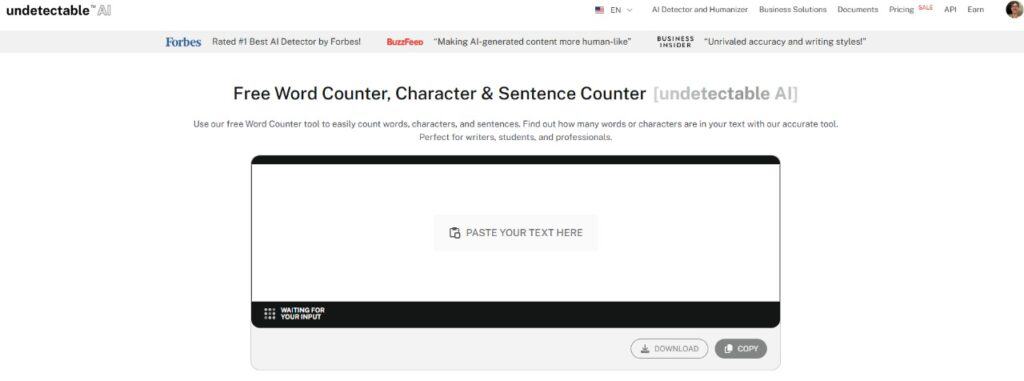
You could use the free Undetectable AI’s Word Counter, character counter, and sentence counter tool to get these numeric metrics for all your journal entries. Aim for higher word counts as you become familiar with the process.
- Notice writing improvements
Being able to pour down your thoughts onto paper naturally makes you more expressive. But if you become a little more mindful, you can gain massive improvements in your writing style.
Give yourself small writing-based challenges, for example, picking up a new word from a dictionary and trying to use it in your entry for the day, and when you complete the challenge, reward yourself for it.
Or, every time you’re done writing, you could run your entry through a grammar and punctuation checker to identify the mistakes you have made and make it a learning session for yourself.
Common Mistakes Beginners Make
When journaling, do not assume you will remember the context of your entry some 5 years down the line when you look back at it.
Try to make it as descriptive as possible. The more details you include, the better it will be at making the entry come alive.
Also, it is always better for a memory to be recorded but not be great as opposed to not being recorded at all.
In the initial months, you WILL want to quit, you WILL feel like you don’t write well, and it’s just not your thing.
Do not want your journal to be perfect. Be it as messy as it can be, and I’m sure the mess will turn into an ‘aesthetic’ when time passes by, and you see the compilation of the journal entries you’ve written over the years.
Start using our AI Detector and Humanizer in the widget below!
Final Thoughts
The more you enjoy journaling, the more likely you are to continue it for longer, and the better you get at it. Just don’t get overwhelmed with the concept of having all your thoughts written down in a neat, clean way.
Get started with whatever journaling techniques you feel the most comfortable with and let it be messy.
On days you are too lost about what to journal, turn to Undetectable AI and get specific prompts to direct your thinking towards a certain path.
Also, use it to get feedback on your writing if you also simultaneously want to improve your writing skills.
Check out Undetectable AI today!