
Let’s be honest, every time a new AI tool pops up in your feed, your inner skeptic probably does a double take.
You are not looking for an overhyped gadget that promises the world and delivers a headache; you need a reliable partner for those grueling research sessions.
Litero AI has officially entered the arena, marketing itself as an ethical academic co-pilot designed to help you write ten times faster while managing your citations and research.
But does it actually deliver or is it just another layer of code pretending to have a soul?
Interestingly, while many AI tools struggle with hallucinations, which is the frustrating tendency to make up facts, Litero AI aims to keep its feet on the ground by linking directly to verifiable scholarly papers from databases like JSTOR and Google Scholar.
In this review, we are cutting through the marketing noise to see if this platform is a true academic ally or just another bot prone to false positives.
From its specialized outline builder to its automated citation features, here is everything you need to know before you ever hand over your credit card details.
Let’s get started.
Key Takeaways
- Litero AI is an AI-powered academic writing assistant, providing researchers and students an ethical means to write scholarly papers ten times faster.
- Litero AI has over 8 features for helping writers push past their mental block, with AI detection and humanization taking the backseat.
- Based on tests we ran with ZDNet’s benchmark, we found Litero AI tends to be prone to false positives but accurately detects unedited AI texts.
- Using Litero AI for academic writing is legal as long as it’s used ethically, as a support rather than the main writer.
What Is Litero AI?
Litero AI is an academic writing assistant designed specifically for students and researchers who need help creating scholarly content.
However, unlike general-purpose AI tools, Litero AI focuses exclusively on source-based academic writing.
This AI tool could potentially help you maintain your unique voice while working with real, verifiable scholarly sources like JSTOR, Google Scholar, and DOI.


Never Worry About AI Detecting Your Texts Again. Undetectable AI Can Help You:
- Make your AI assisted writing appear human-like.
- Bypass all major AI detection tools with just one click.
- Use AI safely and confidently in school and work.
More so, Litero AI functions as your co-writer rather than a replacement for your thinking.
As a result, you stay in control throughout the entire content creation process, from initial research to final formatting.
Key Features of Litero AI
Litero AI has several features available to its users to guide them through the entire writing process.
Below are the top features you get access to when you use the platform:
- Outline Builder
You can begin the preliminary work required to develop organised frameworks for your essays and papers with the help of the outline builder.
Litero will use authentic academic sources to create a foundational draft structure based on the basic information you supply about your topic and requirements.
Instead of you looking at a blank page cluelessly, the outline builder could give you a good place to start building your essay.
Furthermore, you’re not stuck with the generated outline, but can alter it as much as you like to fit your needs.
- AI Writing Assistant
The AI writing assistant is another important feature that’s geared to help you expand on your ideas.
This tool provides you with insightful recommendations as you write, so you push past your writer’s block, if there’s any.
This writing assistant works so well because it comprehends the context of your work.
Based on this understanding, it provides you with recommendations that are appropriate for the argument and flow of your paper rather than general advice.
- Citation Tool
The Litero citation tool produces reliable and verifiable citations in popular academic formats, such as Harvard, Chicago, APA, and MLA.
All you have to do is enter your source details and choose your needed citation style, so the system will give you the appropriate citation.
It’s able to cite in these styles due to its connections to scholarly databases and academic libraries.
So, you should be able to get precise citations without running the risk of artificial intelligence hallucinations.
For further inspection, Litero AI gives you a link to an academic library where you can view the cited source whenever it suggests a reference.
- AI Detector
Before submitting your work, the Litero AI detector helps you see how your writing appears to detection algorithms.
The AI detector finds passages in your text that might seem AI-generated, which is likely to activate detection tools that are used by organizations.
Instead of finding issues after submission, you can address any flagged sections of AI-generated text and proactively revise those sections for more authentic expression once it has been detected.
- Plagiarism Checker
The built-in plagiarism detector in Litero checks your work against a sizable collection of scholarly sources.
You don’t have to export your document to a different platform because the checker operates inside your editing environment.
It suggests rewording or adding appropriate citations to ensure your work stays original if it finds a likely plagiarized passage in its analysis.
- Paraphrasing Tool
You can request multiple versions of your text in different tones or styles.
Using Litero’s paraphrasing tool gives you access to suggestions that will help you express your ideas better.
- Grammar Checker
Litero AI also provides a grammar checker in addition to its writing assistant features.
The checker does the normal spelling, grammar, and punctuation error detection and suggests corrections to guarantee your text is polished prior to submission.
- AI Humanizer
Together with the AI detector, the humanizer gives AI-generated text a more unique and organic sound.
The Litero AI humanizer is incorporated into your normal editing process and deals with stiff or awkward phrasing before it becomes an issue.
- AI Chat Companion
This companion can assist you with your research and is aware of the context of your entire document.
Without leaving your writing environment, you can ask questions about your sources and receive advice. You also have the option of uploading pre-existing drafts to improve them or starting from scratch.
How Does the Litero AI Work?
Litero AI operates as a co-writing partner rather than a replacement for your thinking.
The platform guides you through three main starting points:
- Begin from scratch with AI assistance as you write
- Generate a complete first draft based on your instructions through guided workflows
- Upload existing drafts to refine and improve them
The system uses top-tier AI models, including OpenAI GPT-4o and o1, plus custom fine-tuned models built specifically for academic contexts.
These models work together through prompt chains with research-proven techniques to maximize returns and reduce hallucinations, while RAG (retrieval-augmented generation) enhances results with data from academic articles.
Meanwhile, for the writing process, Litero AI:
- Uses AI commands to expand paragraphs, improve content, or add citations.
- Gets real-time feedback and improvement guidance based on your document context.
- Automatically saves your progress as you work.
- Gives you full editing control over every suggestion
The platform connects you with verifiable sources rather than relying solely on general knowledge.
You can upload your research documents to Litero, interacting with the document through the AI chat in the Litero writing environment.
Additionally, the platform’s AI detection and plagiarism checker can ensure your academic integrity.
Is The Litero AI Accurate?
According to various Litero AI reviews, the platform makes bold claims about its accuracy.
Users report mixed experiences with overall platform stability, though the core accuracy features receive positive mentions.
The real question remains whether Litero delivers on these accuracy promises in practice.
We ran our own test using industry-tested methods to evaluate the platform’s actual performance.
The Test
For this test, we used ZDNet’s rigorous benchmark, which has been used to test several top AI tools for their accuracy.
In the test run by ZDNet, our tools showed 100% accuracy in most scenarios, bolstering our reputation for reliable tools. Let’s see if Litero AI will perform well under the same metrics.
The test includes actual AI-generated texts and human-written texts, which we ran through Litero AI detector and our AI detector.
The Results
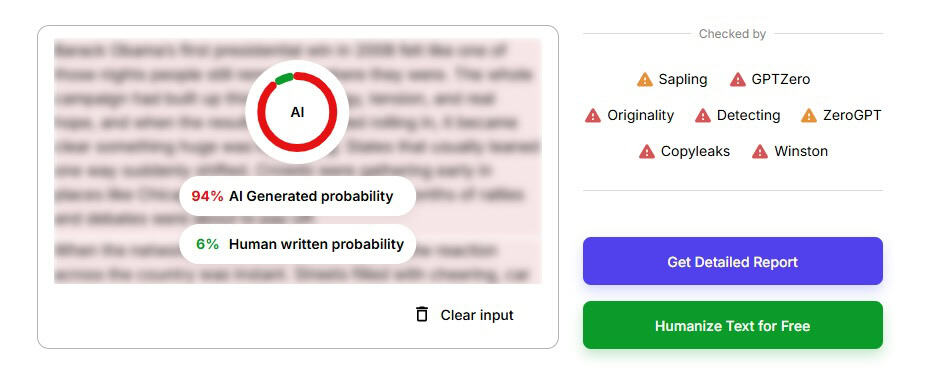
The first test is an AI-generated text with no human input, run through the Litero AI detector. The detector found a 94% AI-generated probability and a 6% human likelihood.
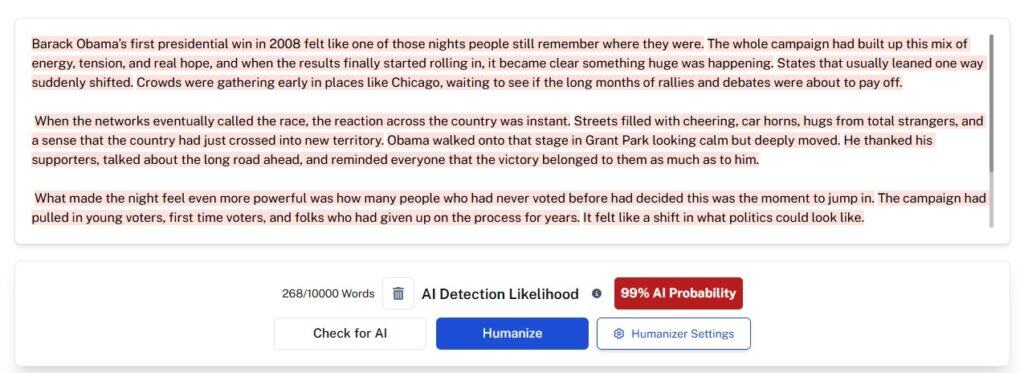
However, compared to our detector’s 99% AI probability on the same text, it’s likely some AI-generated text could slip through Litero’s detector.
The second test is a fully human-written text that Litero AI detector found to have a 97% AI probability. This is a glaring false positive that shouldn’t be.

Meanwhile, for the same text, our detector showed the text is likely human with a 99% confidence.

The result shows that although Litero AI can reliably detect AI-generated text, it can still be overly sensitive, giving users false positives, which isn’t great for an academically-focused tool.
In that case, it’s best to use our AI Detector and Humanizer to genuinely verify your content’s authenticity and humanize it before any submissions to professors and journals.
Litero AI vs. Undetectable AI
You’ve got dozens of AI writing tools competing for your attention, each promising to solve your content creation problems. In the earlier test, we used our detector in tandem with Litero AI.
Although both have AI detection, they serve fundamentally different purposes and excel in distinct areas.
This is how they stack up against each other:
| Litero AI | Undetectable AI |
| This tool offers a complete academic writing assistant. | It focuses on strong rewriting for undetectable AI output and other business-oriented AI solutions. |
| It works best for students, researchers, and academics. | This can work for students, content creators, marketers, bloggers, and others. |
| 10+ million verified academic sources for plagiarism checks and citations. | Its plagiarism checker is not as comprehensive; however, its citation generator is a match. |
| Adjusts tone for academic or natural clarity. | Heavy rewriting to sound human, but may alter meaning in academic writing. |
| Its use case is restricted to academic situations. | It caters to businesses, individuals, startups, and deepfake detection. |
| Offers no API integration. | API integration across business workflow. |
Overall, if you need comprehensive support for academic papers, you can choose Litero AI from start to finish.
However, Undetectable AI steps in to detect AI content in any form, polish AI-generated text, and make it undetectable.
Alternatives to Litero AI
You can look into other alternatives beyond just our tools, and below are some of the notable ones that are great competitors to Litero AI.
- QuillBot
QuillBot was first a paraphrasing tool before growing into a full-fledged writing assistant. It offers similar features to Litero AI.
This tool is a smart pick for writers and students needing help refining their tone and transforming existing text into something more polished and human-friendly.
- Jasper AI
Jasper is another specialized AI tool like Litero AI. Jasper AI, on the other hand, is more suited for marketing departments, content producers, and anybody else who produces several content that are consistent with their brand.
It prioritizes features from multi-channel content production, workflow automation, to SEO integration and brand voice.
- Grammarly
While Grammarly isn’t quite the “academic-writing” assistant that Litero AI aims for, it shines at refining grammar and polishing text.
It catches grammar, tone, and punctuation issues. As of recently, it has also incorporated a plagiarism component and AI detection capabilities.
You can use it when writing and when your draft is in place.
- Wordtune
Wordtune offers writing support by suggesting rewrites for sentences and paragraphs, helping with flow, and giving alternative phrasing.
It’s less focused on full essay workflows like Litero AI, yet its niche aspect gives it an edge with rewriting. It has an AI detector and a humanizer as well, but hasn’t distinguished itself in that aspect.
Nonetheless, if you’re editing or optimizing your writing rather than generating from scratch, this tool has value.
Discover our AI Detector and Humanizer in the widget below!
FAQs About Litero AI
Is Litero AI detectable?
Yes, Litero AI can be detectable, though not automatically or in every situation. Litero AI services focus more on writing tools, citations, and editing features.
It doesn’t highlight stealth writing or anti-detection abilities like our AI humanizer. So its output isn’t specifically engineered to bypass detectors.
Is using Litero AI legal?
Using Litero AI is legal. You are allowed to get writing assistance, research help and grammar support. The concern usually comes from plagiarism or misrepresentation.
The real responsibility is on how you use the output. When you treat it as a study partner rather than a ghostwriter, you stay within safe academic rules.
How Does Litero AI Ensure Academic Integrity?
Litero AI combines multiple safeguards from the plagiarism detector, citation tool, to the Litero AI detector.
You still need to revise the content in your own voice, since that personal layer is what ensures full integrity.
Final Verdict
So, if you’re still wondering “is Litero AI legit,” this review has dispelled some of your doubts. Litero AI has now joined the league of AI tools that consumers like you can use for academic writing.
Although its AI detection capability is no match for our AI detector and humanizer, it still offers great AI writing assistance for its users, citation, and pushing past writer’s block.
However, you’ll have to run its output through a reliable detector like ours to fully polish your work before submitting it.
For full confidence in your work, use Undetectable AI.