
Yes — and here’s how often. Independent testing reveals that AI detection tools falsely flag human writing at rates ranging from 1% in general populations to a staggering 61.3% among specific writing groups.
Consider Marcy, a senior at a major state university whose capstone thesis was flagged as 98% AI-generated despite being drafted entirely from scratch, putting her graduation on hold until version history logs proved her innocence.
It is safe to say that ever since ChatGPT was launched in November 2022, the world has changed. AI is infiltrating nearly every industry and is contributing to the rapid evolution of existing technology. Using AI-generation tools like ChatGPT to produce text has been a popular way to harness its power.
Whether you are a freelance writer, content creator, or even an academic student, AI has been a powerful tool to add to your arsenal.
Enter AI detectors to spoil the party. We are joking, of course, because there does need to be a check in place to ensure that AI is used responsibly and with good intentions. Site owners, schools, and even Google itself utilize AI detectors to ensure we are not passing that work off as our own.
But can AI detectors be wrong? It should come as no surprise that AI technology on both sides of the aisle is still imperfect.
These detector tools routinely suffer from false positive tests. Below is a comprehensive guide explaining how AI detectors work, why they fail, what the research shows, and how you can avoid false positives and protect your authentic work.
Key Takeaways
- AI detectors rely on probabilities, not hard proof. They do not scan for digital signatures or hidden code. Instead, they look at sentence length variation and word predictability, which means structured human writing often gets misflagged.
- Vendor accuracy numbers are misleading. A tool that claims 99% accuracy sounds nearly perfect, but in a university with 10,000 students, that 1% error rate leads to 100 wrongly accused students on every single assignment.
- Non-native English writers face the highest risk. Because ESL writers often use straightforward, highly structured sentences and direct vocabulary, detectors routinely misinterpret their genuine work as machine-generated text.
- Even OpenAI could not make detection work. OpenAI shut down its official text classifier after it achieved only a 26% success rate and regularly flagged authentic human writing as synthetic.
- Version history is your best defense. Keeping a clear digital paper trail, such as Google Docs edit history or Word document timelines, provides timestamped evidence that proves you wrote your work from scratch.
How Do AI Detectors Work?
AI detectors are built using natural language models and millions of data points of both AI and human-generated text. Whenever content is screened by an AI detector tool, it compares it against these data sets and seeks out predictable patterns in syntax, word choice, and the overall structure of the text.
These detectors are trained to recognize patterns and compare them to both AI and human-generated examples. The findings of the AI detector are the likelihood that the scanned content is AI-generated, not a guarantee. AI detectors work on the basis of probability without any definitive evidence.
What exactly are these patterns that AI detectors are looking for? Two concepts that are driving forces for AI detectors are burstiness and perplexity.


Never Worry About AI Detecting Your Texts Again. Undetectable AI Can Help You:
- Make your AI assisted writing appear human-like.
- Bypass all major AI detection tools with just one click.
- Use AI safely and confidently in school and work.
Understanding Perplexity and Burstiness
- Perplexity: Perplexity refers to how complex the language is as its name suggests, and how easily human readers will be perplexed. For comparison, AI-generated text is pre-programmed to have a low perplexity to make things easier for readers to understand. High perplexity indicates unexpected, complex language choices typical of human thought.
- Burstiness: Burstiness refers to the length and complexity of sentences. If you have ever read AI-generated text, it will sound mechanical because many of the sentences have similar length, structure, and even punctuation. Human writers naturally alternate between short, punchy statements and long, intricate sentences, yielding high burstiness.
Most detectors use machine learning algorithms trained on datasets containing both human and AI-generated text. They learn to identify subtle markers that supposedly distinguish artificial content from authentic writing.
The problem? These markers are not foolproof. Human writing can sometimes match AI patterns. Especially if you are a clear, concise writer who follows standard grammar rules.
Some detectors also use reverse engineering techniques. They try to predict what an AI model would generate given the same prompt. If your text matches those predictions too closely, you get flagged. But prediction is not reality. Just because an AI might write something similar does not mean it actually did.
How Accurate Are AI Detectors, Really?
Those who have both used AI detectors and had their content scanned by an AI detector know that these tools are far from perfect.
While companies claim extreme precision, real-world evaluations show significant inaccuracy depending on the domain and writer background.
| Detector | Vendor-Claimed Accuracy | Vendor-Claimed FP Rate | Independent Finding | Last Tested |
| Turnitin | 98%–99% | < 1% | Up to 4% sentence-level FP; over 60% FP on non-native English essays | 2026 |
| GPTZero | 99% | < 1% | High variance on short passages; elevated error rates on technical prose | 2026 |
| Copyleaks | 99.1% | 0.2% | Reliable on generic copy; frequently flags structured data and tables | 2026 |
| Originality.ai | 99% | 1.5% | Aggressive scoring model; elevated FP rate on formal business copy | 2026 |
| ZeroGPT | Unspecified | < 2% | Unstable baseline scoring; routinely flags historical texts and non-fiction | 2026 |
| Winston AI | 99.7% | < 1% | Strong performance on standard essays; higher error rates on short texts | 2026 |
Why Vendor Rates and Real-World Rates Diverge
At the heart of AI detectors is how well they are trained. Changing AI models and algorithms can leave detectors caught with out-of-date data sets, creating a disconnect between lab accuracy and real-world application. This is known as the base-rate problem.
A vendor claiming a 1% false-positive rate sounds extremely reliable in a controlled test environment. However, when applied across a university population, the real-world impact is catastrophic.
A 1% false-positive rate across a 10,000-student cohort means 100 innocent students are wrongly accused of academic dishonesty on every single assignment. Across an entire academic year, hundreds of false flags occur, disrupting real lives.
What the Research Actually Shows

Research confirms that AI detector errors are widespread and systematically biased.
- Stanford HAI Research on ESL Bias (Liang et al., 2023): Stanford researchers tested seven popular AI detectors on essays written by non-native English speakers for the TOEFL exam. The study revealed a 61.3% false-positive rate on non-native essays. Over 97% of the non-native papers were flagged as AI-generated by at least one detector because AI detectors routinely misidentify simple, predictable prose as synthetic.
- The Vanderbilt University Decision (2023): The reality of false accusations led Vanderbilt University to turn off the AI detector feature on Turnitin. Vanderbilt calculated that even a lower than 1% false positive rate across tens of thousands of papers created acceptable risks of misidentifying innocent student work.
- University of Chicago / NBER Research (Jabarian & Imas, 2025): Primary research out of Chicago showed that while commercial tools outperform basic open-source models, almost all systems experience high error rates when analyzing light edits, technical prose, or non-traditional writing styles.
OpenAI Shut Down Its Own AI Detector
Even the creators of AI cannot detect AI consistently. In July 2023, OpenAI quietly retired its official AI Text Classifier. The tool was retired over low accuracy, registering a true positive rate of just 26% while frequently flagging human writing as synthetic.
If OpenAI cannot detect ChatGPT output accurately, third-party software cannot guarantee certainty either.
AI Writing Traces Humanity
Here is something most people do not realize: AI writing actually contains traces of human creativity. Every AI model was trained on human-generated content. In a way, AI writing is just remixed human thought.
That creates a fundamental problem for detection systems. Where does human writing end and AI writing begin? The line is not as clear as we would like to think.
When you use similar phrasing to millions of other writers, are you copying them or just thinking similarly? When an AI uses that same phrasing, is it copying or generating something new?
The overlap between human and AI writing styles creates a gray zone where detection becomes nearly impossible. Good human writing and sophisticated AI output can be virtually indistinguishable.
AI models are designed to produce human-like text. The better they get at this task, the harder they become to detect.
The Six Things That Trigger a False Positive
The AI detector itself does not realize it is providing a false positive report. AI detectors do not actually understand what you are writing about, looking only at surface-level patterns without grasping meaning or context.
Here are six specific writing characteristics that trigger false positives:
1. Formal Academic Register
Writing in a formal, objective tone removes casual speech patterns, driving perplexity down to mechanical levels.
- Example: “The empirical data gathered during the trial indicates a statistically significant correlation between sleep duration and cognitive performance.”
2. Consistent Sentence Length
Drafting multiple sentences with uniform word counts creates an even cadence that algorithms interpret as mechanical burstiness.
- Example: “The research team reviewed the metrics thoroughly. The department heads met to analyze the budget. The management staff approved the resource allocations.”
3. Technical or Legal Terminology
Fields with strict standardized language force writers into repetitive phrasing that matches statistical prediction models. A detector might flag a technical manual or legal document simply because it follows standard formatting and terms.
- Example: “The licensee agrees to indemnify, defend, and hold harmless the licensor from any liabilities arising from third-party operational claims.”
4. Common Phrasing and Clichés
Relying on standard transitions or popular idioms increases word prediction probability.
- Example: “At the end of the day, taking these proactive steps will allow us to move the needle forward in a meaningful way.”
5. ESL Writing Patterns
AI detectors have a strong tendency to flag non-native Engish writing as AI-generated because non-native speakers score low in perplexity, using simple sentences and direct prose.
- Example: “In addition, many students think that studying online is better because it saves time and reduces transportation costs.”
6. Heavily Structured Formats
Documents adhering to rigid templates, such as lab reports or step-by-step guides, naturally mirror LLM instruction formats.
- Example: “Step 1: Unpack the hardware. Step 2: Connect the power supply. Step 3: Depress the power button for three seconds.”
Detector-by-Detector: Known Weaknesses

Different detection engines employ unique scoring algorithms, leading to specific operational vulnerabilities:
- Turnitin: Highly sensitive to formal academic syntax, standardized citations, and non-native English sentence structures.
- GPTZero: Focuses heavily on perplexity and burstiness metrics; routinely flags concise technical documentation, summaries, and explanatory non-fiction.
- Copyleaks: Vulnerable to structured formatting; frequently flags tabular data, bulleted lists, and inline code snippets.
- Originality.ai: Designed with strict thresholds for web publishers; prone to false positives on polished, search-optimized marketing content.
- ZeroGPT: Features inconsistent scoring logic; often flags historical texts, classic literature, and official government reports.
How to Respond to a False AI Accusation
Getting falsely accused of using AI can be devastating. But don’t panic. If your human-written text is flagged as AI, here is the exact order of operations to follow:
- Document Your Writing Process: Before changing anything, gather your evidence. Look for early outlines, research notes, brainstorms, and early draft iterations.
- Request the Actual Report and Score: Ask for the complete report generated by the scanning software to see the specific highlighted passages and overall score.
- Inquire About Tool Specifications and Error Rates: Ask which specific detector was used and request its documented error margins and known false-positive rates.
- Learn Your Appeals Procedure: Review your school’s or employer’s formal policy regarding academic or professional integrity to understand your rights.
- Escalate Your Defense in Writing: Submit a written statement attaching your draft evidence and highlighting documented technical flaws associated with detection algorithms.
Once you have taken these administrative steps, you can evaluate your text to make sure future drafts read authentically.
Instead of just flagging content, Undetectable AI’s tools provide a detailed analysis of why certain passages might trigger detection so you understand the specific elements causing problems.
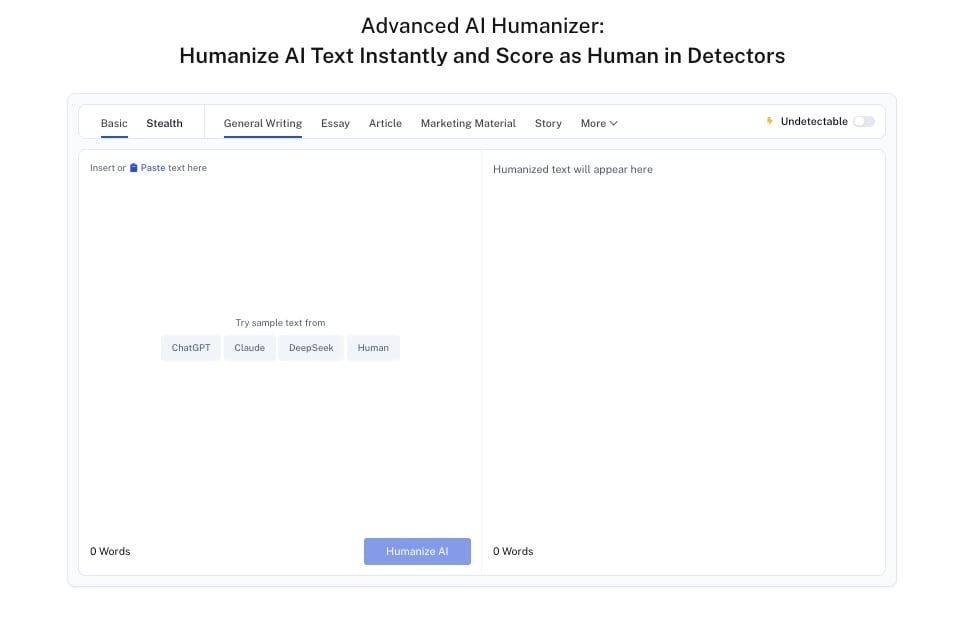
You can run flagged text through the AI Humanizer to adjust sentence structure, tone, and word choices to align with natural human writing without changing your core message.
Evidence That Protects You Before You’re Accused
Building a digital paper trail as you write is the most effective defense against false accusations:
- Google Docs Version History: Maintains a continuous time-stamped record of your keystrokes, revisions, and writing duration over time.
- Microsoft Word Editing Timeline: Enables internal tracking properties that record total editing time and revision histories within document metadata.
- Tracked Drafts: Save distinct file versions at key stages (e.g.,
Draft_1.docx,Draft_2.docx) alongside recorded screen sessions for high-stakes projects.
How to Avoid AI Detection
Audiences and search engines are getting smarter, and that means they can tell when something feels off.
Beyond responding to false allegations, there are proactive steps you can take to mitigate the risks of being flagged as written by AI before submitting your work.
- Add Your Unique Tone and Voice: Generic writing triggers detectors more often than distinctive writing. Develop your personal style and lean into it. Use specific examples from your own experience, reference personal anecdotes, and include cultural references that matter to you.
- Vary Your Sentence Structure: Mix short, punchy sentences with longer, flowing ones. Break some grammar rules intentionally for effect. Add personality quirks like starting sentences with “And” or “But” occasionally. These human touches help authenticate your work.
- Accept Imperfection: Real human writing has small inconsistencies and minor flaws. Overly polished prose can actually trigger detection systems.
- Scan Your Final Work: Always test your writing before submitting it as part of your standard editing process. Pay special attention to technical sections, introductions, and conclusions, as these areas commonly trigger false positives because they follow predictable patterns.
False Negatives: The Other Half of the Problem
While false positives create serious problems for writers, false negatives occur when AI content slips through undetected.
False negatives happen frequently because simple modifications destroy algorithmic pattern matching. Methods that bypass detectors include:
- Inserting minor typos, extra spaces, or varied punctuation.
- Prompting an LLM to write using custom tone profiles or informal slang.
- Running machine output through paraphrasing tools or multi-language translators.
Both false positives and false negatives prove that AI detectors are probabilistic estimates, not definitive proof of cheating.
How AI Detection Will Change
As simple statistical pattern recognition reaches its limits, the industry is shifting toward process-based standards:
- Cryptographic Watermarking: Model developers are researching techniques to embed invisible statistical watermarks directly into AI outputs at the generation level.
- C2PA and Provenance Standards: Digital content provenance protocols are expanding to track text creation from the keyboard onward, creating verifiable records of original origin.
- Keystroke and Process Verification: Academic platforms are moving away from post-hoc text scanning, choosing instead to log real-time keystrokes, editing duration, and revision habits directly within writing applications.
Glossary
- Perplexity: A metric measuring language randomness; lower perplexity indicates predictable word choices.
- Burstiness: The variation in sentence length, structure, and rhythm across a written document.
- False Positive: An error where authentic human writing is misclassified as AI-generated.
- False Negative: An error where synthetic AI-generated text bypasses detection and is classified as human.
- Base-Rate Fallacy: A statistical mistake where small baseline error rates produce massive numbers of absolute errors across large populations.
- Watermarking: Embedding hidden cryptographic markers into machine output to verify its origin.
- Fingerprinting: Analyzing unique writing habits, vocabulary choices, and stylistic signatures to attribute authorship.
Frequently Asked Questions
Can Turnitin detect ChatGPT?
Turnitin scans for structural patterns associated with LLMs. However, it operates on probability rather than direct digital tracking, making it susceptible to false positives.
Is a 100% AI score proof of cheating?
No. AI scores reflect statistical probabilities based on pattern matching, not digital proof of misconduct. High scores routinely occur on formal, technical, or non-native English documents.
Can I be expelled on a detector score alone?
Most major universities prohibit disciplinary action based solely on automated detector scores due to documented false-positive rates and legal liabilities.
Do detectors flag Grammarly?
Yes. Advanced auto-suggestions, tone adjustments, and full-sentence rewrites in Grammarly alter text perplexity and burstiness, causing human drafts to trigger AI flags.
Do they work on paraphrased text?
Detection accuracy drops significantly when text is paraphrased, reordered, or edited by a human writer, as modified syntax disrupts pattern matching.
Are they biased against ESL writers?
Yes. Peer-reviewed studies confirm that non-native English writers experience false-positive rates over 60% due to concise vocabulary and formal sentence structures.
Why do two detectors disagree on the same text?
Different detection software vendors utilize proprietary training datasets, different scoring thresholds, and unique algorithmic weights.
Can I appeal a false detection report?
Yes. You can appeal by presenting version histories, time-stamped outlines, research notes, and document metadata that prove your step-by-step writing process.
Do AI detectors work on code?
No. Programming languages rely on rigid syntax and standardized functions, causing detectors to frequently misclassify human code as machine-generated.
Do they work on non-English text?
Detection accuracy decreases markedly on non-English content because most commercial detectors are trained predominantly on English datasets.
How much text do detectors need to analyze?
Most engines require a minimum of 100 to 250 words to calculate stable probabilistic metrics. Short passages produce highly unreliable results.
Does editing AI text lower the score?
Yes. Varying sentence lengths, changing repetitive vocabulary, and introducing personal anecdotes breaks the uniform patterns detectors search for.
Navigating AI Detectors Without Losing Your Mind
So, can AI detectors be wrong? Of course. Are AI detectors flawed? Absolutely. Do AI detectors work? Most of the time they do.
It is not uncommon for people to think only in dualities, but an AI detector can both be flawed and serve its purpose. When an AI detector is used properly, it can provide a defense against the unethical usage of AI in academia and content creation. But when AI detectors provide false positives and inaccurately flag human text as AI-written, then we have a problem.
We have to remember how early we still are on the generative AI roadmap. The technology we have now will look ancient in five or ten years. As AI technology continues to improve, so too will the accuracy of AI detectors.
Until then, we have to deal with the fact that these detectors are far from perfect and that an AI detection score should never be used as definitive evidence of cheating or academic dishonesty.
If you want to make sure your human-written content stays authentic and misclassification-free, keep your voice intact, your writing authentic, and your creativity unstoppable.
Try Undetectable AI today to transform flagged text into naturally authentic human writing and defend your work with confidence.