
We mostly return home exhausted after a long day at work. Yet, we feel cozy as soon as we get home. The funny thing is that when you try typing the word, your brain freezes.
Is it cozy or cosy? You’ve seen both spellings countless times, but suddenly you’re stuck on which spelling is right.
This is a linguistic dilemma that even professional writers frequently pause to wonder about. You’re not alone as Americans and Brits have been arguing about the correct spelling for a while now.
So, in this guide, we’ll put an end to this confusion.
Let’s dive in.
Key Takeaways
- In British English, the spelling is cosy. For American English, it’s cozy. Either way, the word means the same thing notwithstanding how they’re spelled
- The American z spelling is often linked to Noah Webster, whose 1828 American dictionary helped standardize a lot of U.S. spellings.
- You must watch out for figurative uses of cozy. These figurative expressions mean different things from the word itself.
- Always match your spelling of cozy to your audience’s location. Then maintain a consistent spelling of cozy throughout your entire work.
What Is the Difference Between Cosy vs Cozy?
The English Language has this sneaky way of tripping us up on the smallest things. In this instance, cosy and cozy are one of them.
They mean exactly the same thing, yet an “s” or “z” is enough to make you sit there staring at your keyboard as if you’ve never spoken English in your life.
Definitions and Origins
The definition of cozy remains constant regardless of the letter choice you use. It describes a state of comfort and warmth, and can be used to describe a welcoming space.


Never Worry About AI Detecting Your Texts Again. Undetectable AI Can Help You:
- Make your AI assisted writing appear human-like.
- Bypass all major AI detection tools with just one click.
- Use AI safely and confidently in school and work.
Cozy is perfect when you want to describe a crackling fireplace during a snowstorm that keeps you warm.
As for the origin of cozy, etymologists trace it back to the 18th century. The word stems from the Scottish dialect word “colsie.” It also shares linguistic DNA with the Norwegian concept of “kos.” The Norwegians know this as a cultural celebration of simple pleasures and connection.
Even so, plenty of people still second guess which spelling is “right.” Cozy became the standard American form after Noah Webster’s 1828 American Dictionary of the English Language helped codify U.S. spellings and set them apart from British usage.
Consequently, words that end in “ise” became “ize.” Similarly, cosy transformed into cozy for American audiences. Despite this, the British stuck with the “s” in their spellings.
The confusion today stems largely from global communication. Social media, international publications, and online shopping throw both spellings at us constantly.
Someone in Manchester searches for a ‘tea cosy’ while their friend in Boston types ‘tea cozy’, and both find exactly what they need. Since neither is incorrect, this explains why the question ‘is it cosy or cozy?’ remains popular online.
When to Use
A mismatched spelling sticks out like a sore thumb in professional writing. For this, choosing the right variant is more about knowing where your readers live.
Hence, you have to understand who you’re writing for so things can be simple for you.
Cosy
- British English: Cosy is the standard spelling for people in the United Kingdom. So, in any cosy or cozy UK rules debate, the “s” is always the correct choice for formal writing.
- Commonwealth Countries: Nations having colonial ties with Britain follow British spelling conventions.
- Tea Accessories: In the UK, that knitted jacket you pop over a teapot to keep it piping hot is always called a tea cosy. You can try searching for tea cosy or cozy on any British site. It’ll come up as tea cosy, never tea cozy.
- Proper Nouns: Always spell it as cosy if it appears in a British circumstance, regardless of where your audience lives.
Cozy
- American English: Writers in the United States use the “z” in their spelling. This is the only accepted spelling in American academic settings.
- Phonetic Accuracy: Noah Webster championed the “z” because it actually sounds like the buzz you feel in your mouth when you say it.
- Canadian English: Canada sits on the fence when it comes to this spelling. While often following British spelling, the American influence is strong, so both are often accepted. Yet, “cozy” is becoming increasingly common.
When you are stuck on how to use cosy or cozy in your writing, our AI Humanizer can help you make your work feel natural and flow well for better understanding.

Cosy or Cozy in Everyday Writing
Casual texts and emails are where most people encounter these words. You do not need a strict style guide to decide on the cozy or cosy spelling.
Still, to ensure your writing doesn’t look half-baked, apply these tips to keep your spelling of cozy consistent.
- Social media trends reach a global audience these days with hashtags. You might want to use both spellings in your hashtags to catch everyone searching for winter vibes. Using just one might limit your reach.
- Auto-correct can be annoying when messaging international clients. If you are texting someone in London, remember the cosy or cozy UK rule favors the “s.” Adapting to their local spelling is a nice touch.
- When shopping on British sites, the searches could yield different results. Typing “tea cozy” on a British site might return zero results because they list the item differently. You will find that perfect knitted tea cosy or cozy much faster by matching the retailer’s country.
- Your friends genuinely don’t care whether you use cozy or cosy in your text. So, you can relax in casual conversations and save your spelling anxiety for academic writing with a strict writing guide.
- Stay consistent on your social media. Pick one spelling for your brand or personal accounts and use it everywhere. Your followers will subconsciously notice if you flip between cosy and cozy randomly.
- Your keyboard might be fighting against you without you realizing it. Adjust your language preferences so your device stops “fixing” your correct spelling.
Real-Life Examples of Cosy vs Cozy
Enough with the theory of the word. You’ll now see the cozy and cosy in action to solidify the rules better than a dictionary ever could.
So, when you sit down to write, these examples can help you:
- The real estate agent pointed out a cozy starter place in Manhattan that had a lot of character.
- We spent the whole rainy afternoon holed up in this cosy Edinburgh pub.
- My Sundays are for stacking a bunch of my classic cozy murder mysteries and reading them throughout.
- My cat somehow squeezed himself into the tiniest cosy spot right next to the kitchen fridge. He even flat-out refused to move.
- Dad’s log cabin upstate always feels properly cozy once the woodstove is roaring and the flannel blankets come out.
- My British mate texted that he’d grabbed a new tea cosy for Mum’s birthday.
- I’m properly torn between this perfect cozy Brooklyn apartment and an equally tempting cosy little flat in London.
- Ashley’s cousin in Australia put up an Instagram story about her “cosy night in” with candles and red wine, and now I want to copy her entire evening.
- I picked up this American cookbook that’s nothing but cozy fall recipes.
- The once charming, cosy cabin in the mountains is now overrun with weeds and predators
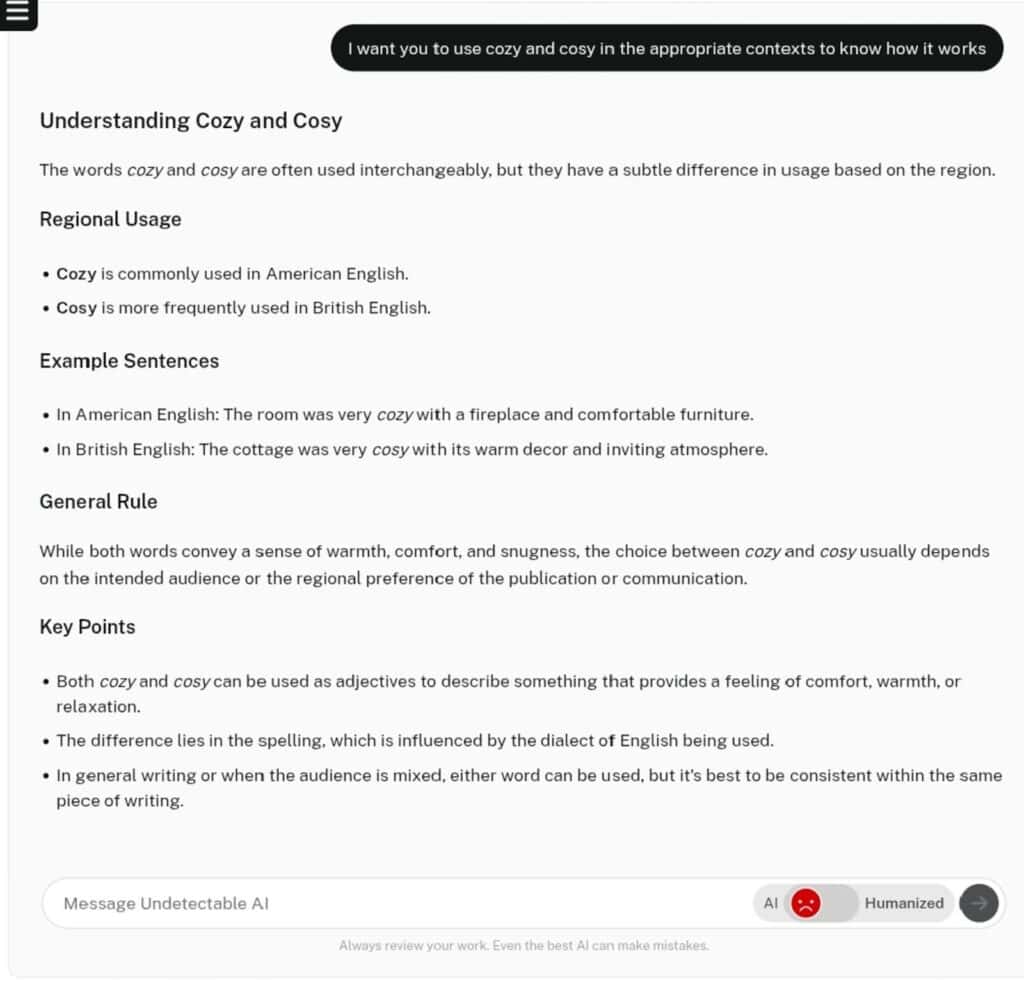
In addition to that, our AI Chat can help you pick the right cost or cozy spelling when you’re confused in your writing.
It can simplify the process based on who you’re writing to and whatever professional writing guides you have to follow. It also provides interactive prompts so you can practice and see the difference in real time.
Figurative Uses and Expressions
Cosy and cozy have wiggled their way into some interesting expressions and figurative meanings.
The word does more heavy lifting than you might expect, sometimes with a slightly suspicious undertone.
Verbs and Actions
These are action-specific cases where cozy is being used.
| Expression | Meaning | Examples |
| To cozy/cosy up | This expression describes someone trying to ingratiate themselves with another person. They mostly do this to gain an advantage over others. | “I bet he’s cozying/cosying up with the boss to get that promotion.” |
| Cozy/cosy down | Cozying down means to get comfortable by settling into a bed or a relaxing spot. | “Let’s cozy/cosy down by the fireplace and talk for a bit.” |
| Being cozy/cosy with someone | This suggests an intimate connection between two people | “They looked very cozy/cosy together at the party”. |
| Too cozy/cosy | This describes a relationship that’s gotten uncomfortably close for a professional setting. | ‘He got too cozy/cosy with her during the office meeting.’ |
| Getting cozy/cosy with someone | It describes when two rivals are becoming inappropriately friendly. | “You’re getting cozy/cosy with the competition.” |
Describing Relationships
Cozy/cosy can also be used to describe the nature of a relationship.
| Expression | Meaning | Examples |
| A cozy/cosy arrangement | This expression indicates that a situation is being handled quietly behind the scenes. This arrangement is for an exclusive mutual benefit that’s deemed unethical. | ‘When politicians and lobbyists appear to have a cozy/cosy arrangement, everyone else is left out of the loop.’ |
| Cozy/cosy relationship | This shows an overly comfortable connection between two groups | “The cozy/cosy relationship between Fred and Jared is suspicious considering the circumstances.” |
| To keep things cozy/cosy | This is mostly used when the person wants to maintain a small and intimate gathering that’s exclusive. | “ I want to keep things cozy/cosy.” |
Describing Atmospheres and Spaces
Cozy/cosy goes even further to describe the comfortable feeling of a space you occupy.
| Expression | Meaning | Examples |
| A cosy/cozy mystery | This usage refers to a subgenre of detective fiction featuring amateur detectives and small towns mystery with minimal violence. | “She loves reading a cosy mystery before bed because it’s light, comforting, and not too intense.” |
| A cosy/cozy chat | This is used for an informal and relaxed conversation. | “We had a cosy/cozy chat over tea before heading home.” |
Common Mistakes to Avoid
Switching between American and British spelling is the easiest way to make yourself look like you wrote your essay at 3 a.m. and never proofread it.
Instead, do this:
- Don’t switch between cosy and cozy in the essay you’re going to submit to your language professor. It’s true that they mean the same thing, but using the spellings anyhow can make your writing look messy. Pick one and stay consistent.
- Also, double-check your keyboard and spellcheck language settings before you start writing. The setting’s default language will autocorrect your intentional spelling to the wrong variant without you noticing early.
- Also, don’t use cozy in a piece written entirely in British English. In the same vein, don’t use cosy in American English content. This inconsistency will put off your readers and editors.
- Avoid spelling the base word one way but the variations another. Like writing “cosy” but then “cozier” or “coziness.”
- Don’t apply cozy in tense situations. When the situation is warm, comfortable, or snug, then using cozy is acceptable.
- You mustn’t miss the negative connotations when describing “cosy arrangements” or “cosy relationships” in professional contexts.
- Don’t use the expression “cosy up” when you actually mean genuinely connecting with someone. The expression means manipulatively ingratiating yourself.
- Lastly, publications usually have a set preference. Submitting an article filled with “z”s to a British editor shows a lack of attention to detail. Always check if they follow the cosy or cozy uk standard before submitting.
Once you’re done writing your essay, you certainly need to check the AI content before submitting it. Your professor or that international publication won’t be pleased with large traces of AI in your essay.
You can simply avoid this with our AI Detector to show you any AI content and ensure your work passes AI detection anywhere.

Give our AI Detector and Humanizer a try in the widget below!
Final Thoughts
You can stop worrying about the correct spelling of cozy or cosy. In casual messages, either version is fine, and most people won’t care. But for anything official, use the spelling your readers expect and stick with it throughout.
As a simple rule, Brits usually write ‘cosy’, and Americans ‘cozy’. In situations where you’re unsure, you can ask our AI Chat to explain things to you.
Use the spelling your audience expects and keep it consistent. Undetectable AI helps ensure your writing stays natural, polished, and human.