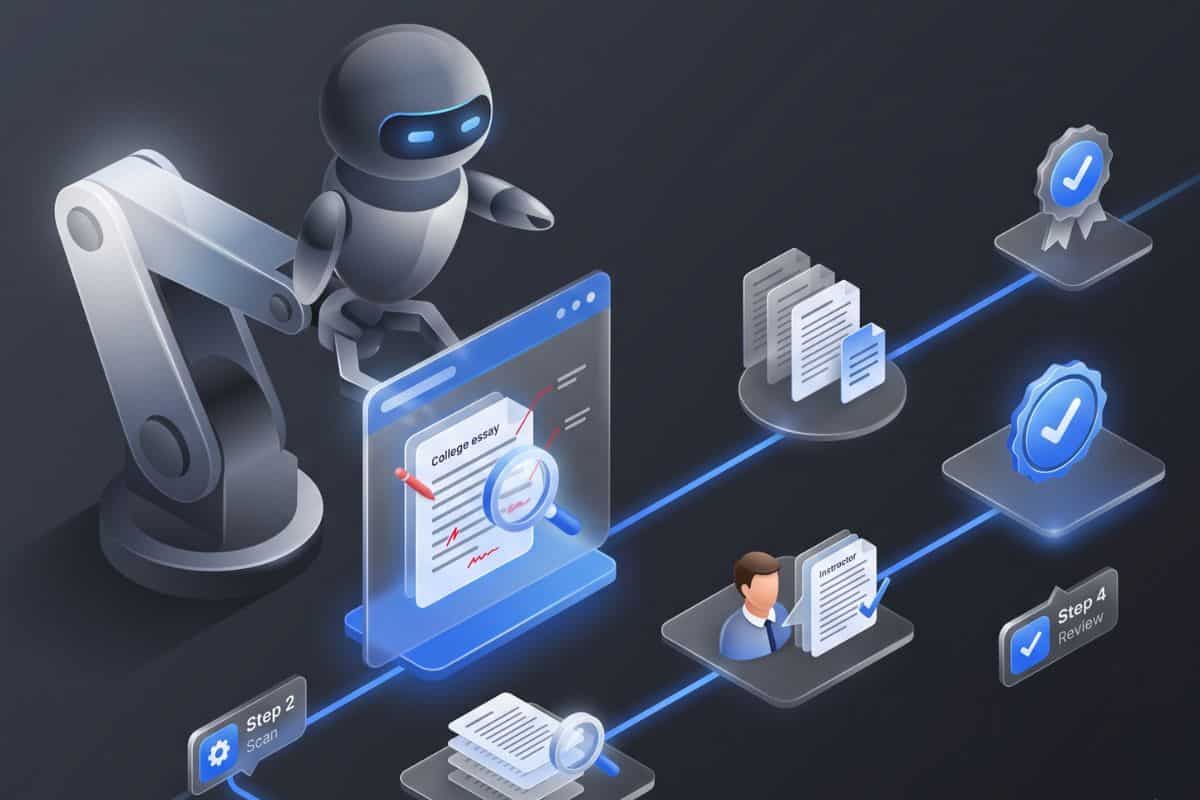
Artificial intelligence has become part of everyday student life. From brainstorming ideas to outlining essays, AI tools like ChatGPT are changing how students approach coursework.
As AI adoption continues to grow, colleges are also adapting by introducing AI detection tools to help protect academic integrity.
Today, many colleges use AI checkers alongside plagiarism detection software to identify writing that may have been generated by artificial intelligence. However, these tools aren’t perfect.
Even the most advanced AI detectors can produce false positives, meaning human-written work may be incorrectly flagged as AI-generated.
Rather than relying on AI detection scores alone, most institutions now treat them as one piece of a broader academic integrity review. Faculty often consider writing history, assignment context, and other evidence before determining whether AI was used inappropriately.
In this guide, we’ll explain what AI checker colleges use in 2026, how these tools work, their limitations, and what students should know before submitting their assignments.
Principales conclusiones
- Colleges increasingly use AI detection tools alongside plagiarism checkers to help identify AI-assisted writing.
- AI detectors can produce false positives, so many universities recommend using them as screening tools instead of definitive proof of misconduct.
- Different AI checkers vary significantly in accuracy, methodology, and supported file types.
- AI detection adoption has expanded rapidly as colleges update academic integrity policies to address generative AI.
- Recent legal cases and university guidance reinforce that AI detector scores alone should not determine whether a student violated academic integrity policies.
Por qué las universidades recurren a los verificadores de inteligencia artificial
When generative AI tools first became widely available, many educators viewed them as another productivity tool.
As students began using AI to draft essays, summarize readings, and answer homework questions, however, universities realized they needed clearer policies and better ways to evaluate original student work.
The challenge isn’t AI itself. Many colleges now allow limited AI use when it supports learning and aligns with course guidelines. The concern is when students submit AI-generated work as their own without disclosure.
No vuelvas a preocuparte de que la IA detecte tus textos. Undetectable AI puede ayudarle:
- Haz que aparezca tu escritura asistida por IA de aspecto humano.
- Bypass las principales herramientas de detección de IA con un solo clic.
- Utilice AI de forma segura y con confianza en la escuela y el trabajo.
To maintain academic integrity, colleges have increasingly adopted AI detection tools that help instructors identify writing patterns commonly associated with large language models.
Just as plagiarism detection became standard over the past two decades, AI detection is quickly becoming part of many institutions’ academic review process. Rather than replacing instructor judgment, these tools help faculty identify assignments that may require closer review.
Instructors also want to evaluate a student’s own reasoning, critical thinking, and writing ability instead of their ability to generate responses with AI. This is especially important for essays, research papers, scholarship applications, and writing-intensive courses where demonstrating original thought is part of the learning objective.
If you’d like to review your own work before submitting, learning how to check for AI writing can help you identify passages that may appear AI-generated before your instructor does.
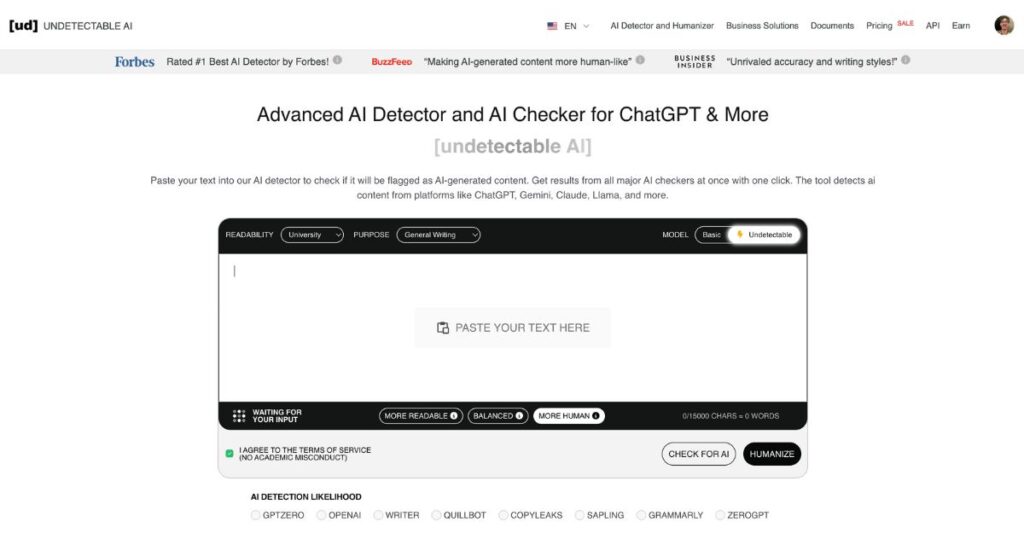
Running a draft through the Undetectable AI Checker allows you to revise flagged sections before submission and better understand how detection tools analyze writing. Here’s how it works:
- Go to Undetectable AI’s AI Checker
- Pegue su texto en el cuadro de diálogo
- Haga clic en "Buscar IA".
- Reciba sus resultados en segundos
- Review the highlighted sections that might be flagged
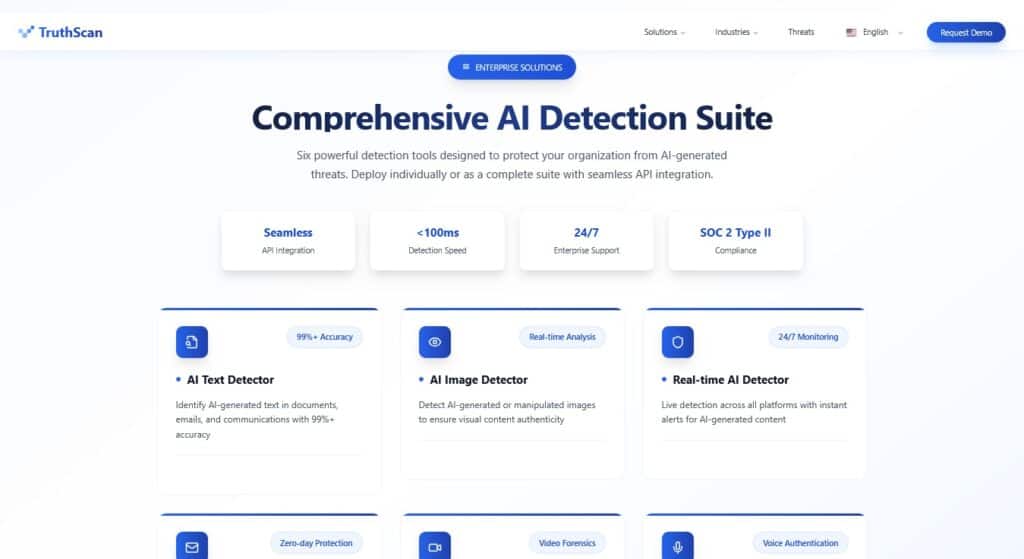
Otra buena opción para comprobar la IA es TruthScan. La herramienta garantiza la precisión y reduce la probabilidad de falsos positivos.
Puede ayudarle a identificar contenidos parafraseados, humanizados y modificados por la IA.
How Widespread Is AI Detection in Colleges Right Now?
AI detection has become far more common than it was just a year ago. As generative AI tools become more capable, colleges are investing in technology, faculty training, and updated academic integrity policies to address responsible AI use.
Según la Lumina Foundation-Gallup 2026 State of Higher Education Study, more than half of U.S. college students now use AI in their coursework at least weekly, even as many of their institutions formally discourage or prohibit it. That gap between student behavior and institutional policy is a big part of why AI detection has spread so quickly across campuses.
A recent Forbes analysis of two major 2026 higher-ed AI surveys found that AI adoption among students is outpacing institutional guidance — leaving many faculty to fall back on detection tools while clearer, campus-wide policies catch up.
Instead of only asking whether students are using AI, many colleges are now asking how they’re using it. This shift has led many universities to integrate AI detection into their existing academic integrity workflows.
Instructors may use AI detectors during assignment reviews, particularly for essays, discussion posts, and research papers where original writing is expected. To see which detectors specific institutions favor, our guide on what AI detector teachers use breaks down adoption by tool.
However, universities are also becoming more cautious about overrelying on detector scores. As a result, many colleges now combine AI detection reports with additional evidence, including:
- A student’s previous writing samples
- Revision history
- Draft submissions
- Citation quality
- Assignment context
- Instructor evaluation
This balanced approach helps reduce false accusations while preserving academic integrity.
¿Qué comprobadores de inteligencia artificial utilizan habitualmente las universidades?
There’s no single AI checker that every college uses. The tools available often depend on an institution’s budget, learning management system (LMS), and academic integrity policies.
Some universities rely on AI detection built into plagiarism software they already subscribe to, while others use standalone AI detectors to review student submissions. In many cases, instructors also use more than one tool to compare results before investigating a paper further.
Below are some of the most common AI checkers used by colleges in 2026.
Detector de IA indetectable
Nuestra Detector de IA indetectable is one of the most comprehensive AI detection tools available for students, educators, and professionals.
Rather than relying on a single detection model, it analyzes text using multiple detection methods to estimate whether content is likely AI-generated.
The detector evaluates writing from leading AI models, including ChatGPT, Gemini, Claude, and other large language models. It also highlights specific passages that may trigger AI detection, allowing users to revise those sections before submitting their work.
One reason students use the tool before turning in assignments is its sentence-level analysis. Instead of simply assigning an overall AI score, it pinpoints potentially problematic text, making revisions more targeted and efficient.
Another advantage is accessibility. Unlike many institutional AI checkers, Undetectable AI is available directly to individuals, allowing students to evaluate their own work before professors review it.
Independent evaluations have also recognized the platform’s performance. In testing conducted by ZDNet, Undetectable AI was tested and trusted, passing all evaluation categories and receiving a 100% accuracy score.
Beyond detection, the platform includes several writing tools that help students improve AI-assisted drafts while preserving their original ideas: the Humanizador AI for making AI-assisted writing sound more natural, the AI Essay Rewriter for restructuring essays while maintaining meaning, and the Parafraseador AI for rewriting flagged sentences and improving readability.
Another good AI checker option is TruthScan, which focuses on accuracy and reducing false positives. It can help identify paraphrased, humanized, and modified AI content.
Turnitin
Turnitin remains the most recognizable academic integrity platform in higher education. For many colleges, it’s already integrated into the learning management system, making it the default tool for plagiarism detection and AI writing analysis.
Turnitin’s AI detection feature evaluates sentence-level patterns commonly associated with large language models and generates an overall AI writing percentage. Faculty can review these reports alongside plagiarism results within the same submission workflow.
Because Turnitin is institutionally licensed, it’s widely used by universities rather than individual students. Access is generally limited to schools with active subscriptions.
While Turnitin is one of the most commonly used AI detectors, the company also emphasizes that AI scores should not be treated as conclusive evidence of misconduct.
Students who want to understand how Turnitin compares with other AI detectors can read our in-depth Turnitin comparison.
GPTZero
GPTZero gained widespread attention after its launch by Princeton student Edward Tian and has since become one of the most recognized standalone AI detection tools used by educators.
The platform supports text documents, PDFs, and several common file formats. It analyzes writing sentence by sentence and provides an overall probability that content was generated by artificial intelligence, along with highlighted sections that appear most likely to have been AI-generated.
Like every AI detector, GPTZero has limitations — detection accuracy varies depending on writing style, document length, and the AI model used to generate the content.
If you’re considering GPTZero, it’s worth comparing its reported accuracy in our 2026 testing with other leading detectors before relying solely on its results.
Originalidad.ai
Originally developed for publishers, SEO professionals, and content marketers, Originality.ai has expanded into educational use because of its AI detection capabilities.
The platform evaluates whether text is likely AI-generated while also checking for plagiarism, readability, and grammar issues. This combination makes it useful for reviewing longer written assignments.
Some colleges and instructors appreciate Originality.ai because it provides detailed reporting and integrates multiple quality checks into a single workflow.
As with other AI detectors, results should be interpreted carefully. For a closer look at its strengths, limitations, and testing results, see our complete Originality.ai review.
ZeroGPT
ZeroGPT is another AI detector that appears frequently in education discussions due to its simple interface and multilingual support.
Users can upload multiple files, paste text directly into the platform, or analyze documents individually. Its support for multiple languages has made it popular among international users and institutions with diverse student populations.
Like other detectors, ZeroGPT should be viewed as an initial screening tool rather than a final judgment. Students interested in understanding how ZeroGPT performs compared with other detectors can explore our AI detector comparisons before relying on a single AI score.
Copyleaks
Copyleaks is widely used in both education and enterprise environments because it combines plagiarism detection with AI content analysis.
In addition to identifying AI-generated writing, the platform can analyze source code and detect content that has been paraphrased or modified in an attempt to bypass AI detectors. Many colleges use Copyleaks as part of broader academic integrity initiatives, particularly in computer science and technical courses where code originality is important.
For a detailed comparison of Copyleaks’ capabilities, testing results, and limitations, read our full Copyleaks review.
¿Cómo funcionan los verificadores universitarios de inteligencia artificial?
AI checkers don’t compare your paper against a database of AI-generated essays. Instead, they analyze writing patterns and estimate whether the text resembles content typically produced by large language models like ChatGPT, Gemini, or Claude.
Modern AI detectors are trained on millions of examples of both human-written and AI-generated text.
Using machine learning, they evaluate linguistic characteristics that are more common in AI writing than in human writing, then generate a probability score rather than a definitive answer. This is why different detectors often produce different results for the same document.
Identificación de patrones lingüísticos en textos de inteligencia artificial
Although every AI detector uses its own proprietary methods, most evaluate similar writing characteristics:
- Estructura de las frases: Large language models often generate sentences with consistent lengths and predictable structures, while human writing tends to vary naturally.
- Predictability and perplexity: Many detectors measure how predictable a sequence of words is. AI-generated text is generally more statistically predictable, though researchers have repeatedly noted that perplexity alone isn’t a reliable indicator, particularly for academic writing or writing by non-native English speakers.
- Tone and writing style: AI models often produce polished, neutral, and consistently formal writing, which can appear unusually uniform compared with authentic student writing.
- Vocabulary choices: AI tends to favor precise, descriptive vocabulary, while human writers mix formal language with conversational phrasing and occasional imperfections.
- Repetition and redundancy: Generative AI occasionally repeats sentence structures or transitional phrases more frequently than human-authored work.
No single characteristic determines whether text is AI-generated. Detectors combine dozens or even hundreds of statistical signals before assigning an AI score.
Limitaciones de los métodos de detección actuales
Despite significant improvements, today’s AI detectors still face important limitations:
- False positives: Human-written work can still be incorrectly flagged as AI-generated, which is particularly concerning in academic settings.
- Non-native English writers: Multiple university researchers have found that AI detectors are more likely to incorrectly flag writing by non-native English speakers, since multilingual writers often use more standardized vocabulary and sentence structures.
- Inconsistent results across tools: It’s common for the same essay to receive dramatically different AI scores across multiple platforms, since each company trains its models on different datasets and evaluation methods.
- Rapidly evolving AI models: Writing generated by newer language models often appears more natural than earlier AI outputs, making detection increasingly challenging as technology evolves.
How Accurate Are the AI Checkers Colleges Use?

No AI checker is 100% accurate. Although detection technology has improved considerably over the past few years, most developers acknowledge that AI scores should be interpreted as probability estimates rather than proof of AI use.
Accuracy varies depending on several factors, including the AI model used to generate the text, document length, writing style, editing after AI generation, and whether the content has been paraphrased or humanized. This is why two different AI detectors can evaluate the same paper and produce very different results.
Some tools prioritize identifying as much AI-generated content as possible, while others focus on reducing false positives these different approaches often produce different accuracy rates.
Independent testing has also shown that detector performance varies considerably between platforms; some tools perform well on raw AI-generated text but struggle after that content has been edited or rewritten by a human.
For students, the key takeaway is simple: an AI score is not a verdict. It’s one data point that should always be interpreted alongside other evidence.
If you want a deeper comparison of today’s leading AI detectors, our guide to the most accurate AI detector explores how different platforms perform under real-world testing conditions.
Falsos positivos y preocupación de los estudiantes
False positives remain one of the biggest challenges facing AI detection in higher education.
A false positive occurs when an AI detector incorrectly classifies human-written work as AI-generated. While detection models continue to improve, no system can completely eliminate this risk. As a result, many institutions are shifting toward evidence-based reviews that consider multiple factors instead of relying on a single AI score.
Today, when a submission is flagged, instructors often review additional evidence, including previous writing samples, revision history, assignment drafts, research notes, citation practices, and overall consistency with a student’s previous work.
This broader review process helps reduce the likelihood of students being unfairly accused based solely on an automated detection result.
If you’re concerned that your writing may be incorrectly flagged, reviewing your work with an AI detector before submission can help identify passages that appear unusually AI-like.
Making thoughtful revisions not simply rewriting to “beat” AI detectors can improve clarity while ensuring your work accurately reflects your own voice. Our guide on avoiding AI detection false positives walks through this process in more detail.
When AI Checkers Get It Wrong: Recent Lawsuits and What They Mean for Students
As AI detection tools have become more common, they’ve also faced greater scrutiny. While colleges continue to use these systems to support academic integrity, recent legal challenges have reinforced an important point: an AI detector score alone should not determine whether a student cheated.
The Adelphi University Case
One of the most widely discussed cases involved Orion Newby, a student at Adelphi University, who challenged the university’s handling of AI-generated content allegations after Turnitin’s AI detector marked his essay as fully AI-written.
In February 2026, a New York state court sided with Newby, ruling that the university’s plagiarism finding was without merit and ordering the charge removed from his record.
The case drew national attention because it highlighted concerns about due process and whether AI detection reports should be treated as definitive evidence.
Although universities have a responsibility to investigate potential academic misconduct, many legal and education experts argue that students should have the opportunity to respond to allegations, explain their work, and present supporting evidence before disciplinary action is taken.
The case also reflects a broader shift in higher education. Rather than relying exclusively on automated detection tools, many institutions are moving toward more balanced investigations that consider multiple sources of evidence.
Today, AI detection reports are increasingly viewed as starting points for review rather than final judgments.
If your work is ever flagged by an AI detector, it doesn’t automatically mean you’ve violated your school’s academic integrity policy.
Many instructors now review additional evidence previous writing samples, draft versions, revision history, research notes, citation practices, classroom participation, and explanations provided by the student before reaching a conclusion.
This more comprehensive approach helps reduce the likelihood of false accusations while ensuring that genuine cases of academic misconduct are investigated fairly.
¿Qué dicen las mejores universidades sobre los detectores de IA?
The official stance from most top colleges is consistent: yes, they’re using AI detectors, but not as the final word on whether something is AI-generated.
Según MIT Sloan, “AI detection software is far from foolproof in fact, it has high error rates and can lead instructors to falsely accuse students of misconduct.” The same guidance notes that OpenAI, the company behind ChatGPT, shut down its own AI detection software because of its poor accuracy.
Carnegie Mellon University has also acknowledged that AI detectors produce false results, noting that “in addition to false positives and false negatives, detection tools may often produce inconclusive results.”
Stanford University has spoken about the unreliability of AI detectors and how non-native English speakers are at a disadvantage: “The detectors are not particularly reliable. Worse yet, they are especially unreliable when the real author (a human) is not a native English speaker.”
James Zou, a professor at Stanford, has also noted that detectors typically score based on a metric known as “perplexity,” which correlates with the sophistication of the writing something non-native speakers are naturally going to trail their U.S.-born counterparts on.
Since most schools agree that AI detectors are not perfect, they’ve decided to do the following:
- Utilizar detectores de IA como herramienta de detección
- Haga que revisores humanos examinen los contenidos marcados
- Considerar el contexto y el trabajo previo del alumno
- Look for other indicators, like writing style consistency
So while a detection tool can provide an estimate of how much of a text is AI-generated content, professors need to use more than just that number to decide whether a student violated the academic integrity policy.
What Happens if You’re Caught Using AI in College?
The consequences of using AI in college depend largely on your institution’s academic integrity policy and how AI was used.
Many colleges now distinguish between responsible AI assistance and submitting AI-generated work as your own.
For example, using AI to brainstorm ideas, organize an outline, or improve grammar may be acceptable in some courses if your instructor permits it. However, submitting an AI-generated essay without disclosure could violate academic integrity policies.
Potential consequences may include a warning, being asked to revise or resubmit the assignment, a reduced grade, failing the assignment or course, academic probation, or suspension or expulsion in severe or repeated cases.
College admissions essays often receive even closer scrutiny, and increasingly sophisticated review processes mean some admissions offices are actively checking for AI-generated content in applications.
Because these essays are intended to reflect an applicant’s own experiences and writing ability, many colleges discourage or prohibit submitting AI-generated personal statements.
If you’re unsure whether AI use is allowed, always review your course syllabus or ask your instructor before submitting your work. Transparency is often the best way to avoid misunderstandings.
Cómo pueden los estudiantes evitar problemas con los verificadores de inteligencia artificial
Whether or not you’ve used AI during the writing process, it’s a good idea to review your work before submitting it.
The goal isn’t to “beat” AI detectors it’s to ensure your writing accurately reflects your own thinking, voice, and understanding of the material.
Here are several practical ways to reduce the likelihood of your work being incorrectly flagged:
- Write from your own research and understanding
- Use varied sentence lengths and structures
- Include original analysis instead of generic summaries
- Support claims with credible citations
- Review your draft for repetitive or overly polished language
- Read your paper aloud to identify awkward phrasing
- Save outlines and earlier drafts in case you need to demonstrate your writing process
- Check your work with an AI detector before submission to identify passages that may need revision
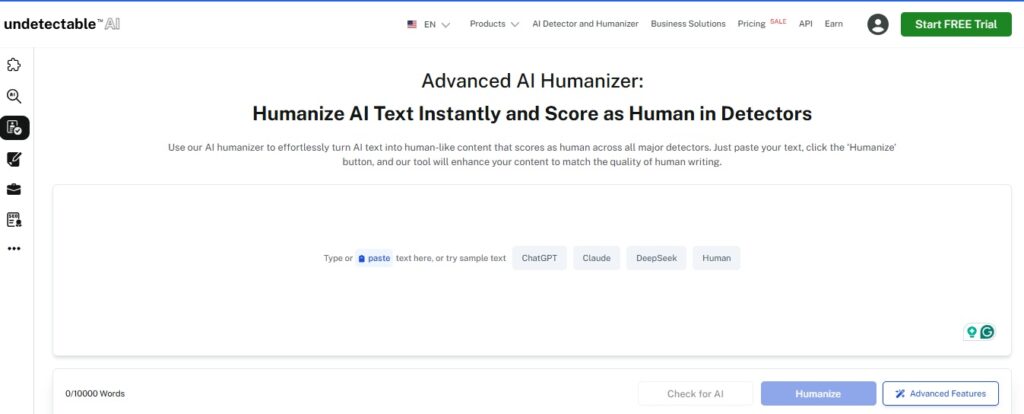
Several Undetectable AI tools can also help refine AI-assisted writing while preserving your intended meaning.
Nuestra Humanizador AI rewrites AI-assisted text to improve readability, sentence variation, and natural flow while maintaining your original message.
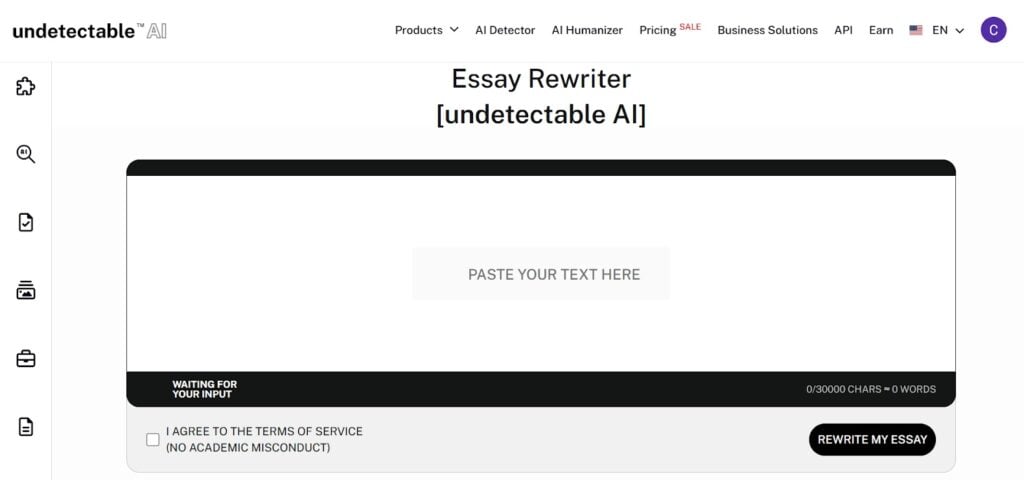
Our AI Essay Rewriter is perfect for avoiding penalties for accidental plagiarism or AI detection in your essays, ensuring your work is 100% original.
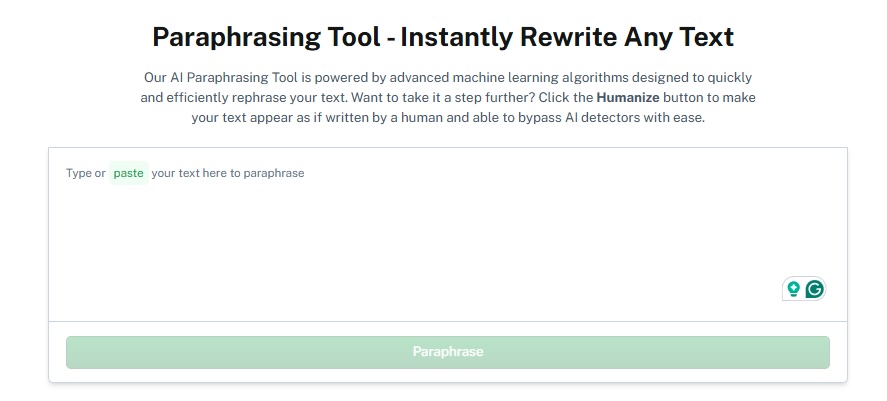
And our Parafraseador AI lets you rephrase flagged sentences, vocabulary, and flow — especially useful if you don’t have a lot of sentences flagged.
Preguntas frecuentes
What AI checker do most colleges use?
Turnitin remains one of the most widely used AI checkers because many colleges already subscribe to its plagiarism detection platform.
However, some instructors also use standalone tools such as GPTZero, Copyleaks, Originality.ai, and other AI detectors depending on their institution’s policies.
Can colleges use an AI detector score as the only evidence in an academic integrity case?
Generally, no. Many universities recommend that AI detector results be treated as supporting evidence rather than definitive proof.
Faculty are encouraged to consider additional information writing history, revision records, assignment context, and conversations with the student before making academic integrity decisions.
Are AI checkers accurate for non-native English speakers?
Not always. Several university researchers have found that AI detectors are more likely to produce false positives for non-native English speakers because standardized vocabulary and sentence structures can resemble patterns associated with AI-generated text.
This is one reason many institutions caution against relying solely on AI detection scores.
Which AI checker is most accurate for college papers?
There is no universally accepted “most accurate” AI checker. Every platform has strengths and limitations, and results often vary depending on writing style, document length, and the amount of editing performed.
Comparing multiple tools and interpreting their results alongside human judgment generally provides the most reliable assessment.
Conclusión
AI has changed how students learn, research, and write, and colleges are adapting just as quickly. In 2026, AI checkers have become a common part of the academic integrity process, helping instructors identify writing that may require closer review.
At the same time, universities increasingly recognize that AI detection tools are not perfect. False positives remain a concern, and leading institutions continue to recommend using detector scores alongside instructor judgment rather than treating them as conclusive evidence.
For students, the best approach is to use AI responsibly, understand your school’s policies, and ensure your work reflects your own knowledge and critical thinking. Reviewing assignments before submission, maintaining drafts, and citing sources appropriately can help avoid unnecessary issues.
If you want additional confidence before submitting your work, tools like the Undetectable AI Detector, AI Humanizer, AI Essay Rewriter, and AI Paraphraser can help you review and refine your writing while preserving your original ideas.
Si tienes dudas sobre el uso de la IA, pregunta a tus profesores. Y cuando quieras que tu escritura siga siendo nítida, pulida e indetectablemente humana, confía en IA indetectable.