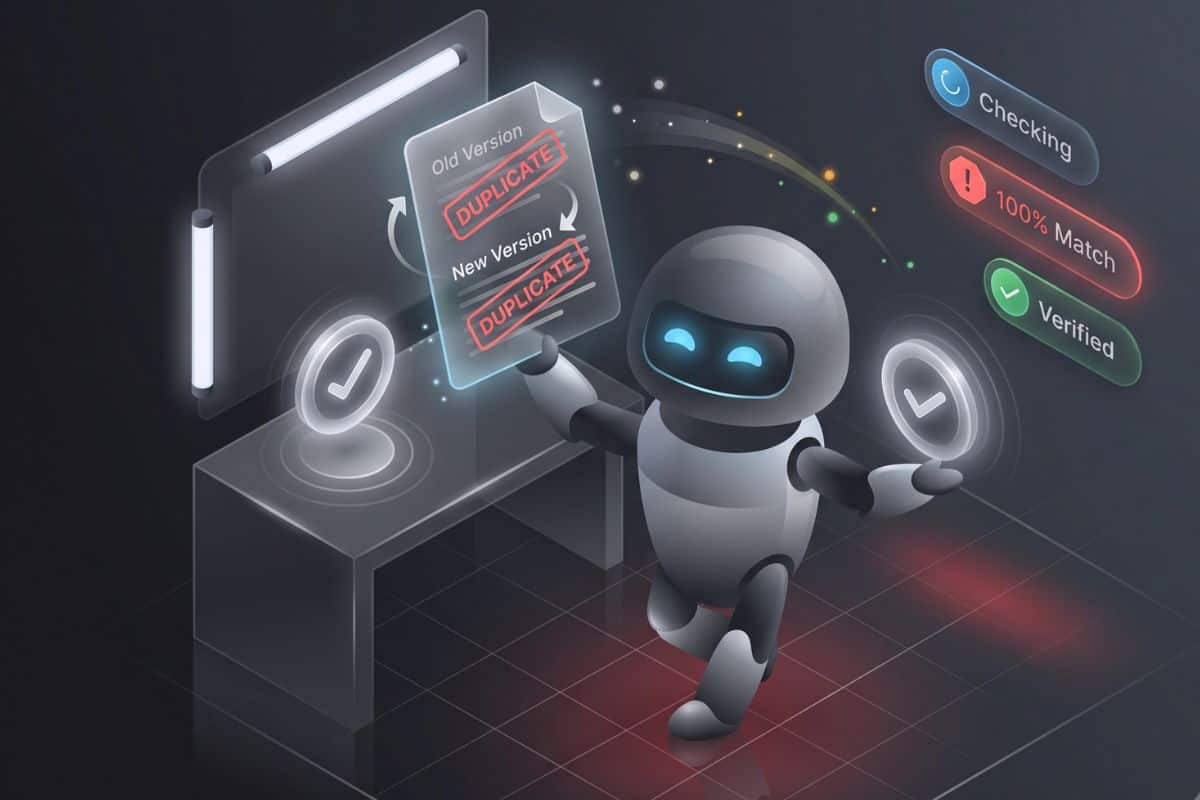
You wrote a great essay last semester on the ethics of social media. Now your new professor has assigned almost the same topic. The old essay is sitting right there in your Google Drive: polished, well-cited, B+. Can you just reuse it?
Usually not, self-plagiarism is exactly the reason why. It’s something that most students and writers don’t consider until it becomes a problem.
This guide will cover what it is, why it’s important, 5 real-world examples supported by case studies, what to do if you ever get caught, and a simple 5 step model to ensure you are on the right side of every submission.
Punti di forza
- Self-plagiarism means reusing your own previously submitted or published work without proper citation, which is recognized as an academic integrity violation by the APA, most universities, and virtually every academic journal.
- Re-submitting a paper for a different class, recycling sections of a published paper, duplicate publication in two journals, reusing data without disclosure, and reusing group work without crediting collaborators are the five most common forms of self-plagiarism
- Consequences range from failing grades for students to retraction and blacklisting for researchers, but every audience faces a credibility hit.
- To prevent this, cite yourself, ask permission to reuse, rewrite rather than copy-paste, and run a self-plagiarism check before you submit.
Metodologia
For this article, I reviewed the APA Style Publication manual (7th edition), Scribbr, Harvard Academic Integrity Policy, editorials published in the Canadian Journal of Cardiology, Research from the Text Recycling Research Project, ethical guidance from legal scholar Pamela Samuelson, Journal policies from anasthesia, and documented retraction cases reported by Retraction Watch.
What Is Self-Plagiarism?
Self-plagiarism is presenting your own previously submitted or published work as if it were new, without disclosing where it originally came from.
Il Associazione psicologica americana defines it as “the act of presenting one’s previously completed work as original and new.”
Non preoccupatevi più che l'intelligenza artificiale rilevi i vostri messaggi. Undetectable AI Può aiutarvi:
- Fate apparire la vostra scrittura assistita dall'intelligenza artificiale simile all'uomo.
- Bypass tutti i principali strumenti di rilevamento dell'intelligenza artificiale con un solo clic.
- Utilizzo AI in modo sicuro e con fiducia a scuola e al lavoro.
Allo stesso modo, University of Glasgow describes self-plagiarism as reusing all or part of your previously written work in a new context without proper acknowledgment, emphasizing that the issue is not ownership, but transparency and originality.
The problem is not the writing itself. It is the deception. You are letting your reader—whether that is a professor, a journal editor, or a grant committee—believe they are reading something original when they are not. That gap between expectation and reality is precisely what makes it a violation.
This keeps the authority high, removes the competitor reference, and actually strengthens your “deception” angle.
Self-Plagiarism vs. Regular Plagiarism
Regular plagiarism, (also called intellectual theft) occurs when someone copies another person’s words or ideas and passes them off as his/her own.
Self-plagiarism is when a student uses his/her own previous work without citing it. Both give the reader false information about the originality of the material he reads, and are taken seriously in the academic and publishing world.
Is It Really a Big Deal?
Reuse can be appropriate and acceptable in casual communications such as blog posts, internal memos, and social media posts.
As you go into the academic, research or grant-writing world, the requirements become much more strict. The unspoken contract in those spaces is that you are submitting fresh thinking and original effort.
As Dr. Eldon Smith, Editor-in-Chief of the Canadian Journal of Cardiology, wrote in a 2007 editorial:
“If an author publishes the same article twice, he or she is guilty not only of the misconduct of duplicate publication, but also of plagiarism; this time, the author has plagiarized himself or herself” (Smith, 2007).
5 Common Examples of Self-Plagiarism
There are several examples of self-plagiarism, from the subtle ones to the most obvious ones, but here are 5 common examples students are mostly guilty of:
- Re-Submitting a Paper From a Previous Class
This is the most usual form and the most unexpected one for students. You do a good job in one course, another professor takes the same topic the next semester, and you brush it up with minimal changes.
Most academic integrity policies treat this as a violation, even though both papers are yours.
The APA notes that some institutions consider it self-plagiarism when a student submits a paper written for one class to complete an assignment for another, without permission from the current instructor.
The solution is to write a new paper or to email your professor before you begin. A two-minute conversation beats a disciplinary case.
- Recycling Sections of a Published Paper
You are writing a follow-up paper, and as a result, copied and pasted that section straight across. Tools such as iThenticate are used by journals to run each submission against previously published literature, and any text that overlaps is flagged.
Even if it gets missed by a detector, it’s still proper that when readers of your new paper come upon this section, they realize that it’s a portion of some older paper.
One of the easiest ways to remedy this is to make a clear reference to the previous work that you have done, and to rework the material in a new context for your new audience.
- Duplicate Publication (Same Paper, Two Journals)
Self-plagiarism is one of the most serious ways to commit academic plagiarism, and submitting the same manuscript to two journals simultaneously is considered such. It is strictly forbidden in nearly all journals’ submission policies.
A researcher submitted the same virtual reality study to two journals at the same time, according to a report from Retraction Watch in May of 2025.
One peer reviewer of one journal identified the manuscript due to having previously reviewed it for the other journal, and marked the conflict. The authors agreed to withdraw the paper. While the researcher’s explanation was a simple mistake, the withdrawal was not.
This can be avoided if you submit your work to a single journal at a time. In case of rejection, withdraw formally from the place of rejection and apply elsewhere.
- Reusing Data Without Disclosure
You ran a study two years ago and collected a rich dataset. Now you want to use the same data to answer a different research question.
That’s perfectly legitimate, and actually good science. The problem is when you don’t tell anyone that the data has been used before.
Undisclosed data reuse inflates the apparent evidence base. If readers believe two independent studies reached the same conclusion, they update their understanding accordingly. If both studies drew on the same dataset, that update was never warranted. In many fields, this is treated as adjacent to data fabrication.
A fix for this problem is to state clearly in your methods section that you’re working with previously collected data, and cite the original study. That one sentence of disclosure is all it takes.
- Reusing Group Work Without Crediting Collaborators
You contributed substantially to a group project last semester. Now you are working on a solo assignment and pulling in a section you largely wrote yourself. Even so, your collaborators contributed to the original work, and presenting it as solo output removes their contribution from the record entirely.
In order to avoid this problem, cite the group project, name the collaborators, and build in substantially new analysis. Use it as a foundation, not a copy.
The Real Consequences

From academic suspensions to reputational damage, the consequences of self-plagiarism are real and long-lasting. Here are the effects and implications self-plagiarism can have on students, researchers, and writers.
Per gli studenti
The most frequent consequence of this is a failing grade for the assignment, which can lead to failure in the high-stakes course.
For instance, the Academic Integrity Policy at Harvard University states that “submitting work for academic credit that has been substantially submitted elsewhere constitutes a violation and is subject to disciplinary action. If repeated or serious, academic probation, suspension, and expulsion may result.”
For Researchers and Academics
This is where the consequences become genuinely career-altering. Journal retraction is the most visible outcome. Retractions are public, permanent, and indexed on Retraction Watch, where they are findable by anyone who searches your name.
In fact, last year, Retraction Watch reported that obstetrician and gynecologist Ibrahim Abdelazim had 10 retractions across several journals, with notices pointing to “anomalous data” and “self-plagiarism”.
These retractions were across papers on premature rupture of fetal membranes, endometrial sampling, and fertility outcomes, all traceable to a pattern of recycling work without disclosure.
Even beyond retraction, there is loss of grant funding, blacklisting by journal publisher groups, and reputational damage that follows you across institutions.
For Professionals and Writers
A published piece that has been copyrighted by a publisher cannot be reused unless you have permission to do so.
If you are a freelancer and originality is a stipulation in your contract, then it becomes a contract violation when you deliver recycled work. Even where neither applies, the trust damage with clients tends to be severe and lasting.
How to Avoid Self-Plagiarism in 5 Steps
Below are some of the ways to avoid self-plagiarism as a student, researcher or writer:
- Cite Yourself
Treat your previous work like any other source. In APA, it looks like this:
“As argued in a previous study (XYZ, 2023), the relationship between originality and integrity is foundational to academic publishing.”
If the original paper was submitted for a class but never published, cite it as an unpublished manuscript. An example will look like this:
Author (Year). Title [Unpublished manuscript]. Institution.
- Ask Permission to Reuse
When it comes to published works, copyright typically vests in the publisher upon publication. That doesn’t give you any rights after all, even if you wrote each and every word.
Contact the publisher and ask. Most academic publishers have a formal permissions process and consider it easy to allow non-commercial re-use.
For coursework, email your professor before you start. A transparent note is all it takes, and every possible response (yes, no, or a modified framework) is better than submitting first and finding out after.
- Rewrite, Don’t Just Copy
Copy and paste, light editing, changing the order of sentences, and swapping a few words are risky moves. Most detection tools look for structural and semantic similarity, as well as exact text matches. A passage doesn’t have to be identical in order to be flagged.
Research from the Text Recycling Research Project found that deliberate rewording can actually be less ethical than straightforward reuse with citation. Why? Because rewording is specifically intended to disguise that material has appeared before, making the deception more active, not less.
A genuine rewrite for a new audience is legitimate. Paraphrasing to hide the origin of a passage is the opposite. Write fresh with a different sentence structure, new framing, and new examples where possible.
- Run a Self-Plagiarism Check
Standard plagiarism checkers scan your work against external published sources, but won’t catch overlap with your own previously submitted or unpublished work. For that, you need a tool that compares documents you upload yourself.
While Turnitin is usually the institutional standard, iThenticate is widely used in research publishing.
Rivelatore AI non rilevabile is a free option worth running before submission. To do this, upload your draft, see what gets flagged, and deal with it before anyone else does.
- Disclose AI Use Where Relevant
Using AI tools to write does not necessarily constitute self-plagiarism; however, using an AI tool without acknowledging it in a context where it is required to be acknowledged does.
The basic idea is the same: to be honest with your reader about what they are reading. Whenever you use AI to help draft or revise your work, follow your institution’s or publication’s disclosure policy.
When Using Your Own Work is Acceptable
Most articles on self-plagiarism stop at the rules. Here is what they leave out: there are documented, legitimate circumstances where reusing your own prior work is not self-plagiarism at all.
Legal scholar Pamela Samuelson identified four conditions under which reuse is ethically defensible:
- When the previous work must be restated to lay the groundwork for a new contribution
- When previous work must be repeated to address new evidence or arguments.
- When the audiences for the two works are different enough that republishing is the only way to reach them
- When the original phrasing was precise enough that rewording it would actually reduce accuracy.
Several journals, including Anaesthesia, now explicitly permit authors to reuse text describing standard methods or protocols from earlier publications, as long as the original source is cited.
Domande frequenti
Is Self-Plagiarism Illegal?
It is not illegal as it’s primarily an ethics and integrity issue. The exception is when the original work was published under a publisher’s copyright; reproducing it without permission can cross into copyright infringement.
Can I Reuse My Own Essay For Two Classes?
Generally not without explicit permission. Email the second professor before you start, explain that you wrote on a related topic previously, and ask whether building on that work is acceptable. Their answer in advance protects you entirely.
Can I Reuse Parts of My Dissertation in a Journal Article?
Yes, with disclosure. Incorporating dissertation chapters into publications is common. It’s however, important to note it explicitly in the manuscript and check the target journal’s prior publication policy.
Does Turnitin Detect Self-Plagiarism?
It depends on whether your prior submission is in Turnitin’s database. If it was submitted through the same institution, it may be there. It is not comprehensive, which is why running a dedicated check beforehand remains worthwhile regardless.
Pensieri finali
Self-plagiarism is reusing your own previous work without disclosure, and the consequences in academic and publishing contexts are real. It’s not a bureaucratic technicality.
It’s about honesty with your reader; letting them know what they’re reading, where it came from, and what is genuinely new.
The good news is that it’s one of the most preventable integrity issues in academic writing. Cite yourself, ask permission, rewrite rather than copy, and check your draft before you submit.
Running it through AI non rilevabile‘s free detector before submission takes under a minute and removes one entirely avoidable risk from work you have invested real time in.