
Symbolism provides many readers with a means to visualize, so it feels as though they can experience the thoughts of an individual in a book or movie.
This is a tool that writers, filmmakers and artists use to imply actions without having to explain the whole thing. It is like talking about something without actually talking about it.
In this article, you will learn how Symbolism works and why it appears often in everyday language, sometimes without you even noticing it.
Key Takeaways
- Symbolism gives deeper meaning to ideas, objects, or actions
- It depends heavily on cultural knowledge, theme, and context
- It uses objects, colours, or actions to represent a deeper meaning
- Common symbols include color symbolism, butterfly symbolism, and universal objects
- Overexplaining, forcing symbols, or giving them inconsistent meanings weakens their impact of symbolism
What Is Symbolism?
So, what is symbolism? Symbolism can easily be described as the use of simple words or items to represent something.
It involves using an item or idea outside of its original meaning.
From the name symbolism, you can easily decipher that it requires using symbols. Especially common symbols to avoid long explanations. These symbols may include flags, icons, and colors that help you get around.


Never Worry About AI Detecting Your Texts Again. Undetectable AI Can Help You:
- Make your AI assisted writing appear human-like.
- Bypass all major AI detection tools with just one click.
- Use AI safely and confidently in school and work.
When you see these symbols, you immediately relate them to something.
Symbolism demands that you consider something beyond what it actually is. Sure, a lightbulb is an electrical item, but used as a symbol in other instances, it might mean a bright idea.
For writers in particular, you could say it’s a quick fix. It guarantees that you won’t need to write full paragraphs just to communicate a message.
In a situation where you want a character to feel trapped, then it would be easy to write about that character looking at themselves in the mirror and seeing nothing but a caged animal.
The easiest approach to consider symbolism is by understanding it as a method through which creatives convey abstract notions and make their readers consider hidden meanings.
It is so because our brains have been programmed to make connections to symbols based on our experience and cultural knowledge.
In other cases, a red rose is a simple flower; however, when applied as a symbol, it might have a deeper meaning. It could be love, lust, or danger, depending on your point of view and situation.
This suggests that context is key, and how you interpret it depends greatly on when, where, and how it was used.
Just the idea that a simple item could have multiple interpretations just makes symbolism interesting.
Definition of Symbolism
Symbolism definition is simple. Just say it is a tool common in literature that requires you to represent an object, person, or action by something outside its literal meaning.
It utilizes a symbol that has been in existence to assign different meanings, depending on themes or plots. Think of it as a game of hide-and-seek for writers.
It makes your reading experience exciting because you have to unravel the hidden meanings behind each symbol.
No doubt symbolism is usually found in art and literature, but it can also be used for simpler purposes. Sometimes you find symbols in your environment.
Imagine seeing a door with the cutout of any gender, you immediately know that it is a bathroom.
Why Writers Use Symbolism
One thing is certain: writers love symbols. It is a very exciting part of their process, because they see it as a challenge or puzzle that readers have to solve.
It also helps them say things in very few words. With symbolism, there is no need to explain every emotion and theme.
The joy of every writer is to create an engaging body of work. That’s why you find that every writer uses literary devices to engage the minds of their readers.
They want to share with their readers meanings that go beyond the simple words used.
When writers use symbolism, they are trying to be mysterious. They just want to paint pictures and scenes that provoke genuine emotions and understanding.
A well-placed symbol makes writing more vivid and interesting.
Here are some reasons why writers use symbolism:
To Show Emotions
Writers use symbolism to show the emotions of different characters, especially when the goal is to create an atmosphere where the reader becomes the character.
For example, to show grief and heartbreak, a writer may write about a character crying while holding a picture. They don’t have to write about the emotion of that character in full.
They simply allow the image of the character in that instance to speak.
It is sufficient that the reader has the picture in their mind because it represents the burden of memory, love, and loss without the author telling the reader about it.
The writer does not have to say that the character “felt sad thinking about her father.” You can do that all by yourself.
To Add More Meaning
Symbolism provides writers with a way to add additional meaning to simple things. That way, readers can see a story in a way that is meaningful to them.
When you look at the use of butterfly symbolism, it might mean growth to you. To another person, it might signify freedom, beauty, or even the fleeting nature of life.
Writers are big on symbolism because it leaves room for interpretation. They also want to see their stories through the eyes of a reader.
To Create Imagery
Writers love symbolism because it adds a visual experience to literature. With symbolism, readers can get a clear picture of the happenings in a book.
By linking objects, colors, or items to writing, writers can create vivid imagery and get a better reception from readers.
How Symbolism Works in Communication
Symbolism does not just apply to literature; it can be applied to your daily communication.
This is because most people naturally see the meaning in an image or idea, and when they understand those images, their brain connects them to emotions or concepts.
Now, when a person says they are ‘drowning in work’, you don’t just immediately picture them underwater. You just know that they are talking about being overwhelmed with their workload.
That is the beauty of symbolism. You don’t have to wait for a person to say too much before getting what they mean.
When you see certain things, your brain connects them to the right information on the spot. Then suddenly you feel like you are in on something, and that makes the message more engaging than a direct statement ever could.
Symbolism in communication creates a shared language between a speaker and a listener. There is a sort of agreement that certain things carry certain meanings.
For instance, there is a general agreement with colour symbolism that red means passion, danger, or anger and white means purity or emptiness.
These collective agreements do not just come out of nowhere; they are formed because they are consistently used in communication, hence the conditioning.
Common Mistakes with Symbolism
Making mistakes is not uncommon when using symbols.
Many people see symbolism as a simple concept, but they forget that it is very easy to mess it up, especially when it gets lost in interpretation.
The following are the general errors that people make when it comes to symbolism:
- Being Too Obvious: Symbolism should be used stealthily. When you still have to explain a symbol, then you should not even include it at all. Let the symbol do its work without explaining it. It works best when it is woven naturally into the story, not pronounced.
- Forcing Symbols: Not everything needs to be symbolic. You have to know when and where you need to add symbols. When symbolism seems forced, your writing will feel exhausting to read.
- Giving One Symbol Multiple Meanings: A common mistake is not sticking to one meaning. Let each symbol have its own meaning. Imagine using darkness to represent safety in your story, then later switching to danger along the line. That confuses your readers. Consistency matters; try not to confuse your readers. If you must make changes, make sure you find a way to make your readers aware.
- Being Obscure: Sometimes, all you need to have a great body of work is to understand your audience. Know the kind of symbolism they can relate to. It is not the time to create unpopular symbols. When you choose to create your symbols, try to strike a balance between originality and accessibility.
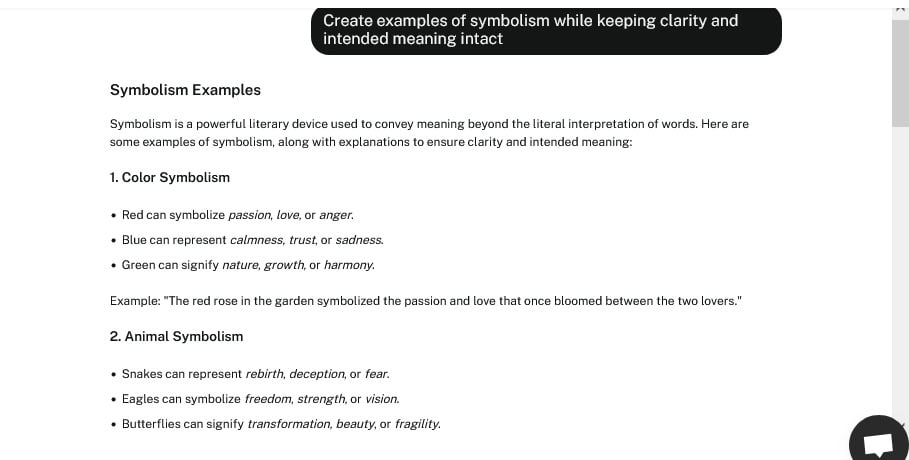
Finding the right symbols can be hard, and sometimes you might have to rely on tools to help you.
That’s why tools like the Undetectable AI Chat exist. Our tool can help create symbolic elements that fit your theme while keeping clarity and meaning.

Here is an example of the Undetectable AI Chat at work:
How to Use Symbolism Effectively
Here is how to use symbolism:
- Know Your Theme: You need to know the theme of your work before adding symbols. Once you have figured out your theme, look for symbols related to it. If you are writing about freedom, use things that have to do with freedom. Make sure to work with symbols that are realistic to your plot.
- Do Not Overexplain: Do not use symbols when you are going to explain them. To enjoy the symbolism, you have to leave your audience to their own devices and allow them to interpret the symbols. Overexplaining takes away the fun.
- Use it Repetitively: For symbolism to make sense, it needs to be used multiple times. That way, it engages your readers from the beginning to the end. It also shows how important that symbol is.
- Use Symbolism Sparingly: Although repeating symbols is a good thing, you also have to know how to put them in strategic places. That way, it is more effective. Think of it as seasoning; you only need enough.
- Use Symbols to Show Character Development: Symbols help to show that a character has grown. Linking a character to a symbol and showing growth through that symbol is the way to go. It gives readers clues about the character’s development, showing the evolution of that character.
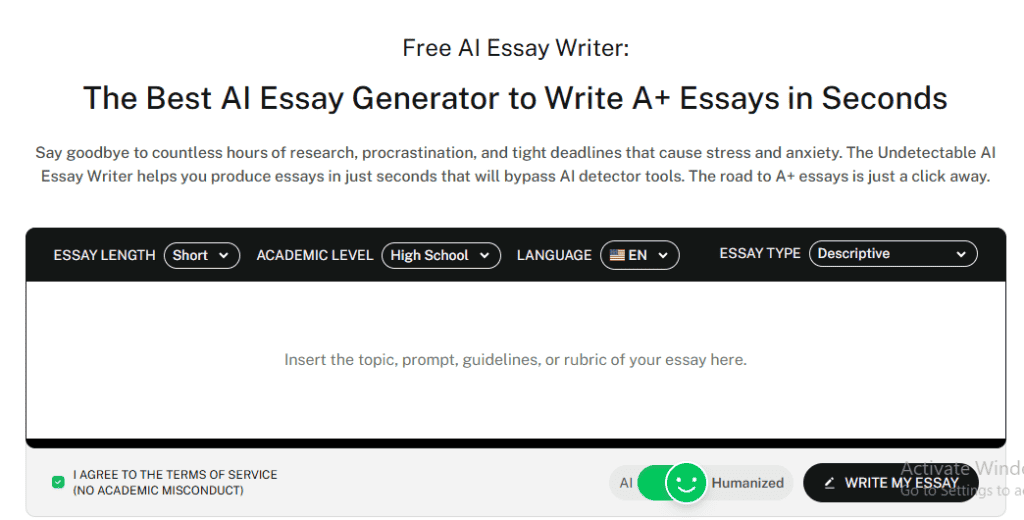
To ensure your symbols align perfectly with your narrative goals, you can use AI Essay Writer to brainstorm and integrate deeper meanings into your work.
This tool helps you explore various symbolic angles for your theme, ensuring that every object or color you choose adds a layer of sophistication to your writing.
Classic Examples of Symbolism
Here are classic symbolism examples that have been used over the years:
| Context | Symbol | Meaning |
| The Great Gatsby | The green light at the end of Daisy’s dock | It symbolizes hope, American Dream, money, and Gatsby’s attempt to reclaim the past |
| To Kill a Mockingbird | The mockingbird | It symbolizes innocence and the harm done when you destroy something innocent and harmless |
| Animal farm | The whole farm | The farm is a symbol of the entire Russia, and the animals are the symbols of various classes and characters within the Soviet society. |
| Harry Potter | Harry’s lightning bolt scar | It symbolizes his relation with Voldemort, fate and survival. |
| The Hunger Games | The Mockingjay pin | Symbolizes rebellion and hope. |
| Hug O’ War | The hug | It means peace, friendship, and the power of love to overcome conflict. |
| The Matrix | The red pill | It shows the choice between truth and illusion. |
| I Have a Dream | The “dream” | The dream represents hope, justice, and the future for racial equality. |
| The Scarlet Letter | The letter “A” | It means sin, shame, and the consequences of guilt in Puritan society. |
| The Raven | The raven | It shows death and the narrator’s journey into madness and despair |
| Lord of the Flies | The Conch Shell | It is used to represent civilization and democracy |
| Lady Macbeth | The imagined bloody hands of Lady Macbeth | It symbolizes guilt |
| The Lion, The Witch, and The Wardrobe | Spring | Represents new life and hope |
| Ozymandias | The ruined statue | Show the downfall of civilization |
| The Road Not Taken | The two paths | a symbol of choices to be made in life |
When you are working on symbolism, especially those created with artificial intelligence tools, it is important that you make sure every symbol sounds as natural and human as possible.
That’s where the Undetectable AI Humanizer comes in.
Our AI Humanizer ensures that you are using symbols that are appropriate, natural, and human-written.

Final Thoughts
Symbolism is an amazing literary device; it may be tricky to figure out initially, but once you understand it, you start to notice it everywhere.
Your symbolism use does not have to be perfect from the outset. Even the best writers create symbols that readers interpret differently from what was intended.
However, that is the best part about symbolism. It allows everyone to interpret however they wish.
You don’t have to use symbolism every time. Sometimes a butterfly can just be a butterfly.
However, if you’re going to use it, make it meaningful and do not confuse your readers, even when you are creating new symbols.
Keep your symbolism clear and authentic with Undetectable AI.