Your teacher mentions GPTZero in the syllabus, or a client asks you to run every draft through it before delivery. Now you want to know one thing: how much can you trust the score it gives you?
GPTZero is still the best known AI detector, but a lot changed this year. It was bought by the company behind Grammarly, it switched to a new detection model in September and updated it again in October.
This review explains how GPTZero works today, where it’s accurate, where it slips, what each plan costs and what you can do if it flags writing that’s yours.
GPTZero at a Glance
| Feature | Details (November 2026) |
|---|---|
| Owner | Superhuman, the company formerly called Grammarly |
| Current model | GPTZero 4.1o, released October 2026 |
| Free plan | 10,000 words a month |
| Paid plans | Premium from $12.99 a month, Professional from $24.99 (billed yearly) |
| Extras | Plagiarism check, writing replay, Chrome extension, Docs and LMS tools |
| Languages | 26 supported, according to PCWorld |
What Is GPTZero?
GPTZero started as a side project by Princeton student Edward Tian in early 2023, weeks after ChatGPT launched. It caught on with teachers almost overnight and grew into a full company with its co founder Alex Cui.
By the time of the Superhuman deal, reports put GPTZero at about 19 million registered users. Today it sells AI detection along with plagiarism checks, citation checks and tools that show how a document was written.
What Changed at GPTZero in 2026
In June, Superhuman announced it would acquire GPTZero and fold it into its writing assistant, as TechCrunch reported. The detector still runs as its own product, but it now sits inside the same company that sells one of the most used AI writing tools.


Never Worry About AI Detecting Your Texts Again. Undetectable AI Can Help You:
- Make your AI assisted writing appear human-like.
- Bypass all major AI detection tools with just one click.
- Use AI safely and confidently in school and work.
The model changed too. GPTZero 4o became the default in September, with better handling of mixed and edited text, and 4.1o followed in October. Any test you read from before September was measuring a different detector.
How GPTZero Works
Early GPTZero leaned on two ideas: perplexity, or how predictable each word is, and burstiness, or how much sentence length varies. AI text tends to be predictable and even. Human writing jumps around more.
Today’s model is a trained classifier that looks at far more than those two signals. It scores the whole document, highlights sentences that look most AI written and sorts text into human, AI, mixed or AI polished.
The newer AI Patterns view also names the habits that pushed a score up, such as repeated sentence openings or stock phrases. That makes the result easier to act on than a single percentage.
How to Use GPTZero Step by Step
- Paste at least a few paragraphs. Very short text gives shaky results.
- Run the basic scan and note the overall label, not just the percentage.
- Open the highlighted sentences to see which parts drove the score.
- On a paid plan, run the Advanced Scan for the reasons behind each flag.
- Compare the result with a second detector before you act on it.
How Accurate Is GPTZero in 2026?
GPTZero claims one false positive in about 10,400 student essays on its benchmark. That’s a company figure, so it helps to look at outside testing too.
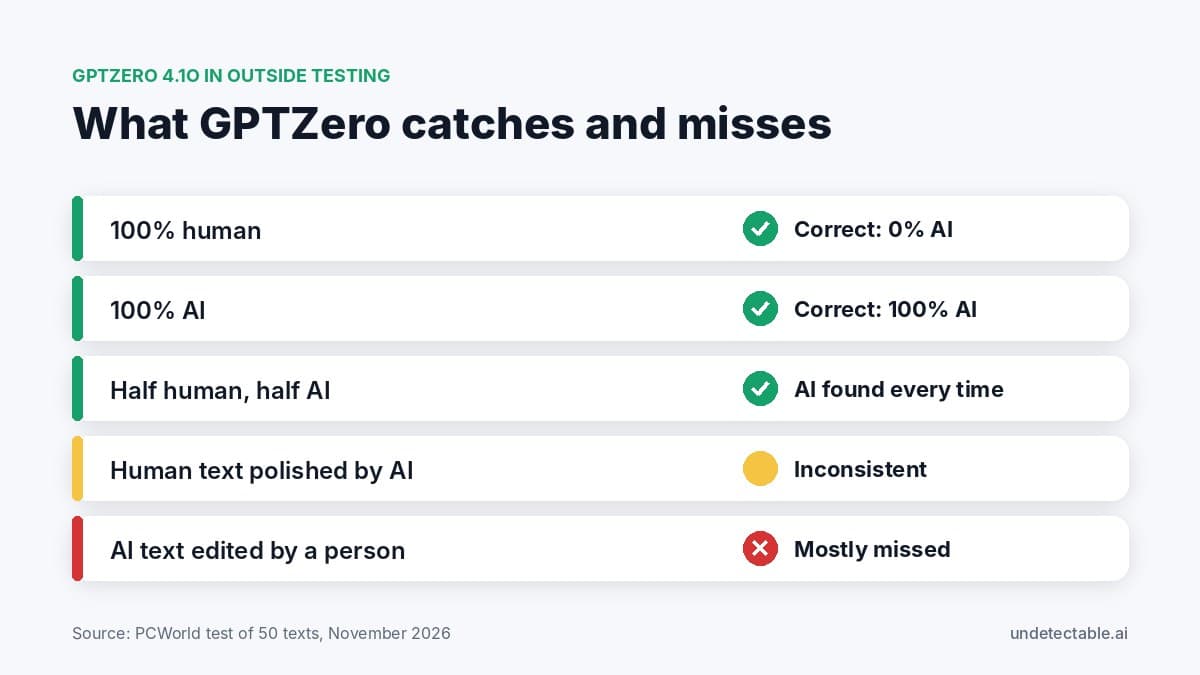
In a November 2026 test, PCWorld ran 50 texts through the 4.1o model. All 10 human texts scored 0% AI and all 10 fully AI texts scored 100%. Mixed texts were flagged as partly AI every time.
The weak spot was edited text. When a person reworked AI drafts, GPTZero labeled some of them 96% and 98% human. When AI polished human writing, results were inconsistent. That matches what most detectors struggle with.
| Type of text | How GPTZero did in PCWorld’s test |
|---|---|
| 100% human | All scored 0% AI |
| 100% AI | All scored 100% AI |
| Roughly half and half | AI found in every sample |
| AI edited by a person | Mostly missed |
| Human polished by AI | Mixed results |
For a deeper look at the numbers over time, see our breakdown of GPTZero accuracy.
GPTZero Pricing in 2026
The free plan covers 10,000 words a month, enough for a few essays. Paid plans are priced by monthly word allowance, and yearly billing cuts the price by roughly 45%.
| Plan | Monthly billing | Yearly billing | Words per month |
|---|---|---|---|
| Free | $0 | $0 | 10,000 |
| Premium | $23.99 | $12.99 a month | 300,000 |
| Professional | $45.99 | $24.99 a month | 500,000 |
Premium adds the Advanced Scan, plagiarism checks and bigger uploads. Professional adds batch scanning of up to 250 files, which matters mostly to schools and agencies.
GPTZero Features Explained
| Feature | What it does | Plan |
|---|---|---|
| Basic scan | Overall label and AI probability | Free |
| Sentence highlights | Marks the lines most likely written by AI | Limited on free |
| Advanced Scan | Explains the reasons behind each flag | Paid |
| AI Patterns | Names writing habits that raise the score | Paid |
| Writing replay | Shows how a document was typed over time | Via Chrome extension |
| Plagiarism check | Compares text against web and published sources | Paid |
| Batch scanning | Checks up to 250 files at once | Professional |
The writing replay tools are worth knowing about even if you never pay. Students can use them to show their process, which is often more convincing to a teacher than any detector score.
GPTZero Pros
- Very accurate on fully human and fully AI text in recent outside tests.
- Sentence highlighting and Advanced Scan explain why text was flagged.
- Writing replay and the Chrome extension help students prove their process.
- A real free plan that renews every month.
GPTZero Cons
- Heavily edited AI text often passes as human.
- Light AI polish on human writing can still raise the score.
- Free plan text may be used to train the model, according to PCWorld.
- Word limits apply on every plan, including the most expensive one.
GPTZero vs Turnitin
These are the two names students hear most, and they work differently. Turnitin is sold to schools and runs inside their systems. GPTZero can be used by anyone, with or without a school account.
| GPTZero | Turnitin | |
|---|---|---|
| Who can use it | Anyone | Schools and their students |
| Free option | 10,000 words a month | No individual plan |
| Shows highlights to the writer | Yes | Only if the school shares the report |
| Writing process tools | Writing replay | Depends on the school |
| Best known for | AI detection | Plagiarism checking |
Why Edited and Humanized Text Is Hard to Detect
Detectors learn from examples of human and AI writing. Raw AI text is easy because it follows the patterns the model was trained on: even rhythm, safe word choices and predictable structure.
Once a person rewrites that text, the patterns break. Sentence lengths vary, odd word choices appear and personal details get added. The detector now sees something closer to human writing, because in part it is.
Humanizer tools try to recreate that effect automatically. Detectors respond by training on humanized samples, which is why results shift with every model update on both sides.
GPTZero vs Other Detectors
Teachers often use GPTZero, Turnitin or both, as we cover in our guide to the detectors teachers use. Publishers lean more toward Originality.ai, which we tested in our Originality.ai review.
Each tool is trained differently, so the same paragraph can pass one and fail another. That’s why checking against several at once is more useful than trusting one score.
Who Should Use GPTZero?
Teachers get the most out of it. The free plan, class tools and writing replay fit how schools work, and the sentence view helps start a fair conversation with a student instead of an accusation.
Students can use the free plan to see how their own essays read before they hand them in. Just remember your teacher may use a different tool with different results.
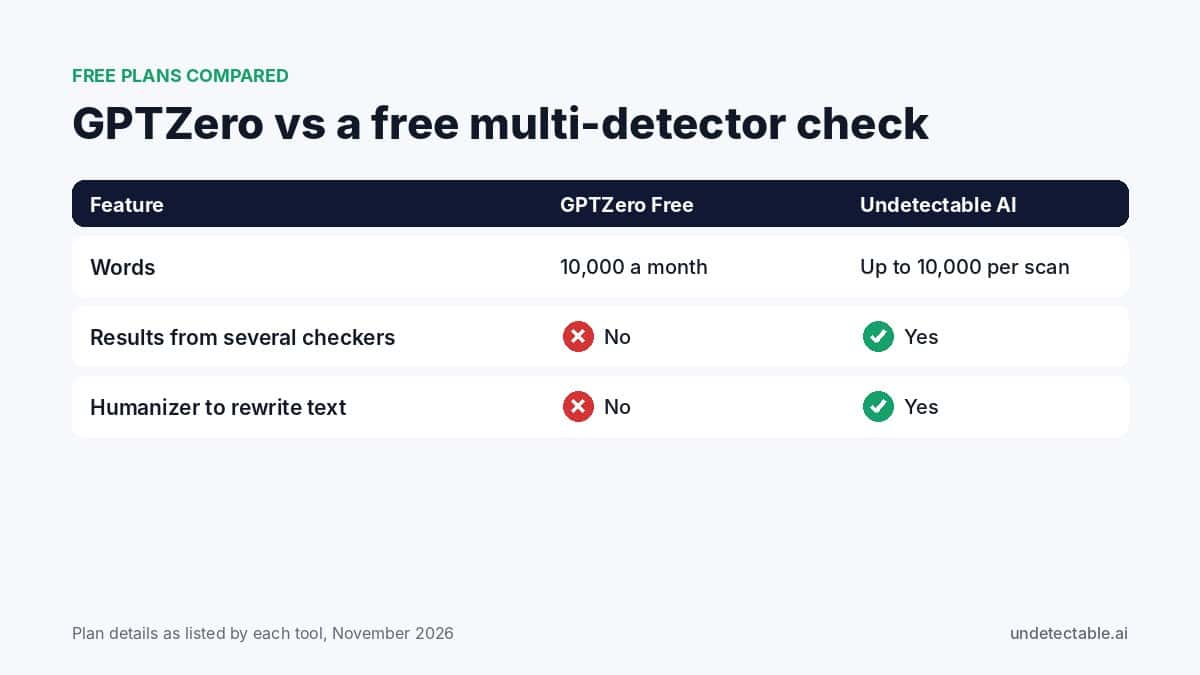
Writers and agencies who check client work every day may find the word limits tight. For them, a mix of a free multi detector check and one paid tool usually costs less.
What to Do If GPTZero Flags Your Writing
A flag is not proof. Detectors make mistakes, especially on formal, simple or non-native English writing. If you wrote the text yourself, gather your drafts, notes and version history before you reply.
Our guide on being falsely accused walks through how to respond calmly and with evidence.
If you used AI to help and want the final text to sound like you, check it first with a free AI detector that shows results from several major checkers in one scan. Then revise the flagged parts in your own voice.
For drafts that still read stiff, our AI humanizer rewrites text into a more natural style. Always follow your school’s or client’s rules on AI use. Our guide on bypassing GPTZero explains the tradeoffs in more detail.
How to Check Your Writing Before You Submit
- Finish the full draft first. Scores on half written text change a lot.
- Run it through two different detectors, not just one.
- Read the highlighted sentences out loud. Stiff or generic lines usually stand out.
- Rewrite those lines with your own examples, opinions and word choices.
- Keep your notes, outline and version history in case anyone asks.
- Check again, then stop. Chasing a perfect 0% often makes writing worse.
The last step matters. Detectors measure patterns, not honesty, and plain human writing can score a little AI. Aim for writing that sounds like you, and keep proof of how you made it.
FAQ
Is GPTZero free?
Yes, there’s a free plan with 10,000 words a month. Advanced Scan, plagiarism checks and larger uploads need a paid plan.
Is GPTZero accurate?
It’s very accurate on text that is fully human or fully AI. It is less reliable on AI text a person has edited, or on human text that AI has polished.
Who owns GPTZero now?
Superhuman, the company formerly known as Grammarly, announced the acquisition in June 2026.
Can GPTZero be wrong about human writing?
Yes. False positives are rare on clean human text in recent tests, but they still happen, especially with short or very formal writing.
Does GPTZero work on other languages?
Yes. PCWorld lists 26 supported languages, though accuracy is usually best in English, where it has the most training data.
Is GPTZero better than Turnitin?
They serve different users. Turnitin is built into schools and strongest at plagiarism. GPTZero is easier for individuals to use and gives more detail to the writer.
Final Verdict
GPTZero is one of the strongest detectors for clearly human or clearly AI writing, and the free plan makes it easy to try. Its blind spot is text that mixes the two, which is exactly how most people use AI now.
Use it as one signal, not a verdict. Pair it with a second check and your own drafts, and you’ll have a much clearer picture of where a piece of writing really stands.