
Just like the calculator made computing easier than doing it by hand, many organizations are now leveraging AI to streamline their most important processes.
Today, more than half of teachers believe that AI has a positive impact on the teaching and learning process, viewing it as a bridge rather than a barrier. So, without a doubt, AI can be used the right way for institutions.
Seeing how this powerful tool works so well for many already, you might want to try using it to streamline your own journey.
But a burning question remains for high school seniors everywhere: can college admissions detect ChatGPT?
Here is everything you should know about navigating this new frontier.
Key Takeaways
Admissions officers rely on a “human” feel to verify essays, often spotting machine-generated text through gut instinct and years of experience.
AI detection tools are part of the process for many universities, though their accuracy is a subject of ongoing debate in 2026.
Consistency is the ultimate green flag, meaning your essay’s voice must match the rest of your application data and test scores.
Brainstorming with AI is generally accepted, provided the final narrative is an authentic reflection of the student’s own life and voice.
Ethical use is the safest path, as colleges are increasingly looking for applicants who can use technology responsibly rather than deceptively.
What is College Admissions?
College admissions is the complex, holistic process by which higher education institutions evaluate and select students for their incoming classes.
It isn’t just about having the highest GPA or the best SAT scores; it is about finding individuals who will contribute to the campus culture and thrive in a specific academic environment. Working with college admissions consultants can help students understand what committees are actually looking for before they put pen to paper.
Admissions committees look at your grades, your extracurricular activities, your letters of recommendation, and, perhaps most importantly, your personal essay.+1


Never Worry About AI Detecting Your Texts Again. Undetectable AI Can Help You:
- Make your AI assisted writing appear human-like.
- Bypass all major AI detection tools with just one click.
- Use AI safely and confidently in school and work.
In 2026, the evolution of university admissions has moved toward “whole-person” evaluation. Because so many students have impressive resumes, the essay has become the “tie-breaker.”
It is the only place in the application where your personality, your struggles, and your unique worldview can shine through. If that voice feels fake or manufactured by a machine, the entire application can lose its credibility.
How College Admissions Review Essays Today
Admissions officers typically review thousands of essays every cycle. They have developed a highly tuned “ear” for the narrative voice of an 18-year-old.
When they read your essay, they aren’t just looking for good grammar; they are looking for a spark of humanity.
They look for the specific, small details—like the smell of a grandmother’s kitchen or the feeling of a first failed driving test—that AI usually struggles to replicate with real emotion.
Today, reviewers often use a “triangulation” method. They compare the writing style of your main essay to the shorter supplemental responses and even the descriptions of your activities.
If your main essay sounds like a PhD dissertation but your short answers are casual and simple, it creates a “tonal whiplash” that triggers an immediate manual review.
The goal is to see a consistent, maturing voice throughout the entire packet.
Can AI Detection Tools Identify ChatGPT-Written Essays?
The short answer is: frequently, but not always. The technology behind AI detection is a rapidly evolving arms race.
As generative models become more sophisticated, the tools designed to catch them must follow suit.
Overview of AI Detection Technology
AI detectors work by looking for “predictability.”
Human writing is inherently chaotic; we use unexpected metaphors, vary our sentence lengths in strange ways, and make “creative” choices that a machine wouldn’t. AI, on the other hand, works on statistical probability—it chooses the “most likely” next word.
Detectors analyze things like “perplexity” (how complex the text is) and “burstiness” (the variation in sentence structure) to determine if a human or a machine was at the helm.+1
Limitations and Accuracy Concerns
No detector is 100% accurate. In fact, many high-profile academic institutions have expressed concerns about “false positives,” where a student’s original work is flagged as AI because it is “too clean.”
This is especially common with non-native English speakers who may use more formal, structured language.
Because the stakes of a false accusation are so high, many colleges use these tools as a “warning light” rather than a final verdict.
How Detection Differs by Platform
Different universities use different software. Some rely on the built-in AI detectors found in Turnitin, while others might use standalone tools.
Each platform has its own “sensitivity” settings. Some might flag anything with a 20% AI probability, while others only investigate if the score is 80% or higher.
Understanding that there is no “universal” score is key to realizing why total reliance on AI is a high-stakes gamble.
Red Flags Admissions Might Notice
Even without a software report, seasoned admissions officers can spot “AI-speak” from a mile away. They have spent years as living lie detectors, and they know when a piece of writing lacks a soul.
Inconsistent Voice or Tone
If your essay starts out sounding like a professional journalist but ends like a high school student, it’s a major red flag.
AI tends to maintain an eerily consistent, slightly “hollow” tone that doesn’t always adapt to the emotional arc of a story.
Sudden Jumps in Vocabulary or Style
AI loves to use “highfalutin” words that the average teenager rarely uses in conversation.
If you use words like “amalgamation,” “precipitated,” or “clandestine” in a way that feels forced or doesn’t match your previous writing samples, it feels suspicious immediately.
Overly Polished or Unnatural Phrasing
A real human essay has “rough edges”—small imperfections in rhythm that make it feel alive. AI-generated content is often too perfect.
It lacks the idiosyncratic “voice” that makes a piece of writing memorable.
- Vague Generalities and Clichés: AI often defaults to “fortune cookie” wisdom, offering broad statements about “personal growth” or “the human condition” without providing the specific, gritty evidence that an admissions officer needs to see.
- Lack of Sensory Detail: A machine can describe a beach, but it can’t tell you exactly how the sand felt between your toes during that one specific summer. If your essay lacks these tiny, visceral details, it feels like it was pulled from a generic database.
- Stereotypical Narrative Arcs: Because AI is trained on vast amounts of existing text, it often falls into “Westernized” tropes and stereotypes. If your essay follows a perfectly predictable “Hero’s Journey” without any unique twists or authentic setbacks, it risks being dismissed as uninspired.
How Colleges Are Preparing for AI in Applications

Universities are not sticking their heads in the sand. They are actively rewriting the rulebook to accommodate a world where ChatGPT is a permanent fixture.
Updates to Admissions Guidelines
Many schools have updated their “Honor Code” or application instructions to explicitly mention AI.
Some schools, like Georgia Tech, have been proactive, telling students they can use AI for brainstorming or editing, but the final content must be their own.
Other schools remain more traditional, requiring a statement that no AI was used in the production of the essay.
AI-Detection Policies in Review Processes
Colleges are currently in a “review phase” regarding AI policies as they look for better ways to prioritize authentic human effort during the selection process.
Many admissions offices are now comparing applicant essays against standard AI outputs to see if a student’s response is too close to a generated default.
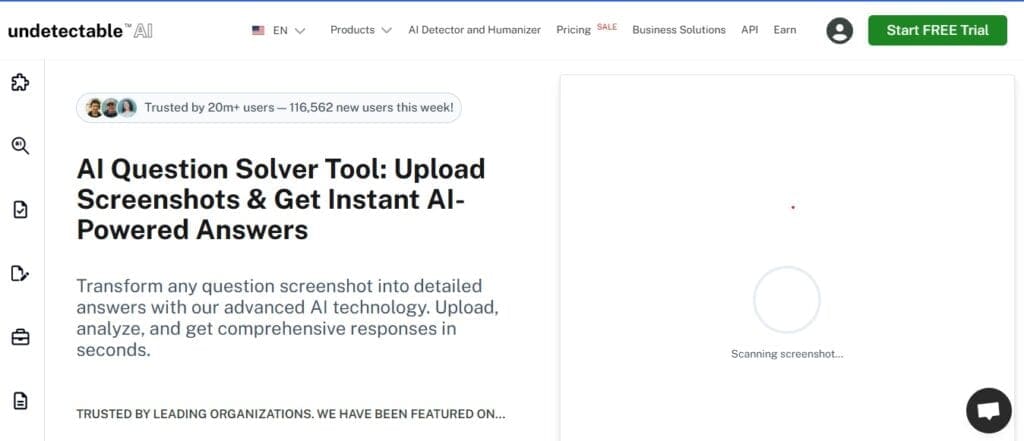
To assist in this evaluation, our Undetectable AI’s AI Question Solver can help answer specific prompts during the admissions review process to provide a baseline for what a machine-generated response looks like.
This allows reviewers to more easily identify when an essay lacks original thought by seeing exactly how an AI would handle the same question.
Training Reviewers to Spot Patterns
Reviewers are now being trained in “pattern recognition” for machine learning. They look for the “over-structured” five-paragraph essay format that AI loves to default to.
They are also being taught to look for “hallucinations”—instances where an AI might fabricate a historical fact or a specific book title that doesn’t actually exist—which is an instant “rejection” red flag.
Best Practices for Writing Authentic College Essays
The goal isn’t to “beat” the detector; it’s to write an essay so human that a detector wouldn’t even be able to find a machine fingerprint.
Use AI Only as a Brainstorming Tool
Think of ChatGPT as a very smart, slightly generic friend. You can ask it to help you list “themes for an essay about perseverance,” but you shouldn’t ask it to write the story of your perseverance.
Use it to overcome writer’s block, not to replace your brain.
Edit and Personalize Your Drafts
If you use AI to help clean up a sentence, you must go back and “roughen” it up with your own voice. Add your own metaphors. Change the rhythm. Inject a bit of your own humor or doubt into the paragraph.
AI-written essays are often too “safe,” which is the opposite of what top-tier schools want.
Ensure Your Voice Shines Through
Read your essay out loud to a parent or a teacher. Ask them, “Does this sound like me?”
If they say it sounds like a textbook, you need to rewrite it. Your voice is your unique “thumbprint” on the page.
- Focus on the “Small” Moments: Instead of writing about “How I saved the world,” write about how you felt when you failed a chemistry quiz but kept going. These vulnerable, human moments are impossible for AI to fake.
- Avoid High-Level Jargon: You don’t need to sound like an Ivy League professor to get into an Ivy League school. Use the language you actually use in your day-to-day life—clear, honest, and thoughtful.
How Undetectable AI Can Help Applicants
In 2026, the savvy applicant knows that “raw” AI output is a liability. Undetectable AI acts as a sophisticated digital editor that helps you refine your work while maintaining your professional integrity.
Rewriting AI Drafts to Sound Natural
If you used a machine to help you structure a difficult conclusion, it might come out sounding a bit stiff.
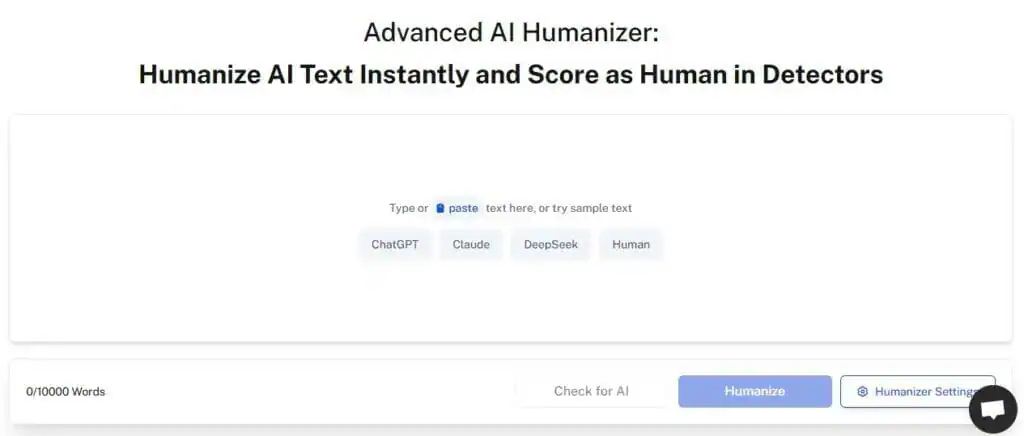
Our AI Humanizer is designed to smooth out those mechanical edges. It varies the sentence length and injects a “human” rhythm into the text, ensuring that the “polish” doesn’t trigger the suspicion of an admissions officer.
Checking for Overused AI Patterns
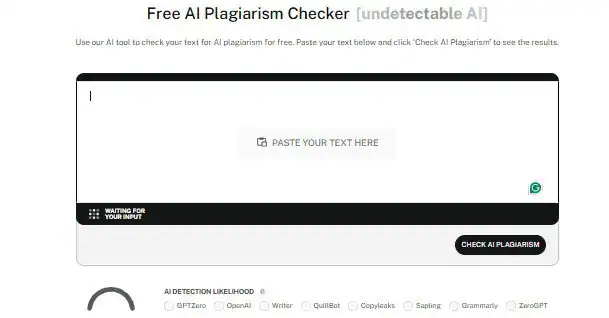
Before you hit “submit,” you can run your essay through our AI Plagiarism Checker. Unlike standard scanners, this tool is tuned to detect the subtle “remixed” plagiarism that generative AI often produces by pulling from its training data.
This ensures your “personal” stories haven’t inadvertently mirrored existing web content.
Maintaining Originality While Saving Time
Undetectable AI allows you to move faster without sacrificing your “soul.”
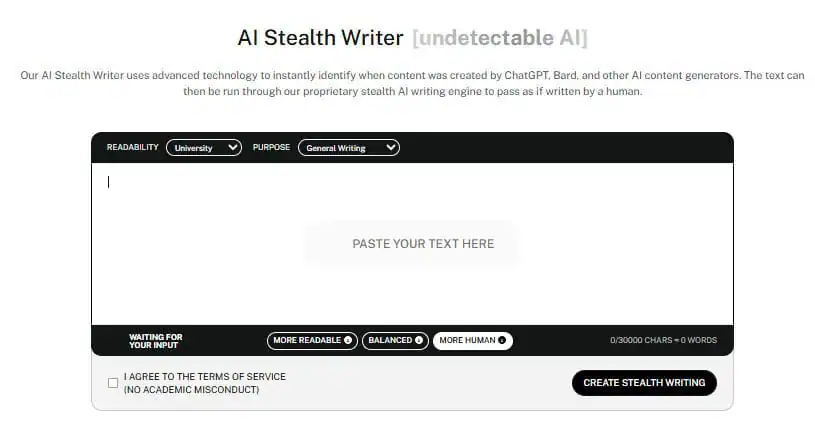
By using the AI Stealth Writer, you can ensure that your brainstorming sessions result in text that feels idiosyncratic and human.
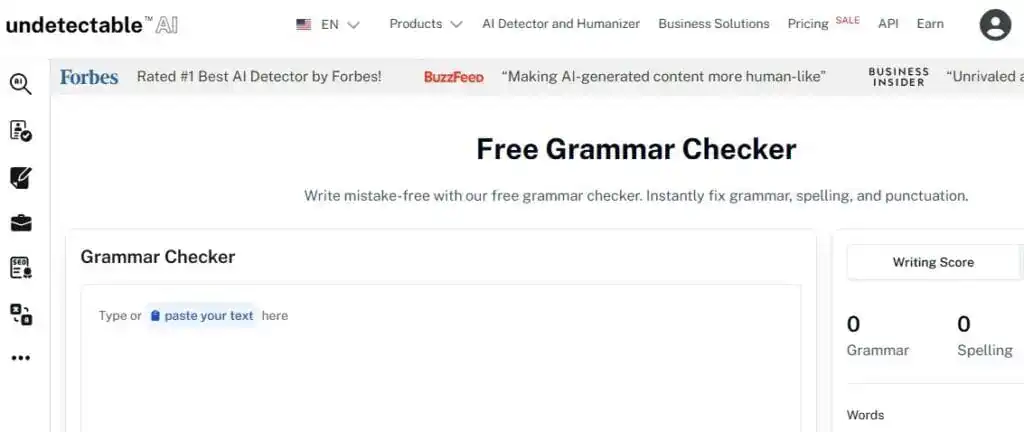
For that final layer of quality control, our Undetectable AI’s Grammar Checker allows you to fix technical errors without the “over-polishing” that often triggers an admissions officer’s instincts.
The Ethics of Using AI in College Applications
The integration of artificial intelligence into the admissions process is a double-edged sword that requires a careful balance between efficiency and integrity.
As colleges refine their ability to identify machine-generated text, understanding the ethical boundaries is essential for any serious applicant.
- The Preservation of “Self”: The primary ethical concern is the potential “loss of self,” where allowing a machine to tell your story means letting an algorithm represent you in the freshman class rather than your own unique voice.
- A Test of Personal Character: While AI can polish a sentence, the admissions process is fundamentally a test of character; relying on a generator to manufacture your life experiences undermines the very growth the essay is meant to demonstrate.
- The Transparency Contract: Not disclosing the significant use of AI can be viewed as deceptive, which destroys the foundation of trust between a student and an institution before the first semester even begins.
- Maintaining Intellectual Ownership: Establishing clear ethical boundaries—using AI for grammar or structural brainstorming while keeping the “heart” of the story human—ensures that you remain the sole intellectual owner of your narrative.
- Avoiding Fabricated Experiences: A major ethical pitfall is the temptation to let AI embellish or fabricate personal achievements; colleges look for honesty, and machine-generated “hallucinations” can lead to immediate disqualification.
- The Risk of Passive Learning: Relying solely on a push-of-a-button solution results in passive applicants who may lack the critical thinking and self-reflection skills required to survive the rigors of actual college life.
- Fairness and Accessibility: Using AI as a writing assistant is one thing, but using it to replace the work of a student creates an uneven playing field, challenging the meritocratic ideals that many universities strive to uphold.
Find out how our AI Detector and Humanizer work in the widget below!
FAQs
Can colleges tell if I used ChatGPT for my essay?
Often, yes. Between AI detection software and the expert “ear” of admissions officers who read thousands of essays, “robotic” or “hollow” writing stands out. The lack of specific, personal detail is usually the biggest giveaway.
Is it cheating to use AI for brainstorming?
Most colleges do not consider brainstorming with AI to be cheating, provided the final writing is your own. However, always check the specific guidelines of the school you are applying to, as policies vary.
What happens if I get caught using AI for my application?
In many cases, it results in an immediate rejection. Admissions is built on trust; if an officer believes you were deceptive in your essay, they cannot trust you to be an honest member of their academic community.
Final Thoughts
For institutions, the goal is to adapt to a world where AI is a permanent fixture. So, can college admissions detect ChatGPT?
Sometimes they use software, and sometimes they use instinct, but they are always looking for the same thing: you. While ChatGPT can provide great ideas and add value as a writing assistant, it can never replace the genuine passion and personal history that makes your application unique.
Let your voice shine through, use technology responsibly, and remember that the goal is personal growth, not just a “polished” PDF.
Ready to ensure your application reflects the real you? Explore Undetectable AI to humanize your drafts and submit your essay with total confidence.